
Both Kieron and Neil have been gallivanting round the country all week, both are recording on a Friday afternoon with the pub in sight, and Neil has already had a text from a mate asking where he is.
Housing Community Summit — a full room, and one uncomfortable answer
Kieron was back in Liverpool, this time speaking solo to a breakout session of CEOs and chairs. The stats he opened with tell the whole story of AI in housing right now: 76% of housing staff say they use AI. 69% of the public don’t know AI is being used in public services at all, and don’t trust it. 87% rate their own AI skills as low. And 44% of organisations still have no AI policy. Enormous usage, by people who’ll openly tell you they don’t know much about it, with nothing written down about what they should or shouldn’t be doing.
Then he asked the room how they know they can trust their AI’s responses. The headline answer: we don’t know.
So he sent them five questions to take back to their teams:
- Which documents does it read, and who keeps those current?
- Can it show its sources, so an answer can be checked rather than just trusted?
- Who built it, who signed it off, and who reviews it?
- What happens when a policy changes — does the agent change with it?
- Would you be comfortable if this answer reached a resident, the regulator, or the ombudsman?
If you can’t answer those, you’ve got work to do.
The complaint that came back from its own reply
Neil was chatting to a friend (in a bar, obvs) who lives in a housing association property. He’d put in a complaint last week, ten pages, written with the help of AI. He got a response but couldn’t tell whether it was AI or not. That’s good because the housing association is a Leading AI customer so there’s a reasonable chance KnowledgeFlow wrote the reply. Complaints in housing are up 90%, and one report this week says they’ve doubled since ChatGPT. The genuinely good side: people who’d struggle to write a compelling complaint can now represent themselves properly. The difficult side for housing thought is there’s no change to statutory response times so they’re having to deal with twice the volume and ten times the size.
“Which bit of stupid is that?”
A customer emailed Neil to explain they’d been busy so hadn’t moved their AI adoption on, but mentioned in passing that one of the team had put a load of confidential information into a public AI tool to produce a three-page report which they thought was “great”. This is an organisation that has a private, secure AI assistant built specifically so that wouldn’t happen. Dumb. The formatting was lovely, apparently.
Are we all going to die? A 10% chance, apparently
Kieron got asked about the Anthropic researcher’s resignation on a webinar with the Moving On Up team and gave the honest answer “You’re about as qualified to assess that number as I am.” The more useful point came from a Radio 4 interview which said you can’t buy a sandwich, board a plane, or ride in a lift without a regulatory framework, and yet you can build superintelligence, and the only real constraint is investment. The companies themselves are asking to be regulated. Nobody’s going to stop first in a trillion-dollar race.
A Singaporean government minister running his life on a $15 Raspberry Pi
He uses a Raspberry PI with 8GB of RAM, a small local model, and it manages his schedule, drafts his speeches, and briefs him before visits. Which raises the trillion-dollar question: if that’s all most people actually need, has everybody placed their bets in the wrong place? Meanwhile Nvidia posted $96.2 billion of revenue in a single quarter, up 106% year on year. And Kieron’s mum is currently a data centre protester in Devon, banners up outside the house and everything.
Watermarking, properly explained
Donald got under the skin of how Claude’s watermarking actually works. It isn’t a label, it’s a pattern woven through the way tokens are assembled, detectable if you hold the right key. Very clever, but easy to bypass by pasting the text into a different model and asking it to rewrite while retaining everything. So much for the end of the AI detector industry.
Also: Daniel Susskind’s book on teaching in an era of AI. PISA scores have fallen and haven’t recovered post-pandemic, and his answer is to train children both with AI and without it so they understand the difference. Kieron tells the story of the 1890s New York horse manure crisis (he so full of **** 🤣). And the discovery that China’s clampdown on AI companions applies only to Chinese citizens. Their companies are free to sell AI boyfriends and girlfriends abroad, though Neil doesn’t think Mrs Watkins will allow him to have one and Kieron’s worried about spending too much time on a screen without that kind of distraction.
It’s been one of those weeks…
Two mates. A bar. Thirty years of business between them. And all they want to talk about is AI.
Pull up a stool — we’ll get the beers in. 🍺
TRANSCRIPT
Neil Watkins
All right, I’ll take your advice and we’ll get the pantomime horse of a podcast underway for this week. Kieron, you’re looking very cheerful for a man who’s been running around the country all week.
Kieron White
Well, you better start good.
I am cheerful because it’s almost, we’re recording this on Friday and it’s the weekend coming up and that is a very good thing for me. I’ve had a very busy week. Yeah, it’s been great. Really enjoyed myself this week. Been out and about, talking to people, been on a webinar and we’ll share with, talk about it, I’m sure, but the Housing Community Summit for 2026. I was invited to speak there again. And I’ll share with you what happened in that, but yeah, really good.
Neil Watkins
Oh, well, I saw you on there. It’s a wrap for the conference and you were in their little video at the end. That was nice. That was nice. Fame at last, Kevin.
Kieron White
Yeah.
Yeah.
Yeah, I wonder because I saw the photographer coming in the room, but I didn’t know he was filming as well. But I could kind of see him coming in over the back of the audience. So yeah, that was good to have made the reel. Well, if I’d have known, if I’d have known he was filming, then I could have made it even, I could have walked out more.
Neil Watkins
Yeah. Is that when you started doing the big gesticulation and, oh, hello, I’m over here.
He can be more dramatic, really.
Kieron White
That was really good. How about you? You’ve been gallivanting around the country too.
Neil Watkins
I have been gallivanting. Yes, I’ve been around the country this week and I too, I’m glad that it’s Friday that we’re recording this and I’ve already had a text from Amit saying, are you coming to the pub and I was like, I can’t do something. I’ve got to do this thing first. I can’t, I can’t just nip off. So, so not yet, not yet. So soon enough, soon enough, we’ll be in our respective locals.
Kieron White
Not yet.
Neil Watkins
At 4:00, I would imagine for a year, yeah.
Kieron White
Shortly after, yeah, I hope so. That would be very good. If we survive the AI onslaught that’s coming our way, apparently, according to a junior researcher, it appears to me, from Anthropic.
Neil Watkins
Okay.
That’s right.
But a guy who was really fed up with his bonus and decided to quit in the most dramatic style.
I’m not sure that is the story.
Kieron White
Well, he’s certainly done him. No, he’s certainly done himself a lot of, I guess, a lot of good from getting an influencer profile. But I was asked.
Neil Watkins
He has. He’ll never get into the job. He’ll never get into the job in AI though, will he?
Kieron White
No, indeed. I was asked about it on the webinar and my first answer was, well, you’re about as qualified to answer it as I am, frankly. Are we all going to be killed by AI systems? And how you work out that is about a 10% chance. I mean, I’d like to see the maths behind that equation.
Neil Watkins
Right.
Kieron White
That’s kind of a finger in the air at best. So yeah, but interestingly, my reflection on it on the webinar was, I should call out on the webinar, moving on up, which is a network, a group of people who are passionate about getting care experienced people into apprenticeships.
Neil Watkins
Yeah, indeed.
Yeah.
Yeah.
Kieron White
which is tremendous because they really struggle. If you are a care leaver, 18, which as we know is a pretty challenging time because I mean being in care is obviously not the greatest experience and that’s very underselling it. But then you are suddenly left to your own devices and having talked to my son about getting an apprenticeship, I mean it’s a lot of admin, it’s a lot of work to work out what’s going on and without a parent or a
carer to kind of guide you through that, you’re left on your own to do it. So massive challenge and I’m delighted that the Moving On Up Network are, they work under the Amazing Apprenticeships team and with them and their job is to try and focus on getting more apprentices into, sorry, more care experienced people into apprenticeships. So
Good on them. I was delighted to join their webinar.
The point I was making was about whether we’re all going to be killed. And here’s the challenge, is it is an unregulated sector, really. AI, I mean, they’ve got the EU Act and a few other things coming in. But I heard a guy on Radio 4 talking and he was saying, you can’t buy a sandwich without being subject to a regulatory framework.
And yet, and you can’t go on a plane or go on a lift or, but yet you can build super intelligence. And the only thing stopping you is really investment. And they’re not sure of that at the moment. So it is potentially a challenge and probably needs a bit more regulation, maybe a lot more.
Neil Watkins
Yeah.
Well, we talked a little bit about regulation before, especially when it comes to things like safety and people and all of that good stuff. And I’ve got a couple of things I want to talk about on that. But just come back to your main point about, you know, the 10% chance of AI killing the entirety of humanity in 10 years time. So I kind of
I’m a bit near about it because actually my daughter worries about it and she said to me, don’t, why aren’t you worried? I was like, well, there’s absolutely nothing I can do about it. So it’s one of those things which I just cannot control. All I can do is try and use it for things that I think are important and things are good, like the moving on up stuff, like our good friend.
Kieron White
Exactly.
Neil Watkins
Johnny Hoyle and all the good stuff that he and the team are doing for care leavers. I think that is important and but actually the stuff, I mean, I listened to a bunch of things on the FT and The Economist on the way up from London this morning and it was talking about
terrorists trying to, well, depends on who you, one man’s terrorist and another man’s freedom fighter is the old expression, isn’t it? So yeah, yeah, trying to work out how to make ballistic missiles, which, I mean, if they’re anything like me, then that’s going to be, you know, wooden and sticky back plastic and some gaffer tape, that’s going to be rubbish.
Kieron White
Man, they.
Yeah.
Neil Watkins
But there was a, was it Claude Anthropic who let out their report today on state actors trying to use it for things like bio weapons. And that is genuinely, you know, generally worrying. Anybody who’s seen the James Bond movie, the one where James Bond dies, which is the wrong thing. I mean,
Kieron White
Yeah.
Neil Watkins
How can James Bond ever die? That’s just the wrong thing, isn’t it? But yeah, the old bioweapons is genuinely a concern. But they, as it pointed out on the article I was listening to, you know, they’re just not going to stop. And as much as, you know, Musk and Altman and others have all said, yeah, we need a pause.
Kieron White
Ha ha ha.
Neil Watkins
What they mean is, I want to pause for other people so that I can crack on and get to the get ahead of everybody else and be the best and be the first of super intelligence, and so yeah, I…
Kieron White
Yeah, great. Well, the Radio 4 dude said a thing which I thought was quite interesting. He said, these companies are actually asking to be regulated. Because they kind of realise there is a challenge, but it’s a trillion dollar market that they’re going for. And until someone tells them to stop, they’re not going to. So there is a kind of angle, the challenge is global regulation here. There’s no point in regulating
Neil Watkins
Yeah.
Kieron White
just the US models or the UK models or any other, is there? Because you’re going to have other countries building them.
Neil Watkins
Absolutely. Thanks.
Kieron White
But it is a concern about the designing a virus, design missiles, whatever, you know, just sort of in theory, people without the resources to do that, being able to. That is a concern. That does worry me. In my mind, that is going to happen. You just hope that it is minor enough that it’s not a significant problem.
Neil Watkins
Yeah.
Kieron White
But, yeah, challenging.
Neil Watkins
Yeah.
It is really challenging. And of course, Open AI released Astra, their new supermodel this week. And I know that Mark at our end has been testing that and thinks it’s very good. He’d been pretty complimentary about it so far, and especially from an agentic perspective, it couldn’t run.
Kieron White
No.
Neil Watkins
big old workloads apparently and I’ve yet to play that I’ve no chance this week, but yeah, that’s, but again, that’s just another example of that kind of escalating race. You know, one brings one out, the next one, the next one, the next one. And part of it is all that kind of, I think I mentioned this, was it last time we talked?
Kieron White
Right, exactly.
Neil Watkins
But in the US, the backlash against AI and data centres using power and water and the environment, messing up local environments, etc. And there was a really fascinating thing I listened to this morning about one of the ministers in the Singaporean government who runs his entire schedule on a Raspberry Pi.
And he’s got, so he’s downloaded a small language model and apparently this thing that cost like 15 bucks has got 8 gig of RAM and it just churns away and manages his schedule, produces his speeches or briefs him on whenever he’s doing visits, etc.
Kieron White
It’s incredible, amazing.
Neil Watkins
And the question that was really in what the article was about was, you know, have all these people place their bets in the wrong place. You don’t actually need all these huge data centres with all these huge expensive chips, because actually, if you’re running something small and what you’re really interested in is
scheduling and meetings and things. You don’t need to know what hairy bikers in California have for breakfast on a Thursday in September, because it’s not really relevant. So you could run away with something really small and sensible on a tiny device. So I thought it was really, really interesting from a perspective of if all of that investment
is wasted. What’s going to happen to the whole AI boom? What’s going to happen to the stock market? What’s going to happen to a lot of things? So yeah, and stuff we again, stuff we just can’t control. All we can do is try and use anything. But I did I did think it was a really interesting example and maybe we should get our techie geeks to have a little play, get a little Raspberry Pi.
Kieron White
Wow.
The.
Neil Watkins
Pie and have a little play and see what’s possible.
Kieron White
Yeah, build it. Yeah, so you can build a tiny model. Well, my mum would be very pleased with that because she is, she lives in Devon. I know, I know how important her wellbeing and happiness is to you. But she lives in Devon and there is a proposal to build a pretty large data centre down there. They’ve identified it. They were going for planning and her and the local residents are furious.
Neil Watkins
No, good.
It is, it is.
Yeah.
Kieron White
about it for lots of reasons. And yeah, so she’ll be very pleased. Maybe she could put a proposal to say, well, I’ve got a Raspberry Pi you could borrow instead.
Neil Watkins
I said I can do, I can run it from the from the living room. But you’ve talked before about your mum on here, I think, where you know she was talking to, it must be Pi, yeah, Pi the AI about about art and things, and it was engaging in conversation about
Kieron White
Yeah.
Coin, yeah, yeah.
Yeah.
Neil Watkins
painting on plan air. So yeah, I thought that’s where you were going. I thought that’s where you’re going with the story. But no, if she’s if now she’s a data centre activist in Devon, then brilliant.
Kieron White
There you go. Well, you do. Well, you do have a good memory.
She is. She definitely is. She’s got outside her house, she’s got the big banners up. So the only, I know I was, but then there are quite a few of them in their town, so I didn’t feel quite so bad. But I did, I was tempted and I’ve said to her, but imagine the internet speed you’ll get.
Neil Watkins
That’s right.
Kieron White
Living next door to a data centre.
Neil Watkins
You could run an, you could run an extension cable and get all your electricity for free. Just get through the wire and just, you’ll be fine.
Kieron White
There you go. Yeah, just pop it over the fence. Plug that in really. But no, she could she could start herself a little AI business running with 0 latency if you’re right next door to it.
Neil Watkins
Yeah, yeah.
She, yeah, yeah, she’d have the fastest AI in the country. It’d be brilliant.
Kieron White
But.
Anyway, on investment and costs in here, I got a little guessing game for you. How much revenue do you think in Nvidia, their last quarterly reported data? How much was that? How many dollars do you think they did in revenue in 1/4? In 1/4?
Neil Watkins
Okay.
In revenue.
I don’t, I, I, if I was gonna send them, I’m gonna go, I’m gonna make a wild guess: 1.2 billion dollars.
Kieron White
Right, $96.2 billion in 1/4. Apparently that’s up 106% on last year. So I mean, somebody’s very happy and they presumably won’t care too much whether it’s on a Raspberry Pi or in a data centre as long as you’ve got an Nvidia chip in it. Unbelievable. Nearly 100 billion.
Neil Watkins
Ha ha ha.
Egg.
Correct.
Kieron White
Billion dollars a quarter.
Neil Watkins
I don’t know if this is true, but I read something that I’ve forgotten the chap’s name now. Is it Jason, the guy who runs it all, the rock star of, he’s always wearing his leather jacket and looking cool. Jensen, that is. Apparently he bought the majority of shares for $200 back in…
Kieron White
Oh yeah, yeah, Jensen, yeah.
Wow.
Neil Watkins
1997 or something. Can you imagine? Unbelievable. I bet, I bet he doesn’t need to run up and do a podcast every Friday.
Kieron White
Will.
Teeth.
Well, we would do it for the love anyway, wouldn’t we, Neil?
Neil Watkins
We’d do it for the crack if we were that rich, Kieron, but we might be doing it from boats or more sunny climes than the ones we’re in.
Kieron White
That’s true. From the, yeah, from the Caribbean somewhere. Let me tell you about the housing thing, shall I?
Neil Watkins
Well, speaking of houses, yeah, let’s talk about housing. Good segue.
Kieron White
Yeah. So I was, yeah, really good, really good session. I was there on the Wednesday, it’s a two day event. They get loads of people from the housing community come together and really, really good fun to be there. I was, as I mentioned last, I was there last year as well. This time I was there speaking just me, not with a client, which is always a bit alarming because
I get it that if you don’t really want to go hear from a vendor at these things because you get a very warped view of the world I think. So anyway.
Neil Watkins
Yeah.
Yeah.
Well, even even with even with a customer there, lots of them are so rubbish because they’re effectively selling the fact that they bought these bloody things. And I think lots of those things are so skewed anyway. So yeah, anyway, you were you were you were up front and central on your own.
Kieron White
Yeah, that’s true.
I was, and it was, I had almost a full house, so it was a restricted session, which was good. It was a breakout session, aimed at CEOs and chairs, had a wider range of folk there. And it was, firstly, I kind of set up with what’s going on now in housing and the big message for most organisations, but the stats are very
telling in housing is big usage, massively grown. Now 76% of housing staff say they use AI, which is great. But when you go to the other side, tenants, 69% of the public don’t know that AI is being used at all in public services and don’t trust it to be used. And so you’ve got this kind of
Neil Watkins
1.
Kieron White
two sides of the, one side we’re using it a lot and then the tenants that don’t know. The other challenge is 87% was this figure from a report, from a research, happy to post those in the show notes. That said that people felt their AI skills were very low and they didn’t, and only 40
I think it was 44% don’t have a policy still, an AI policy for their organisation. So what you’ve got is massive usage with people that would openly tell you, it turns out, that they don’t really know much about it and no policy in what you should or shouldn’t be using. So that was one of the things we
Neil Watkins
Wharam.
Yeah.
They must be leaking loads of confidential data.
Kieron White
So much. I mean, the, well, we know, I mean, they’re using tools, so much shadow AI going on. I heard of 1 housing association only two weeks ago, they’ve put the firewall up on ChatGPT because they’re just aware so much of it’s going on. So you can only use their prescribed tools.
Neil Watkins
Yeah.
Kieron White
But yeah, massive challenge. So that’s one. We talked about what…
Neil Watkins
Can I just, sorry, before you just go on to that, did you see, I posted it on LinkedIn, I’ve got a friend who lives in a housing association that will not be named, but uses AI for handling complaints. And I told him this yesterday and he said, I put in a complaint last week about something and it’s been going on for two years. I said, do you use AI to create? He said, yeah, of course I did. And I was like, how long was the letter? He said that was about 10 pages.
Kieron White
I hate it.
Yeah.
Neil Watkins
And I said, I said, did you get a response? He said, yeah, I did. I wonder if it was your AI that replied. I was like, well, there’s no, could you tell it was an AI response? And he said, no. And I said, well, in that case, I’ve got no, I’ve no idea. And I’m, but yeah, it was, it was hilarious. He just, we were just chatting about AI in general. And then I mentioned the complaints thing and it being such a big deal.
Kieron White
Probably was ours then.
Neil Watkins
Yeah, I got a response to my complaint and probably from your, probably from your tool. How funny. Yeah.
Kieron White
There you go. That is good. Well, complaints was the big thing, one of the other stats I talked about, because it’s up 90%. In fact, I just saw an article this morning from, is it from anyway, some publication saying it’s doubled. The number of complaints since ChatGPT has doubled. And our blog
Neil Watkins
I.
Kieron White
this Sunday goes out is on that same subject. And there’s a really good side to it, which is you’re now enabling, AI enables people that otherwise would find it very difficult to write a coherent, you know, compelling, strongly worded or whatever they want to say. So, you know, to represent themselves and in housing and in education,
getting the voice of parents, the voice of residents and really understanding what’s going on for them is important. So good, up to the point where you’re then getting vexatious claims and indeed people going for the maximum kind of, well, I’m entitled to all of this compensation, you know, and they start seeing the money as opposed to solving the problem. So it’s a huge challenge, but volume is the big.
Neil Watkins
Yeah.
Yeah.
Yeah.
Yeah.
Kieron White
the big thing. And some housing associations are using a bit of AI to try and understand the complaints because they’re getting 10 page letters. Nobody’s using it, well nobody in that group was using it yet in the way that knowledge flow would deliver an answer for you with evidence, with trust baked in.
Neil Watkins
Yeah.
Kieron White
So that’s the big point that we keep making is your residents are empowered with these tools. Your teams are now double, you’ve doubled the workload. There’s no change to the duration of what the code says about how quickly you’ve got to reply and much, much longer responses, not only twice as many, but
Neil Watkins
Yeah.
Yeah.
Kieron White
probably 10 times in depth. So you need AI on that side too, as you know, is the big thing. So we were talking about that. And then we did a lot of table discussions, which is great, and let people kind of think through the pillars, the strategy pillars. So there’s sort of three big things, people and culture, data and governance, and use cases and roadmap were the three sort of pillars of your AI strategy.
Neil Watkins
Yeah.
Isn’t that six pillars?
Kieron White
So…
Well, you could kind of say that, couldn’t you? But this three is a much better number. I was told by a very learned, a very learned man that told me you should always answer in three. So there you are.
Neil Watkins
The.
One, two, three, many is how people think, yeah.
Kieron White
So, and they had, we didn’t have enough time to get properly into conversation, but it was nice to get, you know, hear some real thoughts.
Neil Watkins
What sort of what sort of things came out?
Kieron White
So the big question was, because one of the questions I posed was, how do you know you can trust your AI’s responses? And the big headline was, we don’t know if we can trust it. That’s like, I mean, we just don’t know. And there is, you know, the sort of whole point really that I wanted to kind of get across is, you need to know, don’t you?
Neil Watkins
Yeah, absolutely.
Kieron White
If you’re going to use this to answer complaints and deal with sort of resident challenges, then you’ve really got to know what it’s using, how it came about its answer, and not allowing the kind of co-pilot approach of it found some answers. And they seem, you know, as we know, you read it, it looks amazing in its response and you
Neil Watkins
Plausible.
Kieron White
You can’t cheque all of it, so you just, you know, extend it. So, and I came up with some things in the report that I’ve sent them. I came up with some questions that they should ask about things they’re currently running, which is, do you know? Here’s 5 questions, right? Five questions that you should ask of your team about the AI one.
Neil Watkins
Yeah.
Kieron White
Which documents does it read and who keeps that current? Two, can it show its sources so an answer can be checked and rather than just trusted? Who built it, who signed it off and who reviews it?
Neil Watkins
Yeah.
Yeah.
Kieron White
Number 4, what happens when a policy changes? Does the agent change with it? And then finally, would you be comfortable if this answer reached a resident, the regulator or the ombudsman? And if you can’t answer those, then you really need to go back and have a priority look at what you’re doing with your AI.
Neil Watkins
Yeah.
Kieron White
And that was one of the things that came up was about the idea of people creating co-pilot agents. A few people were ahead of the game a bit and doing that, which is great, but they raise themselves, but how do we know they’re right? Who’s checked them? Team A have created one and now they use it and maybe a few other people have got on to that.
Neil Watkins
Yeah.
Exactly.
Yeah.
Kieron White
But is it right even at the beginning? Never mind, is it right when the regulations are updated next year?
Neil Watkins
Yeah.
Kieron White
So yeah, so that was the kind of the nub of it all, but it was really good, a huge engagement. They were a lovely audience actually for the, you know, I’ve talked before about staring at an audience and you see the sea of faces that just kind of only think, oh my God, they hate me. There was so much smile. Oh, I had it. I mean, I always get that voice in the back of your head and when you’re presenting that’s like, well, but you see it in the room when they’re just staring.
Neil Watkins
I’ve never had that.
That’s different, that’s different.
Yeah, yeah, you do.
Kieron White
but there were lots of nodding and smiling throughout. So I thank them because that really helps. It helps at the time, in my mind, it makes me perform better thinking, well, this is landing a bit. I can see that this is relevant and I think I do a better job for them rather than, oh God, they hate it. I better move on quick.
Neil Watkins
Ha ha!
Oh.
Yeah.
Yeah.
Kieron White
Yeah, it was very good. I really liked it. And I met Kirsty Walk briefly as well. She was hosting the main event. That was quite fun too. But she was pretty focused at that time, so I didn’t really chat to her.
Neil Watkins
Ohh, nice.
She, when she coming on to talk about things, then…
Kieron White
Oh yeah, I forgot to invite her to the podcast, but next time I see her.
Neil Watkins
Oh, Donald. I’ll share this with you though. I was in a I was in a certain establishment on Monday evening and I saw a friend who hadn’t seen for absolutely ages and he works in a different part of the world. He and by that I mean he works in investment.
and banking and all that nonsense world. And he said to me, he said, I haven’t seen you for ages. And when am I coming on your bloody podcast then? Why you haven’t got me on to talk about my AI stuff? And I was like, OK, so that was that was a genuine surprise. So yeah, exactly. How did you know?
Kieron White
Ha.
How did you know how to podcast? Yeah, that’s why people keep on…
Neil Watkins
You’re not our audient.
Kieron White
Yeah, sorry. Well, Johnny Hoyle have a call out on the shout out on the web on the webinar about it. So he said, and I love listening to it. Yeah, we should get him on.
Neil Watkins
Did they?
Yo, that’s a great idea. Yeah, let’s get Johnny on. He can talk. He can talk.
Kieron White
Yeah, Johnny, here’s your invitation to get in touch with us and get in touch with our with our agents and the.
Neil Watkins
Excellent. What you got is…
Give me a shout, Johnny. I’ll sort it out. Kieron is rubbish at the admin.
Kieron White
It’s true, sadly, so.
Neil Watkins
Ah.
Oh, well, it sounds like you had a great time in Liverpool then.
Kieron White
I did indeed. It was very, very good. I was delighted to be there. It was lovely. The feedback afterwards was really nice. Lots of people came up and were like, that was the best session I’ve been to here. And one guy said that he’d come from Spain specifically to see it, which was, I was like, well, that’s amazing, but you should have just got in touch and I could have saved you a flight and done a Teams meeting instead.
Neil Watkins
He could have done this. Have you heard of Teams? We could have just done this by video call. Well, no, that’s highly complimentary. That’s really good. Well done. Well done.
Kieron White
Yeah.
Right.
Yeah, but that was it was really good.
Thank you very much.
Neil Watkins
Yeah, well, I can’t. I’ve had a much less busy on the Leading AI front activity this week, but there was a couple of things that I wanted to pick up. I got I got an e-mail from someone who
we’d be a customer we’ve been working with. And they said, oh, yes, well, blah, blah, blah. We’ve been very busy and we haven’t quite got to this. Anyway, one of the team has put a whole lot of confidential information into Claude and produced this three-page report. I was like, which bit of stupid is that? It’s like,
Kieron White
No.
Neil Watkins
You know, we created a private ChatGPT for you. We created tools specifically so that they didn’t go outside and you’re going, oh, look at this, it’s lovely, it’s formatted, beautiful. We can fix the formatting. It’s not the point. The point is you people are putting confidential data out. We’ve already discussed losing confidential data already, but yeah, nuts, absolutely nuts. So
a big part of the adoption challenge. And I saw that the adoption thing is coming back around again. Tech UK, who we are members of, are doing a whole session on AI adoption later in the month, 22nd September, I think. So that’s one of the things to go to that because I know that I can’t, but
Kieron White
Great.
Neil Watkins
I think it’s such an important topic for us, and as we discussed, you know, the whole JISC pilot and learning from colleges and universities about adoption in their organisations and how do we take those lessons across to other sectors as well. So, yes,
Kieron White
Indeed. And that’s what that, I mean, that three pillar slash 6 pillar strategy, I mean, the people and culture is first on purpose. And it is about, you know, what are you teaching, what are you training? You know, giving a lunchtime webinar and prompting isn’t good enough, frankly, you need a bit more than that. And who’s in charge of this bit and that bit? So yeah, it’s really, really key to how are you going to get that right? And data.
Neil Watkins
Yeah.
Yeah.
Yeah.
Kieron White
Pillar 2 in all of that area is the big challenge. And getting your data organised so that AI can actually do the thing for you is where everybody needs to be, as we’ve talked about many times.
Neil Watkins
Yeah.
Yeah, one of the other things that I did hear from one of the team was that, actually, I had a conversation with a customer who said, oh, I can’t get the perpetual memory working. So I asked Ben if he’d have a chat with him. And it turns out he didn’t want perpetual memory. He wanted context.
setting and context is king as we knew from the Gartner conference, but it was really interesting. I thought they’d sorted that stuff out ages ago, but it turns out that, you know, things like new people being added and new information. So how do you keep that contextual stuff up to date for your organisation? And given the areas that they’re working in, that’s just going to become even more important.
I know we’ve got some technical solutions, but we’re back to the whole data and curation and keeping things up to date and making sure that it’s all live. It’s not once and done, and I think that’s part of the problem for lots of people is because so much happens, it feels like so much is done in the background on the free models, you know, it’s all upgraded and you can pick which one you need for which task and da da da, it’s all done for you.
Actually, if you’re running your own private model, there’s actually quite a bit of effort in making sure it’s up to date and people underestimate that is my personal proof.
Kieron White
Exactly. Well, and the argument is that the initial response to that is, well, Co-Pilot 365 is plugged into our SharePoint, so that’s great. And you’re like, is it? I did share with the group on Wednesday that if you ask Co-Pilot 365 what redundancy conversations have happened,
Neil Watkins
Yeah.
Kieron White
see what comes up. And you’ve got to be really confident that you haven’t saved something in the wrong place, because it does. I mean, Copilot 365 respects the your own, the access of your users, you know, what they’re allowed to go into. But who’s not saved something in the wrong folder?
Neil Watkins
Hahaha.
Okay.
Yeah.
Exactly, because they haven’t checked when it when the save comes up and they jumped at the fully to cheque the file name and then you can’t find the bloody thing afterwards and you have to go to searching for it. Yeah.
Kieron White
Exactly that. Yeah, and notwithstanding that, of course, it’s scouring across your whole 365 is useful for some tasks, but it isn’t useful for a response to a complaint where you need to know it’s the right policy and the right information, not just a draught version that’s sitting around somewhere, a half-written thing that was
Neil Watkins
Yeah.
Kieron White
you know, whatever. So, yeah, it’s getting your data organized, as always. There’s always something to do, isn’t there?
Neil Watkins
Yeah.
There is always something to do. That’s why we do this on a weekly basis because there’s always something new. It’s not, there was, I was chatting to somebody else in a different sector and they were like, oh, things just don’t change that fast in our sector. We’ve got an offer to talk about. I was like, all right, okay, that sounds like a boring place to work then.
Kieron White
It’s all right, but this is the way it’s perfectly good for people with brains like ours that get bored easily and want to be on the next thing.
Neil Watkins
Oh, something shiny. Cool, right. Have you, what else is on your list?
Kieron White
Yeah, great.
Good stuff.
Well, I’ve only got, I was talking with Donald yesterday about Claude watermarking. So as you might remember, we talked about it before, from the 1st of August, the EU Act requires AI produced work to be tagged or in some way identified as such. And Claude have added watermarking into their stuff.
Neil Watkins
Ohh, yes.
Yeah, yeah.
Kieron White
But Donald has got under the skin a bit more of how they’re doing it, because it’s not like they write, this was produced by AI in text, we’re talking about specifically here. They’re doing a really clever thing where it is the way that they, the way that the tokens are put together in the response has a sort of thread through it, which is
enables you if you are Claude and have the right unlock tool, you can then cheque and say, yeah, that’s definitely written by Claude. So really interesting, but apparently entirely, you can overcome it entirely by copying and pasting it to a different AI tool and then saying rewrite this, retain everything in it, and it will, all that token
Neil Watkins
Interesting.
Thank you.
Kieron White
whatever they’re doing, the little trails they’re leaving in the tokens is gone. So it’s yet another. I was thinking about for the AI detectors that run in education, so Turnitin is a very big one. There’s a few others. Zero GPT, or is it GPT Zero, one of the way around. Anyway, there’s a bunch of them, but none of them are 100%, let’s say, being polite.
Neil Watkins
Mm.
Mm.
Kieron White
You couldn’t rely on any of them to actually make a decision. But yeah, I was thinking they’re going to be gone if watermarks are clear and easy to spot. But it turns out all you got to do is go, right, take that into ChatGPT, rewrite this for me. And there you go. You’ll get away until ChatGPT put them in as well, of course. Now you need to find one of these scurrilous
Neil Watkins
Yeah.
Kieron White
Chinese models, and I shouldn’t call them that, should I? They’d be after me.
Neil Watkins
No, you shouldn’t. You shouldn’t. I’ll take that out.
Kieron White
One of the find one of these Chinese models that will then redo it without a watermark.
Neil Watkins
Yeah. Just talking about education, one of the things I read this week was how to teach the next generation in an era of AI by a guy called Daniel Susskind. I don’t know if he’s related to Richard Susskind, but… Oh, excellent.
Kieron White
Ah, yes, I just, he is, he’s his son. I’ve got the, I’ve just got his book on what to tell your children or something. Yeah, I’ve just got a hold of it.
Neil Watkins
Yes, yes, that’s exactly the one. So let me, spoiler alert, I’m going to tell you what he says.
Kieron White
I do, yeah, please do, yeah, save me, save me reading it.
Neil Watkins
Yeah.
Well, broadly speaking, he says it’s a bit like when the calculators came along, and actually I’ll set a bit of context first. Something called the PISA scores, which measure how well education systems are working around the world, both literature and numeracy have dropped off massively in the last wee while and people were expecting them to recover after the pandemic and they haven’t, they’ve actually got worse. And part of the reason they believe is around AI. And what Daniel says is that it’s a bit like when calculators were introduced to maths lessons. And I know that you’ve got a picture in your slide deck of teachers protesting against having calculators in 1976 or 77 or something stupid. And he said, it’s a bit like that moment, but the way to deal with it is to train with AI and train without AI. And so that children can understand the difference. And that’s what the education system needs to do, is how to use the tools and understand them.
Kieron White
Yeah, that’s right, yeah, yeah.
Neil Watkins
But actually, if you don’t have the tools, what’s the differences? And then I should have been being much more thoughtful about the approach to teaching these things. So that’s the basic premise of what he’s going to push. So I don’t know how many pages, 300 pages, that’s what it falls down to.
Kieron White
All right, all right, there you go, as always. I will have a listen, because it is very relevant, particularly education. The future of education is obviously close to our hearts of many of our customers, so be good to be good to check, look into that.
Neil Watkins
It is. And to us, for your children and my grandchildren. So yeah, no, it is. I actually thought it was a really interesting article, but I hadn’t clocked it. He was related to Richard Susskind, but actually I figured that there couldn’t be that many Susskinds on the old media environment. So yeah, this should be just.
Kieron White
No, indeed. He wrote, I remember hearing a little extract of one of his books, I think it’s about future of work or something, and he wrote about the horse manure crisis in New York of 1896 or whatever. It’s A fascinating story and it’s, I don’t know if we’ve talked about it on here, but it was, if I try and pricey it, it’s
Neil Watkins
Yes, I do remember that one.
Kieron White
They used to have so much horse manure in New York City because of all the obviously horse drawn everything. They were filling like fields with, you know, metres deep or feet deep, I guess, in that time, particularly in the US of this stuff. And so they were putting out like loads of how do we solve this problem? And people were spending loads of time on innovative solutions for what they do.
and then someone invented a motor car and all of that went away overnight. And it’s really interesting because, you know, all the kind of big challenge, probably the biggest challenge in New York at that time, it was causing health crises and all kinds of stuff, literally went away, well, hardly overnight, but with a new technology, so it was very interesting, I thought.
Neil Watkins
Yep.
But very quickly.
Yeah.
Yeah, well, listen to Daniel’s book and yeah, I thought it was a really interesting article that I read on it. So that was good.
Kieron White
Very good eyes. I certainly will. That’s my weekend reading for you or listening, as it will probably more likely will be.
Neil Watkins
Excellent. More likely. Yeah, more likely. And there was one other thing on my list for this week, and I mentioned this last week, was about Chinese authorities clamping down on AI relationships. But what I hadn’t realised until this week was
Kieron White
Good stuff, I’ll go on.
Neil Watkins
They’re only doing that for Chinese citizens. They’re very happy for their companies to sell AI relationship assistance, bots, whatever you want to call them, AI boyfriends and girlfriends to other countries. So anybody outside China, they can, and the main one has 10 million outside of China alone.
And so I’m assuming, maybe wrongly, but I’m assuming that’s kind of Southeast Asia. But it really interests the Chinese authorities very keen on one rule for one rule for their citizens and a completely different rule for everybody else. So I don’t know if that’s if that’s their world takeover model is to reduce the birth rates of all of their neighbours.
Kieron White
No.
Yeah.
Neil Watkins
By having everybody have virtual relationships and no actual children.
Kieron White
Sitting at home with, yeah.
Wowzers. Well, there is a lookout for us all. And if you haven’t got an AI boyfriend or girlfriend, then you know, maybe now’s the time to have a look. Ten million of them. That’s quite a few, isn’t it? Wowzers.
Neil Watkins
Yeah. Well, I don’t think, I’m not sure, I’m not sure Mrs Watkins will allow me to have an AI boyfriend or girlfriend, so I’ll steer clear of that if that’s all right with you.
Kieron White
Yeah.
Yeah, indeed. Yeah, no, indeed. Well, I spent enough time on my screen without without having that as well, so…
Neil Watkins
Yeah, I think that’s why I’ve got my eye problems. I’m spending too much time at the screen and not looking at my boyfriend or girlfriend.
Kieron White
You know what they say about that stuff. So no, I can’t put it on the podcast, but you know, you know what we’ll make you make you go blind.
Neil Watkins
No, no, I don’t. What do they say, Kieron?
I’d have to edit that out as well.
On that note, I’m going to do the other thing that’s probably going to make me go blind and go to the pub and have a few beers and chat to my mates about sheep and farming and pheasants and whatever else goes on around these countryside parts.
Kieron White
Very nice. Well, and I will, given we finished a couple of minutes early, I’m going to nip up and collect my son as a surprise, as I don’t get to pick him up very often from school, so I’m going to do that.
Neil Watkins
Excellent. Excellent. You do that, and you have a great weekend, and I’ll see you next week.
Kieron White
Nice one, and you take care. See ya. Bye.
Neil Watkins
Cheers, mate. Bye-bye.

Latest posts
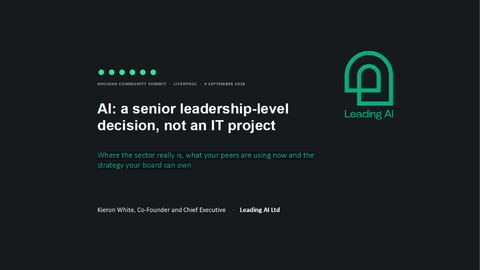
Free webinar – AI in Housing is a senior leadership decision, not an IT project
Events