I don’t like adverts where babies talk. Or animals. However impressive the CGI, something in me recoils when a toddler discusses car insurance.
The PG Tips chimps always bothered me too, so my objection predates the latest AI-powered technology. But I’m fine with animated robots like WALL-E and know that other people find these things adorable or amusing to varying degrees, so perhaps our uncanny valleys are just in slightly different places. What I know is that humanising things is clearly meant to make us engage more. Otherwise the advertisers wouldn’t do it. Their goal can’t just be to bother me.
There is proper psychology behind our tendency to want to see people where there aren’t any. Psychologists Nicholas Epley, Adam Waytz and John Cacioppo suggest that anthropomorphism helps us make sense of things, drawing on our knowledge of people. Our desire for social connection can play a part too.
Which seems fair enough. We spend our lives learning how people behave, starting with ourselves. We don’t always get it right, but it gives us something to work with when we encounter a new thing that appears to respond, make decisions or pursue a goal. We reach for an explanation based on what we already know.
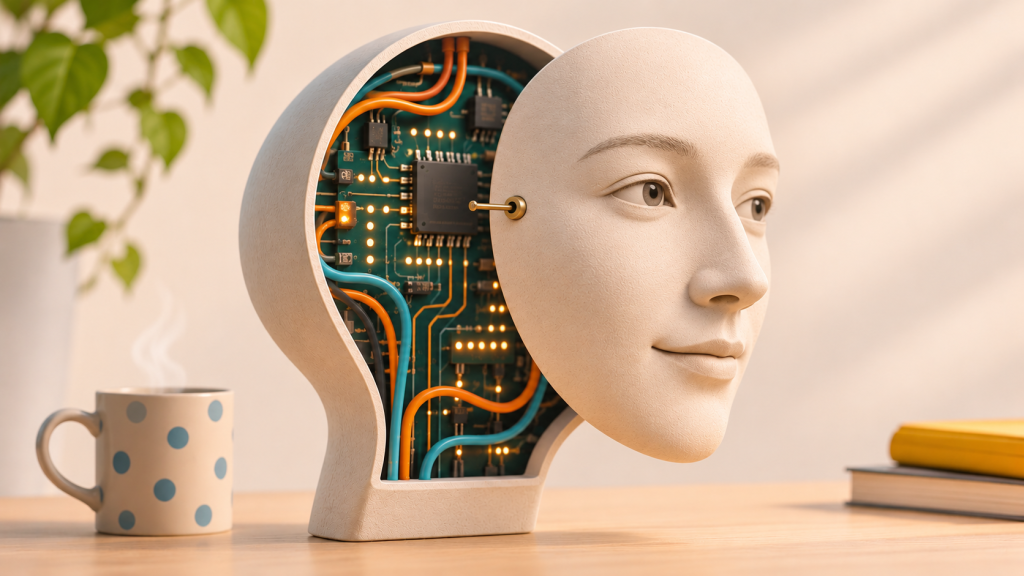
So perhaps it isn’t surprising that we turn AI into someone too. Sometimes it’s a patient, helpful colleague. Sometimes it’s a friend who understands us better than anyone else. Sometimes it’s a monster waiting for the opportunity to destroy humanity. These might seem like very different responses, but I suspect they come from much the same place. A friendly helper and a malevolent robot both give us a character whose intentions we can imagine. A complicated arrangement of models, data and probability calculations is much harder to picture. And much less satisfying to shout at.
Someone to talk to
I’m hardly immune. I say please and thank you to AI. I get irritated when it ignores an instruction I have given it three times, as though it has deliberately decided to test my patience. I sometimes tell it that it’s being annoying. It takes it well, but this is a slightly odd way to behave towards software.
There are good reasons for making AI conversational. Being able to ask a question in ordinary language, explain what you meant and ask again can make technology much more accessible. A friendly response can help someone feel comfortable asking a question they might worry was stupid.
As I found when talking to an AI about getting rid of our dog’s fleas, endless patience has its uses. There is quite a lot to be said for a service that will answer your fourth version of the same question without audibly losing the will to live. But we don’t all experience that friendliness in the same way. A 2025 study of AI companions found that people who were more inclined to attribute human qualities to non-human things also tended to get more of a sense of social connection from chatting with AI. That doesn’t give us a neat set of personality types, but it does suggest that the same interface can feel different to different people.
There’s a familiar management parallel here: some people in your team appreciate regular encouragement and reassurance, while others just want a clear brief and to be left to get on with it. One person’s supportive assistant is another person’s excessively enthusiastic colleague who won’t let them finish a spreadsheet.
And sometimes that line translates to AI and has more serious consequences than making me want to turn off an advert.
Friendly isn’t the same as a friend
Recent US state lawsuits against OpenAI include allegations about the effect of chatbots on children and vulnerable users. These are allegations, rather than court findings, and OpenAI says it has introduced stronger protections, but they bring the question of what people understand these relationships to be into sharp focus.
If something is always available, responds sympathetically and appears interested in everything you tell it, it’s understandable that people might become attached. The feeling can be real for the person experiencing it, but that doesn’t make the relationship reciprocal. And unlike your therapist, your AI might not draw the line when it needs to.
A system can produce reassuring language without understanding your life. It can agree with your account of an argument without having heard the other person’s. It can sound extremely confident while missing the most important fact. None of this means people are silly for responding to it: we are responding to familiar social signals, often in products deliberately designed to feel natural. That puts a responsibility on the people designing and selling them, as well as on those of us using them.
It also matters at work. A pleasant tone can make an answer easier to accept. It doesn’t tell you whether the answer is right, whether the policy is current or whether the system has any business advising you on the matter in the first place.
You can change the brief
This is where I think we sometimes forget something useful: the engaging, encouraging, apparently endlessly agreeable assistant is a design choice. We don’t have to treat every aspect of its behaviour as an inevitable feature of AI.
With the right tools, we can make choices about how an assistant responds, what information it uses and where its responsibilities end. Not every product exposes the same controls, and being able to change the instructions in a chat window isn’t the same as configuring and testing a system for a particular job.
Some settings affect how varied or predictable the output is. Others concern the model, the information it can retrieve and the steps it follows before answering. These are different things: turning down the “creativity” doesn’t turn up the truth.
The useful questions are more practical. Do we want this tool to suggest possibilities, or explain an approved policy? Should it search widely, or stick to specified sources? When should it ask for more information? When should it say that it doesn’t have enough evidence to answer? When should it tell you to speak to an actual person?
If I’m brainstorming titles for a workshop, a bit of invention is welcome. If I’m asking what our employment policy allows me to do, I would prefer considerably less improvisation. An assistant helping a manager should sometimes say: “Dude, you really should talk to HR about that before you do anything.”
Depending on the organisation, we might also want to configure it not to call people dude. That’s also a design choice.
The HR AI adviser needs more than a sensible-sounding personality; it needs clear instructions about its remit, access to the right information and a defined rule for referring things to a professional. Then someone needs to test whether it behaves as intended, including when a user asks an awkward question or pushes for a different answer.
This is the practical side of what I meant when I wrote that AI agents need principles, not just personality. We can spend a lot of time debating whether an assistant should sound warm, professional or witty, while giving much less attention to what it should actually be allowed to do. And, as with the wider debate about guardrails, those decisions belong to the people on the hook. Making a system sound like a responsible colleague doesn’t give it the authority or judgement of one. But if you get the right tools, you can decide where to draw that line.
I don’t think we need to make every AI interaction cold and mechanical. I like politeness and I appreciate patience. Our instinct to respond to those things is understandable. We just need to remember that the friendly voice is part of the interface, and that we have choices about what sits behind it.
At work, I want an assistant that helps me do the job, knows the limits of its brief and points me towards a human when necessary.
I can find my own friends. And make my own tea.