I have worked in the public sector for most of my adult life, so I know that not every letter arriving at a public body is entirely straightforward.
There are the very long ones explaining which members of the Royal Family are, in fact, lizards. There are the ones from people lining their hats with foil to defeat government mind-control programmes. There are complaints about conspiracies that would require several government departments to be far better resourced and coordinated than any government department has ever been.*
Nobody wants those letters to become longer or more plentiful. But they are precisely the sort of correspondence AI could help identify and deal with, allowing an actual person to spend even less time subjected to them.
Because most complaints are not mad.
Most complaints I’ve seen are about bins that were not collected, a school decision that a parent does not understand, a housing repair that still has not happened or a benefit that has stopped for reasons that are unclear. They usually involve a service that has failed — often because of an error; there’s surprisingly little ill intent knocking about — and a person struggling to find someone who will listen and help.
And now AI is changing who can complain and how they do it.
The 27-page complaint about the bins
The BBC recently reported a sharp increase in AI-assisted complaints arriving at councils, schools and other public bodies.
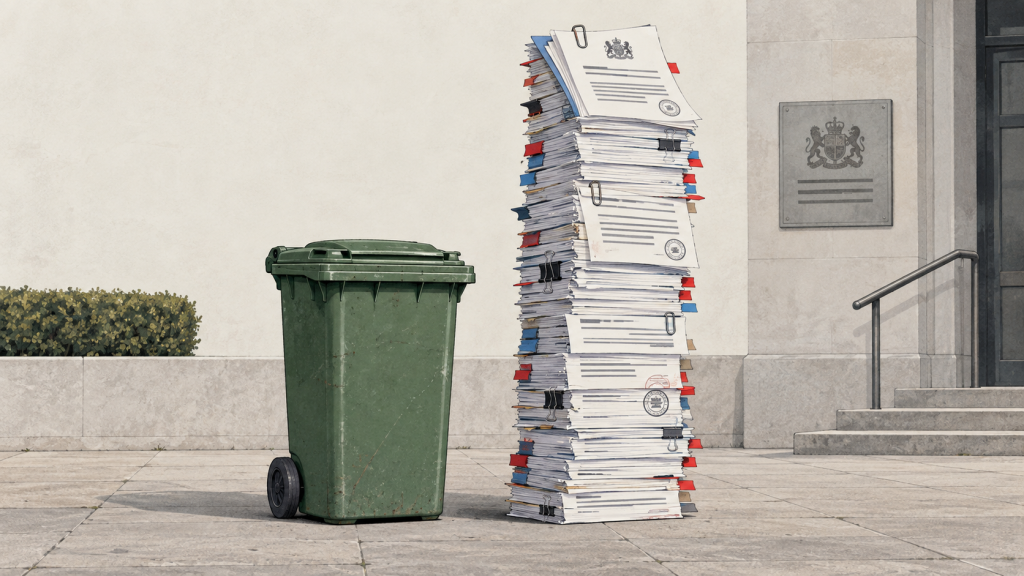
Deborah Evans, chief executive of Lawyers in Local Government, offered a glorious example. A complaint that might once have occupied one side of A4 and said, in essence, “You didn’t empty my bins”, can now run to somewhere between 19 and 27 pages, quote case law and refer to several Acts of Parliament.
Some of those alleged precedents may not say what the complaint claims. Some may not apply. Occasionally, they may not exist.
But once something looks like a legal submission, the person handling it may feel obliged to check every argument. A straightforward complaint becomes a research exercise, possibly involving the legal team, several operational systems and a great deal of searching for the original point.
Evans estimated that responding by employing more people could mean doubling the complaints-handling workforce – and that’s bad news if it means fewer staff delivering the services themselves. That is an informed estimate, not a national statistic, but it illustrates the pressure services believe they are seeing.
The Parliamentary and Health Service Ombudsman also identifies the growing use of AI by complainants as one factor driving demand. Complaints requiring investigation rose from 6,111 in 2020–21 to 9,692 in 2024–25 — around 59%.
AI did not cause that entire increase. Public services are under pressure; delays and mistakes generate complaints. Awareness has improved and expectations have changed in our on-demand world. But AI is plainly affecting what people can produce and how much work may be needed to understand and answer it.
Complaints literacy has never been equally distributed
It would be easy to turn this into a story about difficult members of the public acquiring a new machine for producing unlimited, vexatious correspondence. Some of them undoubtedly have, but there is another side to it.
Some people have always been much better at operating public systems than others. They know which words to use, which procedure applies and when to mention the Ombudsman. They can organise a chronology, quote the relevant policy and write a calm but firm email making clear that they will not be going away. I am that person. My Karen powers are real.
Sometimes this is about education, the jobs you’ve done, confidence or background. Sometimes it is the ability to pay for professional advice. Quite often, it is simply having enough time and energy to keep pursuing the matter.
Other people are busy, less confident with formal writing, neurodivergent, confused by a confusing system or already exhausted by whatever caused the complaint. Some do not complain because they think nothing will change. Others worry that it might affect the services they receive or find “fighting the system” too emotionally draining.
The BBC spoke to one woman who struggles with writing and said AI had made a real practical difference to her ability to represent herself. As public services increasingly move people away from telephone conversations and towards written channels, someone intimidated by writing may simply give up. But they shouldn’t have to.
That’s why I can’t get upset about a busy person, or someone with additional needs, getting help to tell the council that the bin men did not come and they now have to climb over a toxic puddle of something sticky just to leave home. That is not abuse of the system or misuse of AI. It is access.
Schools understandably worry about receiving more and longer complaints from parents. But schools also want parents to be engaged.
Making it easier to articulate a legitimate complaint is not, in itself, a bad thing.
The problem is that only one side has had the upgrade
A complainant can now turn a few sentences about what happened into something resembling a formal legal submission, in seconds. The organisation receiving it still has to work out what actually happened. They have to separate the substance from the filler, find the relevant records, check what staff did, locate the current policy, check any law quoted and decide what action to take. It must then produce an answer that is accurate, fair and proportionate — and for which an identifiable human remains accountable.
The words have become very cheap: verification and responsibility have not.
This is not confined to Britain. The European Ombudsman handled 3,490 complaints in 2025, 54% more than the previous year. AI is not just helping people write complaints, and it is telling them where to send them, what they might be entitled to and how to frame their case. Sometimes usefully; sometimes confidently incorrect.
The answer should not be to make it harder to complain, or to dismiss anything polished or lengthy as “obviously written by AI”. A long complaint may describe serious harm; a short one may be entirely without merit. The challenge to public and private organisations is to improve complaint handling at roughly the rate at which the public can now improve complaint making.
Everyone’s got an assistant except the complaints team
Using AI to handle complaints should not mean pointing a generic chatbot at an inbox and letting it decide who is right. Nor should it mean producing an equally grandiose reply. Useful AI would help you identify the actual complaint beneath the legal-sounding guff. It could extract the separate issues, flag missing or contradictory information and distinguish a request for an explanation from a request for action or compensation.
It could also retrieve live information from other systems: whether the bins were marked as collected, when the repair was logged, which letters were sent or what decision was recorded. It could check current policies and real legislation, cite the sources used and create an evidence pack showing what was considered and how the draft answer was reached. A person will still review the evidence, make the judgement and take responsibility for pressing send.
Better complaints should mean better services
Complaints tell us where a process is confusing, communication has failed, something has gone wrong repeatedly or a policy is producing results nobody intended. Making them more accessible should give organisations a broader and more honest picture of how their services are working. But that will only happen if the real signals are not buried beneath an expanding mountain of plausible prose.
AI has given more people a tool for navigating the system. That is not going away, and I don’t want it to. The sensible response is to give the people on the other side better tools too — not to defeat complainants, but to understand them, check the facts, answer properly and gather the insights to improve the service. Because the answer to a 27-page complaint about the bins may not be a 28-page reply: it is a short, accurate answer from someone who can show that they checked whether the bins were collected, what the council promised and what happens next.
*All real examples of letters I have seen from the great British public. And that was when you had to put things in envelopes, so it required an impressive degree of effort to get in touch.

Latest posts

Free webinar – AI in Housing is a senior leadership decision, not an IT project
Events