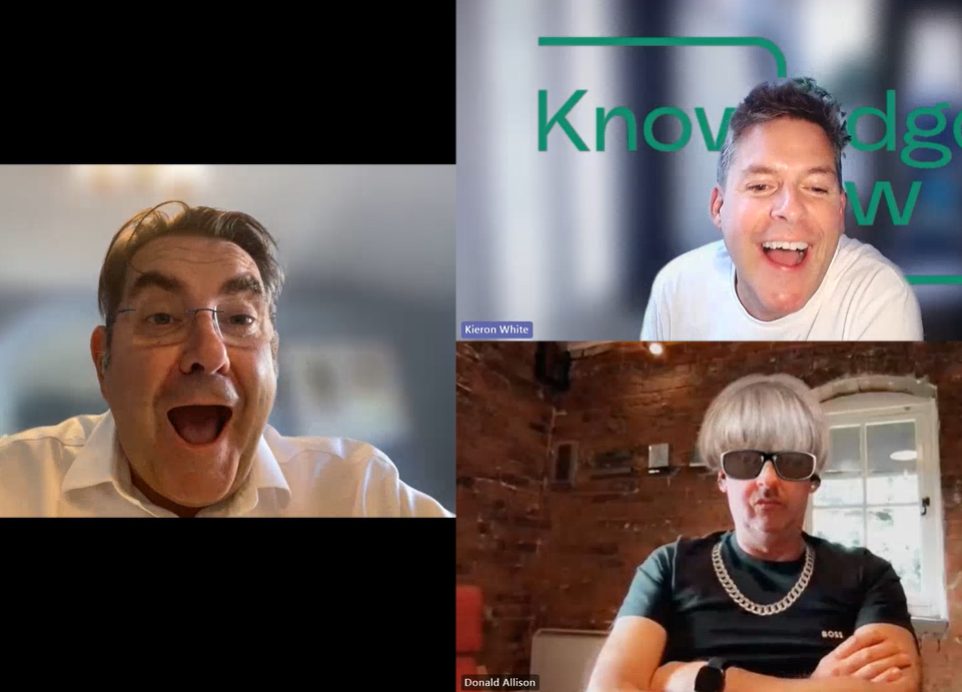
Six legs on the pantomime horse this week. This time the third stool goes to the man who started it all, the on, the only Donald Allison, CTO and architect of KnowledgeFlow.
The origin story is better than any of us remembered. In June 2022 Neil was getting ready to retire. Donald said don’t do it because I’ve built this exciting thing with AI. In August, Kieron and Neil went to the biggest AI conference in the world in Vegas, got hideously sunburned, avoided the gaming tables, and had a minor incident in the Bellagio bar that remains permanently classified. They came back, went to see Donald, and a month later Leading AI existed. Donald had built a private ChatGPT before RAG had a name. Everyone he showed it to said the same thing: that’s magic. Nobody believed it could do what it did.
Three years on, this is the conversation about what’s actually under the bonnet. It’s the most technical episode we’ve done, but hopefully everyone will learn something from it.
Why KnowledgeFlow lives in your Azure tenancy. Donald’s answer is the cleanest argument for it we’ve heard: your security is already there. Role-based access, the lot. So why would you break that barrier and drag your board minutes, CVs and medical notes somewhere else — just to make the software easier to write? Better to write software that complements your security posture than one that dismantles it.
The safeguarding filter that catches the question, not the answer. Edge devices filter what comes back. But if a student asks how to build a bomb, the LLM refuses — so the edge device sees nothing, and nobody ever knows the question was asked. Donald built it the other way round. Catch it before the LLM ever sees it.
The browser extension nobody talks about. Use Azure or OpenAI APIs directly and internet retrieval goes out through their connection — quietly bypassing every firewall and filter you’ve got at the edge of your network. KnowledgeFlow routes it through the user’s own browser, own gateway, own firewall. Kieron’s summary: “So we’re even more secure than Azure.”
The hardest thing he’s ever built. The hardest thing to do in AI isn’t unstructured date (like 700-page legal packs, or 1,00 PDFs). It’s structured date like spreadsheets. A SQL database with 50,000 rows is harder than a library, because the differences between line 1 and line 427 are minuscule — and LLMs are built for unstructured data. As Kieron puts it: it knows the difference between a kettle and a car, but 10 and 11 look basically identical.
The BidWriter argument. A customer handed it back this week. Kieron asks the uncomfortable question: should we retire some of the early tools? Neil defends it hard — 60% of a bid in two hours versus two weeks — and reminds everyone of the 190-question spreadsheet he cut and pasted for two days before Donald said “I can fix that” and built the button. Donald’s verdict, and the line of the episode: give me a trowel and a pile of bricks and ask me to build a house — imagine what that’s going to look like. Plenty of people can prompt. Most can’t. That’s who the tool is for.
And the thing Kieron caught him building. Automated downtime alerts started pinging from something called “KnowledgeFlow for Procurement.” Donald’s response on air: “I don’t know what you’re talking about.” Then, after a pause: “So, I’ve started to put the building blocks together.”
What’s he most proud of after three years? Not the tech. The daily 09:30 team call. The team is scattered across the country, still here, still moving, working on things that help people who need it. As he puts it: we make a difference.
Two mates and the man who built it. A bar. And all they want to talk about is AI.
Pull up a stool — we’ll get the beers in. 🍺
TRANSCRIPT
The Big D podcast-20260729_
Kieron White
That is fabulous. I hope we’re recording. We are.
Neil Watkins
Okay.
That’s brilliant.
We are recording. I’m having that. That’s fantastic.
Kieron White
That is awesome.
Kieron White
I like it. Hey, Big D, you alright?
Neil Watkins
Cool.
Donald Allison
Yeah, you?
Kieron White
Yeah, good. Thanks. Thank you.
Donald Allison
Excellent.
Kieron White
I am.
Donald Allison
Excellent, excellent.
Neil Watkins
Well, I didn’t get the t-shirt memo. I needed a grey t-shirt, shouldn’t I, or something in the middle, something different.
Kieron White
Yeah, you’d have to go, yeah, halfway half there, and Grey Grey shows up your man ***** sweat most most prolifically, I can tell you.
Neil Watkins
I would have to.
Ha ha ha!
Donald Allison
So just everything to hide everything. Dark colours, no stripes.
Neil Watkins
Yeah, exactly, exactly.
Neil Watkins
Excellent.
Right, well xin that case, let’s get this pantomime podcast underway for a special edition of the six-legged pantomime horse with this week with the one, the only, we know him affectionately as the big D, Donald Allison, the man behind
Kieron White
Yeah, here he is.
Mm.
Neil Watkins
All of it, and he is responsible. I mean, look at him, he’s cheery, cheery chappy, isn’t he? Let me.
Donald Allison
You don’t call me grumpy for nothing.
Kieron White
Ha ha ha.
Neil Watkins
Well, let me tell everybody a little, let me tell our audience, I say everybody, our audience, a little story, a little bit of background. Back in June 2022, it must, was it 2022? Crikey, it must have been. You said, oh, fancy a drink. And I was like, OK, I haven’t seen Donald for Donkeys. Let’s go and have a chat.
Donald Allison
Yeah.
Kieron White
But.
Neil Watkins
And you basically said, what are you going to do? And I was like, I don’t know. Everything nice and teas running along nicely. I think I’m going to retire. And you said, don’t do that. I’ve just invented this thing with AI and it’s brilliant. I think it’s got legs. And I was like, well, funny enough, Kieron and I are off to Vegas for a little jolly in August and we’re going to cheque out this.
whole AI thing and we went off to Vegas and got hideously sunburned, managed to avoid any of the gaming tables because we saw loads of people throwing loads of money away. We avoided a minor incident in the Bellagio bar, which will definitely remain just between Kieron and I.
And we came back and went, maybe Donald’s got a, maybe we should go and have a chat with Donald and let’s see what we come up with. And then not even a month later, Leading AI was conceived and set up as a business. And here we are almost three years later on what has been a roller coaster of a journey, hasn’t it? I mean,
Kieron White
Yeah.
Donald Allison
No.
I know.
Neil Watkins
It’s been, even though it’s three years, it feels like 3 minutes, doesn’t it? Because when you first came to me and said, I’ve done this thing and it’s like a private ChatGPT, we didn’t know it was called Rag at the time, did we? It didn’t even have a name then. You were so far ahead of the curve that no one else was doing it in the country that we knew about. You were the only one.
Donald Allison
Yeah.
Nope.
No, nobody wanted it. No, nobody knew what it was. I mean, every time I showed it to anybody, they’re like, oh, that’s magic. That’s fair enough. What’s that? They didn’t believe that it could do what it was doing.
Neil Watkins
Yeah.
Yeah, yeah. Cool. So, yeah, Donald, it’s tradition for us to ask our guest to give a little bit of background, a little bit of history and one interesting fact about themselves.
Donald Allison
Didn’t give me that, but did you want interest in?
Neil Watkins
No, I didn’t. I just made that up, actually.
Kieron White
He did, he made that. He’s never asked that before, Donald.
Donald Allison
I, I just that, that’s the hardest part, one interesting fact.
Kieron White
But.
Neil Watkins
Yeah.
Donald Allison
Where have I come from? So traditionally, I’m a software engineer. I graduated with a software engineering degree, which was a long time ago. I came out of having a software engineering degree, doing that for four years, and then decided I don’t want to do that. So I did systems integration and did
A lot of work on Unix boxes, some microsystems, 3D modelling for people like Ford, and yeah, and then…
Neil Watkins
Did you?
Kieron White
Cheating.
Neil Watkins
Hmm.
Donald Allison
And then I got a job doing some integration for Barclays and worked for Barclays for five years or so. So I’ve been out the integration piece, but then when you’re in the integration piece, you do a lot of subconscious coding, you do a lot of scripting, you do a lot of…
efficiencies, you do a lot of things, you know, why would I do that four times when I can just write one script and do it once? So you said, you’re never too far away from the software engineering part and then, and then like you said, 2021, 2020-ish, I was sort of tinkering around and thought, oh, what’s this new stuff going on over here?
I’ll have a look at that.
And then it just bore out of that, really. It bore out of that.
And here we are. I didn’t realise it was three years. I keep telling people it must be about 12, 18 months.
Kieron White
Haha.
Neil Watkins
That’s because we don’t let you out very often.
Donald Allison
Oh, no, but it’s, but where we are, I mean, we can go into it, but it’s the reason it sort of seems so short is we’re not in any traditional business that’s sort of manufacturing that your product set changes every
two, three, four years, this product set evolves and changes every two, three, four weeks.
Kieron White
Yeah.
Neil Watkins
It’s much faster than that now.
Donald Allison
And.
Kieron White
Matt says, interestingly, Matt Atkinson on the FE AI side of our business, he says this is the hardest business he’s ever had to be involved with. And he said, like, you’ve got customer adoption problems, you know, trying to help them use it. You’ve got the constant speed with which things are moving all the time. You’ve got the kind of customers
I guess immaturity in AI. I mean, by definition, we kind of all are really, I guess, in that world of where, what do they choose to do with AI when, so you’ve got that makes sales very hard because you’re always up against this kind of, yeah, we know we want it, but we’re not sure what for. And we try and help them with that. So yeah, it’s
Donald Allison
Yeah.
Kieron White
Interesting. The pace is great fun, I think, but does make it probably harder than most businesses to run, isn’t it? We’re not just selling the same old thing time and time again.
Donald Allison
No.
It’s really difficult and that’s why we try and or I try and focus on, I try and focus on the outcome, not the technology. You know, the outcome is important for the user, for the customer, for the company. You know, they have a job to do. They have a, you know, and we need to facilitate that job in a much more fast, very efficient way.
We don’t go in and say, we’re AI, woohoo, you know, how amazing is this? You know, it’s about the outcome. But our job is to keep up to date with the changes in the AI world and make sure that our tooling is the best tooling it can be.
Kieron White
Yeah. Yeah, interesting. And it is, I mean, and that is tough because we’re up against all the time. And we talk often on the podcast about co-pilot and Claude and ChatGPT and I mean, Gemini, and we’re kind of in a space where we are being squeezed. I think it feels like right now that’s squeezing us into a place that
Donald Allison
Okay.
Kieron White
only knowledge flow can play the regulatory space. Maybe that’s going to be a good thing. Who knows? It’s sort of brilliant and awful all at once, isn’t it? You think we’ve carved out a little piece and then all of a sudden that turns up somewhere else with a free bit of AI overlay on someone else’s tool.
Donald Allison
Yeah.
Yeah, well, what we’ve got is we’ve got the power of integration. We’ve got the power to cut across all the systems. We’ve got the power to mould. You know, we said we were never going to be bespoke, and we’re not fully bespoke, but we are. We have built a platform that’s adaptable.
for every outcome. So we can build integrations into all our systems and pull data from multiple different systems into knowledge flow and then deliver what somebody might take three, four weeks to do in three, 4 minutes.
Kieron White
Yeah.
Can you remember back to when, so we started out selling what we now call our version one tools. And so we’d have one for policy and if you want a bid writer, we’d have one for bid writer. And in college quality was the first time we ended up in a kind of, they needed three in one. So we ended up with sort of clumsily having different links you had to click.
Donald Allison
Yeah.
Neil Watkins
Yeah.
Kieron White
You then pulled together Knowledge Flow at some point. Last summer, I think it was about this time last year when Knowledge Flow was first.
Donald Allison
It was out, it was after, or it was even more, even probably during, you remember we had the meeting at Tech UK and we had everybody there. And we turned around and said, we need to move away from a VIEW, we need a platform play.
So we need a platform with multiple assistants that can do different jobs. And we looked at it, or I described it as you’re in a large corporate and you have different departments. So you have HR, you have buying, you have procurement, you have legal, you have all the different departments and you need the assistance on the left hand side to be able to
You know, what am I asking today? Am I in, you know, I need a question about HR, I need a question about legal, and I need a question about procurement, and having that single port to your entire business, and that’s where it came out of, and then you came up with knowledge flow.
Kieron White
Yeah.
Donald Allison
And then after that it was just born out of that really.
Kieron White
Yeah.
Neil Watkins
And.
Donald Allison
I was like, can I have more assistance? Can I have more than five? Yeah, you got 10? Can I have more than 10? Or yeah, you can have 30. Or can I have more than 30? Yeah, you can have 100. Yes.
Kieron White
Alright.
I was going to say, so one of my favourite things about Leading AI as a company has been working with you and getting to know you and that your anything’s possible attitude, although not without a fair bit of resistance and moaning along the way, I would like to suggest. But the thing, but
In when in in so the what matters I think for our customers and we were having a conversation earlier with someone about vibe coding and everyone can vibe code something now with some pretty basic tools knocking around. The thing that you’ve brought from the very beginning and it was most evident when Ibby joined us in the dev thing is is that old school
Donald Allison
Yep.
Kieron White
solid, safe, repeatable, documented, tested, bringing all of that with it so that we can confidently stand behind the tools. And I think that is really important, but it must be a continual battle because you can vibe code something in 10 seconds and probably spend half an hour having to write the documentation for it afterwards.
Neil Watkins
Cook.
Donald Allison
Thanks.
But you’ve got to, you’ve got to know, it’s a software engineering, it’s a foundation of binary, of bits and bytes of computing. And you know, as much as we all love a baby and we do, you know, there’s some things that I have a conversation with them and he turns around to me and says, well, how do you know that? Well,
Kieron White
Yeah.
Donald Allison
And I know that because I’ve got the foundation. I’ve spent 20 years learning the foundation of a computing system. That’s never going to change. But what we’re doing now is we’re layering on top.
the fundamental foundation of what a computer system does, how it talks to the infrastructure, how it talks to the hardware, and that’s still the same. But most people just don’t know how to, you know, the vibe coders of this world don’t know how a lot of things work. You know, I talked to Ibby about networking, for argument’s sake.
Kieron White
Yeah.
Donald Allison
You know, and I was talking to her about subnets.
It was like, what? I was like, you don’t know what a subnet is and how you subnet and supernetting and all that. I was like, no. And those are just fundamentals of everything that never changes. Your networking infrastructure, your protocols never change, or haven’t changed for a long time.
Neil Watkins
Okay.
Kieron White
Yeah.
Neil Watkins
Yeah.
Kieron White
Interesting.
Neil Watkins
Can I just say, has anybody else got volume and sound issues or is it just me?
Kieron White
I’m hearing, I’m hearing, so I’ve not got sound issues. I am hearing some further interference than as usual.
Neil Watkins
There is, there’s a lot of interference I’m getting.
Donald Allison
Cook.
Right, is that any better?
Neil Watkins
Yeah, much better. What was that?
Kieron White
Hang on, I’m easy.
Donald Allison
Yeah, I think it’s my fan that’s going off.
Neil Watkins
Yeah, yeah, thanks for that. I was just going to say, we were just talking about Gibby. Really interesting little story about him, because he probably never listens to this, but others may. But yeah, he was a graduate and couldn’t get a job. And he got like a first class degree, couldn’t get a job.
And it was actually, he paid a recruitment person to get him a job. And they contacted me and said, we’ve got this young person, great credentials, are you interested? And we met him and we thought we’d take a chance in him. And now look at him, how he’s grown.
Donald Allison
Gooding.
Neil Watkins
It’s interesting, isn’t it, because one of the people we’ve been talking to on the kind of special guest podcast was earlier was talking about, you’ve got to get the foundations right. If you get the foundations right, the rest of it just follows. But if you don’t get the foundations right, the stuff that you end up making is built on sand and dodgy and how do you know it works, how do you know it’s ethical and all that good stuff.
Donald Allison
Yeah, we spoke about this. How does, you know, your people who are vibe coding, you know, some of the ideas that they have are brilliant. I have never taken that away. The ideas that are coming out are superb. It’s just the tooling that’s not great. And the tooling, we spent such a long time getting 42,001.
Neil Watkins
Cook.
Yeah.
Donald Allison
27,001, all those are part of our foundation of what we build on. You know, we have to have architecture diagrams. We have to we have to be answerable to our system.
Neil Watkins
Interesting enough, I’ve had a request from somebody in healthcare who’d just gone through an ISO order, a series of ISO orders. I was like, if you’d only told me a couple of weeks ago, we could have we could have set that into your knowledge flow for you. He could have had one of them and they were like, no.
Kieron White
Yeah.
Donald Allison
Um…
Kieron White
Yeah, the ISO tool is a very helpful habit. Sitting in a monthly ISO meeting, I am often looking at the knowledge flows ISO assistant to get the answers. It’s brilliant, though, because it knows all the documents we’ve got. You know what I mean? So actually, most of ISO is have you got a thing that describes this and have you got a log of it and can you prove it?
Neil Watkins
Yeah.
You prove it.
Kieron White
And so being able to ask and get it instantly rather than, I mean, God, with my filing system or lack of filing system, I’ll be here for hours.
Donald Allison
Yeah.
Neil Watkins
Keeping Dropbox where you shouldn’t be keeping it.
Kieron White
I don’t keep any clients up in Dropbox. It’s not because it’s not secure enough. Dropbox make no make no claim to keep your stuff entirely secure. Well, talk about security, Donald. I would like to explore with you the conversation about building inside the clients as your tenancy, because I think we’re still unique in that.
Neil Watkins
Exactly.
Yeah.
Kieron White
There are obviously companies out there that will build you your own AI tools that are over to you to look after, good luck to you after we’ve left. That is the only other people I think that build inside your Azure, but we’ve chosen to do it as a kind of as a service.
Donald Allison
Yeah.
Kieron White
So tell me about that. Why that and why not more SAS based? Just send the data to us and we’ll have it all. It should be far cheaper, a hell of a lot easier.
But why not? Data security, I’m guessing.
Donald Allison
Cheaper, easier. I don’t know whether it’s cheaper, easier. I we started this with security as as as the number one piece. So, so where does the security lie? Security lies in your Azure tenant.
Kieron White
Still is, yeah.
Donald Allison
All the layers are already present there. You are not.
You’re not relying on anybody else to feed security. So your security is already in place, already there in Azure. Your documents are already secured under role-based access and everything else that comes with it. So why would you decide to break that security barrier?
pull your documents outside of there to make it easier to write a piece of software.
surely it makes more sense to write the piece of software that complements your existing security strategy. It doesn’t break it. So that’s where I was really, and that’s the foundation of where I was. I still believe that’s the right way to go. I still believe that SAS is, it has a place.
Kieron White
Yeah.
Donald Allison
but not when you really do want to put sensitive documentation in there. You know, your sensitive documentation could be anything from board minutes to CVs to medical notes to anything. And are you comfortable with withholding all that information somewhere else? No. You know, you already have the cheques and balances in place.
on in your Azure tenant. So it’s easier for you and more secure for you for us to write software that works with you.
Kieron White
Yeah.
It does take a bit of persuading sometimes that it’s a secure option, doesn’t it? The amount of due diligence we have to jump through to get access to people’s Azure tendencies.
Donald Allison
So.
Oh yeah, you do, but then, but then that’s…
Just imagine on the flip side of that, if you’re asking that those people who have so much security, oh, and can I have all your data, please?
That, you know, that the amount of hoops you would have to jump through to get the data out of that scenario would be tenfold.
Kieron White
Yeah.
Donald Allison
So, I’d rather jump through their security hoops than come and, you know, and us to take all the documents out of that security posture.
Kieron White
Yeah. And it’s definitely been a great USP for us in terms of being able to handle sensitive and secure private data, which is obviously a load of our tools play in that space. So it’s very cool. The other thing that it would be great to get your reflections on is also the admin console. So we met one of our old dev
Donald Allison
Yeah.
Neil Watkins
Yes.
Kieron White
friends a long time ago, Neil and I on the podcast, Mark Slater, slash, as he likes to go by. And he, we were, it was a pure show and tell really, and kind of quite open and honest. And at one point I screen shared with him the admin portal. And he at that point went, holy, that is amazing.
He said the concept that you can deploy a tool from one to another without the data, let’s just be really clear for our audience, it takes the settings and if we’ve built a timetabling thing somewhere, we can move the timetabling thing somewhere else. But that idea that you’ve built everything as a variable that we need to play with. So how did that, why was that, is that just old school?
Donald Allison
Yeah.
Here.
Kieron White
Software engineering courses do it that way, is it?
Donald Allison
Yeah.
It’s that simple for me, old school software engineering. That is never building a platform which isn’t, once you hard code something, you’ve narrowed your audience.
So for me, everything that I want to build, everything that I build has the ability to change its persona, change its wrapper. So yeah, I think that’s probably one of our unsung heroes is the admin.
The way, the way we we deploy.
Because we deploy the same piece of software, we maintain the same piece of software across all our tenants, so that the core software is the same, but we have the ability to make it look completely different, act completely different, based upon, again, the outcomes that the customer needs.
Kieron White
Yeah.
Donald Allison
what does the customer want to achieve? Well, we can make that happen. And also, there was a part of me at the time that thought, you know, with people’s adoption of AI being…
Like people are not sure what it does, how it works, what do I prompt, how do I say it, how do I put something in? You know, I think one of the first ones I built was for a…
Neil Watkins
Mm.
Donald Allison
Oh, it’s for the insurance company and a large marine insurance company and they turn around and one of the prompts that I saw some come through saying somebody asked it what what what ice cream flavour do I like?
And you’re like, so you don’t know what you’re doing, you don’t know what it does. So how are you going to ask it the right question if you don’t know what it does? So therefore, we’re going to have to help you on that journey. And the only way I can help you on that journey is to be able to configure it and give you the help that you need by the buttons, by the quick actions, by
You know, by the prompts and by, you know, helping we helping you prompt your way through to your outcome.
Kieron White
Yeah. Nice. And on top of that, Bill, the safeguarding piece, which we’ve talked about on here before, this kind of, this is, so one of the, if you want to put anything in front of students ever, then the Department for Education regulatory requirements are that you have a safeguarding philtre and can track and trigger.
Donald Allison
So.
Yeah.
Yeah.
It.
Kieron White
if people are having conversations that you would want someone to know about. So you built that, which is great, because that runs across all of them, again, through the admin console. It can trigger off anyone, anytime.
Donald Allison
Yep.
It.
Yep, and one of the thoughts that I had was that was, you know, you have edge filtering devices which catch responses from the internet, which are from particularly spurious websites or URLs or whatever. And I wanted to go one step further because I wanted to be able to catch
not catch, catch is the wrong word, but sort of philtre out somebody asking the question. What is the question they’re asking? Because the answer is bad, but the question is also equally as bad. Now, most of them catch the answer coming back. So the answer coming back might be something quite spurious.
But I want to know.
what question have they asked in the LLM for it to be able to answer or try and answer that question. Now sometimes, you know, if you’re trying to ask, I don’t know, what’s reasonable to say, if we have all sorts working in education, but if you just ask how to make a bomb, you know,
The LLM will not answer that because it’s safeguarding its guardrailed.
Kieron White
Yeah.
Donald Allison
So, the edge device that’s filtering the request will not pick that up because the LLM comes back and says, I can’t answer that question.
Kieron White
Yeah, interesting.
Donald Allison
Well, I, I, but we know that that question was asked.
Kieron White
Yeah.
Donald Allison
So therefore, we’ve caught it before the LLM can do anything.
Kieron White
Yeah, interesting.
Donald Allison
So, that’s why it was built that way. Uh, you know, we could have we could have we could have just relied on the Edge device, but I don’t I didn’t think that was enough.
Neil Watkins
Mm.
Kieron White
And didn’t you take?
Yeah. And you said to me at some point about the risk with, I think it was co-pilot, but other tools that allow you to tunnel through your firewall to get to the internet.
Donald Allison
Oh, so, so that, yeah, so what we have is we have a browser extension.
So, we have a browser extension which sits inside Knowledge Flow. Now, with it, we’re not trying to overcomplicate this. If you use Azure APIs or if you use Open AI APIs, it will use…
Microsoft Azure’s internet connexion or OpenAI’s internet connexion to retrieve the answer. So it can effectively circumvent any firewalling or any filtering that you have at the edge of the network.
So what we have is we have a browser extension, which effectively uses your local machine’s browser capability through your firewall, through your default gateway, through everything what you do. So any internet received information, data, whatever,
through knowledge flow will come through your firewall so it will be secure through your firewall.
So, if you do it through Azure, Azure uses its own internet connexion out of the data centres, and it doesn’t do that.
Kieron White
Yeah, interesting. So we’re even more secure than Azure. That’s what I’m hearing.
Neil Watkins
VIEW.
Donald Allison
Yeah, we try. We try. Yeah. We think about everything. You know, this is about the software engineering part. You think about all the scenarios. You try and think about all the different connotations about who’s going to use it, how are they going to use it, what, you know, security, safety is key to these things. Because if you’re not secure and you’re not safe, then what are you? You know, you’re just throwing out a chat
Kieron White
Is.
Donald Allison
Apple.
Kieron White
Yeah, exactly. Yeah, definitely. No, we were. Now, tell me this. You’ve just been redoing the way we do indexing. So the knowledge flow, just to quickly catch up anyone who’s listening that might not know all about it, it’s mainly A retrieval augmented generation or RAG AI tool. That means you can have a vast document library and it will find answers in there. So it’s able to answer a question about policy or a question about from
all of the legal cases that have ever existed on a subject is able to find best practise in Ofsted reports, etc, etc. But that process of doing that is a process called embeddings and it is more complicated than it appears, isn’t it? You can just press a button and make it do basic embeddings, but then your answers will be
Donald Allison
Mm.
Kieron White
not correct. But you’ve just been working on a load more indexing. Can you share that or is this still very secret sauce we don’t want to give away to anyone else that’s in this struggling with this problem?
Donald Allison
Yeah, far too transparent, but the problem with vector databases is what we thought, especially when you were looking across policies and documents who have so many similar idiosyncrasies or some paragraphs are so similar, or you know, they can be, you know, you can take meeting minutes that from one minute
From one month to the next, they’re not that too dissimilar because you, you know, the meetings follow a structure anyhow.
So it’s very easy to sort of look at one particular document and go, well, that’s the answer, when it isn’t the answer because it was a meeting from last month, not this month.
Kieron White
Mm.
Donald Allison
So when we’re doing the indexing now, we do a, we do some pre-processing. So we pre-process it. So we pulling out key vector or key pieces of data that we will embed into the vector database, into the chunks that will allow us to categorically
turn around and go, ah, yes, that is the document we need and that is the document you need to retrieve the answer from. So yeah, it’s, we’re expanding on that quite a lot at the moment. You know,
Kieron White
And all the other bits, hybrid search that you have on there, NER, BM25, re-ranking, cognitive sentence matching. I mean, it’s like, I’m amazed we get an answer back within an hour from them. We get the amount of work it’s going to do.
Donald Allison
Yeah, being twenty-five, all all that.
Yeah.
Neil Watkins
Yeah.
Donald Allison
It doesn’t.
Neil Watkins
I don’t know what some of those things are. What are some of those?
Kieron White
Some of it’s secret sauce, Neil. You can’t, you don’t want everyone to know. The combination of those and the settings that you apply to them is what makes knowledge flow accurate.
Neil Watkins
No, is it? Alright, fair enough.
Donald Allison
If.
That.
Neil Watkins
Ben.
Donald Allison
Well, we do combine a lot.
Neil Watkins
But it’s like, is that like your prep sandwich where they’ll just give you a list of ingredients and then they, yeah, and you make it and you make it wrong.
Kieron White
Okay.
Yeah.
Donald Allison
Can’t deconstruct it here. No, we’re not.
Neil Watkins
Yeah, yeah.
Kieron White
It’s very…
Neil Watkins
So what would you say is the hardest? I had two questions and they’re very simple. They’re simple to ask. I’m not sure if they’re easy to answer. But what’s the hardest technical challenge you’ve come across in building knowledge flow? And what’s and is that the what are you most proud of in what you’ve done so far?
Donald Allison
Paul.
Neil Watkins
I thought it was simple to ask.
Donald Allison
Yeah, this is just a tricky one.
Kieron White
I’m tabling.
Donald Allison
The hardest thing, the hardest thing has always been my my nemesis is
Uhh.
Structured data.
So, Excel spreadsheets.
CSVs, SQL. The reason is the difficulty is because what we tried to do is when we when we started this and your ChatGPT, your Clauds, all the all the GROUP and everything, you know, when you when you log in and you try and upload anything more than 20 documents, it goes, no, we can’t do that. You need to, 20 is our maximum or whatever it is. So we turned around and went, right, we can’t do that.
Kieron White
Yeah.
Donald Allison
because when we’re looking at medical notes, when we’re looking at solicitors notes, we’re looking at all the bits and pieces, you know, those case packs can be 6, 700 documents.
Effectively, that’s easier than reading 50,000 lines of a SQL database.
Because 50,000 lines of a SQL database, the commonalities between those lines are so minuscule. So pulling out the differentiators between line one and line 427 or whatever that may be, that’s difficult and that’s tricky. And there’s always a scenario. And what I found is there’s always a scenario
where you feel like you’ve got to the magic answer and you know, your wands all waving and you run, hey, it’s done, it works. And then somebody will come along and go, wait a minute, I’ve just done that and that’s the answer and that’s it. And you just think, well, I know why that’s come out as an answer. I know what it’s done, but that’s just another scenario that I need to cater for.
to make sure that it works. So this unstructured data is actually easier than structured data in a RAG because RAG or LLMs are almost better built for unstructured data.
Kieron White
Yeah. And this is the problem of, as we’ve talked about before, is the problem for an LLM is it knows the difference between a kettle and a car, but ask it the difference between number 10 and number 11 and they’re basically the same thing. Then that’s where it struggles with numbers entirely, doesn’t it? And you’ve managed to.
Donald Allison
What about?
So, no.
Yeah.
Yeah.
Kieron White
you’ve managed to hack that. Is that the right phrase? Probably not. Hack is really not a word we should use. But what are you most proud of? That’s what Neil asked the second part of that.
Donald Allison
Engineer, I’ve engineered it.
Neil Watkins
Engineer, Kieron, engineer.
Donald Allison
Yes, but it’s.
I think definitely, I’m going to be sound sad and but we’re the company, it’s the most proud of actually, you know, we all work together, we have a call and you know, and you two have got to thank for this.
because it’s something I was alien to, but we have a call 9:30 every morning with everybody and we all work separately. We all work in different parts of the country. We rarely get together, but we should do it more, but it’s just, you know, life gets in the way and work gets in the way. And we’re still here three years later and we have a lot of customers on our books and
we are moving forward at an incredibly fast rate and it’s so enjoyable. You know, it’s grateful, you know, to work in some of our ways is grateful.
Kieron White
It is good. It is good.
Donald Allison
is a blessing.
Kieron White
That is good. And I love the idea that what nearly all of our customers are doing are focused on helping people, helping underserved people in the main and disadvantaged folk. And that always gets me out of bed. So working with a great team on stuff that matters, not just, we’re not just there to make someone some more money, which
Donald Allison
Yeah.
Yes.
Kieron White
Yeah, most comma seems to be, yeah.
Donald Allison
Yeah, we make a difference. We do make a difference and it’s making a difference to people’s work life at least, but that work life makes people, makes a difference to people on the ground.
Kieron White
So here’s the challenging questions.
Not technically challenging, strategic. We had a strategy session on Monday, which was really good, and we could talk about some of the things that came out of that if there’s time. But so I had a feedback session with a customer who has had BidWriter, and they had it on a trial basis. And headlines are, they’ve come back and basically said,
it’s not really doing it for us. We think we’re going to hand it back rather than what they are going to hand it back, we’ll not think. And it was a difficult thing to listen to, but there was good feedback that they were giving. There was a whole bunch of it’s personal feeling rather than anything, which is very difficult. As you know, a lot of
Donald Allison
Yeah.
Kieron White
we get from people as well. I didn’t like the way it wrote like that. And we can change the tone a bit, but then you’ll get another colleague over here that says, I like the way it writes. So that’s always a battle. But here was the thing that, a couple of bits that went through my mind is it strikes me, we created BidWriter.
Donald Allison
Yeah.
Kieron White
more than two years ago, probably, when no other tool was able to do anything like that. And people weren’t even aware that that was something AI could help you with in any, you know, people were using ChatGPT to give answers to bid questions, but not bringing their whole library of case studies that the organisations created and roles and methodology statements and all of that stuff and drawing on that.
Donald Allison
OK.
Kieron White
So the difficult question is, are there tools we should think about retiring?
Because what my concern is that these guys were using Claude and basically saying, yeah, we’re using Claude alongside it. And frankly, it’s a bit better at answering the knowledge flow is. And I was like, well, that’s partly annoyingly because Claude writes better. And that’d be great once Microsoft finally bloody allow us to use Claude inside Azure securely, then that could help.
But the other side of it is that they aren’t that bothered about the security of their documents, because it’s, these are, you know, it’s a small company we’re talking about. They’ve got a lot of proposals. The only part of those proposals, which is in any way sensitive, will be the cost tables. And ultimately, you know, if they, if they give all of those to Claude and they end up in an LLM, that’s not a declarable data loss. That’s just a, I might get told off.
by my boss. So the question on my mind is, given knowledge flows focus on regulatory stuff where it matters, where the answer has to be right, and where you need consistency,
Should we think about retiring BidWriter and maybe some of the other early tools which people are now able to do in other ways? And my fear is always that if we keep going head to head with it and we can keep improving BidWriter and for some organisations it’s perfect. I think I know what’s going on.
Neil Watkins
Yes, it is. I don’t want to lose it. So just to be clear, I’ve just, I’ve done a couple of bids recently and it to get to get 60% of the where there in two hours where it would normally take you two weeks just gives you such an advantage. And it’s not perfect. And I think
Kieron White
No, wait.
Donald Allison
No, I, I, I’m with you, I…
Neil Watkins
There’s something about expectation management for people where it, but the honest truth, I’d be gutted if you if you shut it down, because the next time I need to write a bid, I’m going to be bloody starting again and messing. And actually, the other thing I would challenge back to you, Kieron,
Kieron White
Yes, it is.
Neil Watkins
is there’s something about, and I can cut both sides of the coin, right? I can be ruthless and say, that’s no good, let’s just cut that, we’re not going to do that, that’s fine. But on the other side, it’s driven a whole load of innovation. So for example, we did a bid for an organisation and
and they asked, they basically had two spreadsheets with 190 questions in and what a pain in the bum that was. And I was cutting and pasting and cutting and pasting and sticking the prompt in, asking it, getting the answer, sticking it in the bloody spreadsheet. And then Donald went, oh, I can fix that. So he’d let me spend 2 days doing
all of that kind of cut and then they, oh yeah, I’m pretty sure I can fix that. The next thing comes on, yeah, press this button and do do do do do do do do, yeah, and we’ve now answered question 7 of 197, we’ve now answered question 8, and you can watch it just go through and just to get that is incredible. So I hear you, but I would
I would advocate the bid writer isn’t one of the ones for the cult, or if it does get cold for other people, then, you know, I think it’s a personal choice. I think if anyone’s using it and they’re getting value from it, then brilliant. So, I mean, I’d be gutted, but it drives innovation. And that’s the point that I’m trying to make is that
Kieron White
Yeah.
Neil Watkins
It’s forced, it’s forced us to do things. And not only do we now move from pressing the button, Donald’s created a little wizard at the front which says, you know, how many turns do you want it to do? So you’ll get the answer back and then it can ask, it can ask itself the question, you know, is this a good answer? What score would you give it? If it’s less than four out of five, then go back and have another bash of it. So
just that not accepting the first answer out of the door and actually providing some judgement on it. So it’s already moved on way, way much further. And I think for some people, I get it, and we’ve talked to lots of people about this recently, that whole piece about
Kieron White
Yeah.
Neil Watkins
people using the frontier models that are free and accessible, they’re getting, or you’re paying $20 a month or whatever, and you’re getting access to the latest bells and whistles. Of course they want that, but the reality is you can’t have them in the secure environment in the UK at the moment. You just can’t.
Kieron White
Yeah.
Neil Watkins
And so it’s managing, some of it is managing expectations as well. And that is a real challenge for us. It is a real challenge. And I don’t think that’s going to, I think it’s going to change anytime soon, is the honest truth. I think we’re just going to have to keep on going. But to answer your question, should we be retiring some of our products?
Kieron White
Yeah.
Neil Watkins
Quite possibly, but we’re already doing that. We’re doing that with the version ones that you mentioned earlier. You know, they’re going out, we’re changing, we’re updating the models, but this is the other thing that we just don’t tell our customers we’ve moved models. You know, they’re going to, most of them don’t even know which model they’re on, is the honest truth. So all they want to know is
it actually works. It’s a bit like hygiene and they just want to know that it’s working for them. So anyway, I would, I’m going to stop advocating for bid rights and let Donald answer the question that you asked him 10 minutes ago.
Donald Allison
So my simple answer is what we started off from saying is,
The speed of change and the speed of improvement that we are experiencing in the AI world makes BidWriter always going to improve.
So, yes, you are up against somebody who is capable of using Claude or Claude Code or Codex or whatever they’re using, and they’re using it in a in a way that is that is that works for them. Great.
Our bid writer will always improve. So the different, the newer models, the newer prompts, the newer sort of, you know, tooling that we put around it, that will always improve. And I’m really rubbish and crap at metaphors, but you give me a trowel and a pile of bricks and ask me to build a house.
You imagine what it’s going to look like, so…
Basically, there are people out there who can prompt and there are a lot of people who can’t.
So bid writer cuts across the masses. There are a few people out there who do know how to prompt and do how to use it, but the majority don’t.
Kieron White
Mm.
Yeah, interesting. And I think one of the things on my mind in a slightly more technical answer to Bid Writer’s problem is we’ve designed Bid Writer pretty much really well for a kind of public sector procurement audience where they want lots of evidence of how have you done this before.
And so therefore, if you think about it in a technical sense, what we do and built by design is that as soon as you’re answering question one, it’s going to do a retrieval into your index, bring back a load of chunks that are relevant stuff and write about those in its answer. And I think one of the things from this feedback from
Neil Watkins
Yeah.
Donald Allison
Yep.
Kieron White
this company earlier is they want a bit more time on the kind of creative answer, of course, because that model will always favour going back to what you’ve done already, as opposed to some new way you could do it. So I do think there’s, and this is the stuff of a button problem, so it’s pretty straightforward to test, is to say to it, first up,
Donald Allison
Yeah.
Kieron White
let’s do some brainstorming or you go away, knowledge flow and give me some thoughts about how I could best answer this and then let’s go look in the index for stuff that’s adjacent, the same as or whatever.
Neil Watkins
Interesting.
Donald Allison
personality of the LLMs as well. You know, we know the personalities of the LLMs can change, change the answers, will change the inference or change the way it writes dramatically. So it’s for us to know the personalities of the LLMs to put them in the right places for the right people.
Kieron White
Yeah.
Neil Watkins
Yeah.
Kieron White
Yeah.
Donald Allison
And we can change, you know, going back to the admin console, if they turn around and say, we don’t like that, with the press of a button, we can change all of their knowledge flow to 55, 56 solve, 54, 40, whatever you want to do.
Neil Watkins
Interesting.
Donald Allison
It’s you put on the portable.
Kieron White
Can’t get 5-6 yet in as yourself securely, can we?
Donald Allison
I don’t know, I’m not checked. I checked mobile routes yesterday, but not checked five-six.
Kieron White
Yeah.
Up, up.
I bet it’s not there yet. We’ll probably get it in about next September 2028. I imagine they’ll release it to the UK South.
Donald Allison
What?
Neil Watkins
Thank you.
Donald Allison
They’re rolling him out really fast now because it’s a race to the top, isn’t it? Or race to the bottom, whichever. That, you know, every…
Kieron White
Yeah, okay, that’s encouraging. But once they let us have Claude, then we’ll be laughing. Well, hopefully.
Donald Allison
I don’t know why, I don’t know why there’s not, there’s a blocker on that one, but it’s there, it’s listed, but you just can’t get access to it right now.
Kieron White
Yeah.
Neil Watkins
Maybe, yeah, maybe Microsoft haven’t heard their token bill.
Donald Allison
That we haven’t, that’s what it is.
Neil Watkins
Yeah.
Kieron White
So on the Monday, Donald, this is a good share with our audience about how Donald works. On Monday we spent the afternoon together talking about where we should go, the importance of regulatory, the regulatory focus for knowledge flow, evidence packs, audit trails, more data, integration layer, all that good stuff.
We also talked about building a knowledge flow for procurement that could do a bunch of things in inquiry handling and supplier sorting and invite quotes and deal with quotes and effectively automate the whole kind of first steps of a procurement world. So you said, okay, great.
Donald Allison
Yeah.
Yeah.
I haven’t done anything with that yet.
Kieron White
Well, so I get alerts, as you probably know, although you’re probably going to turn them off me. I think you, Ibi and I are the only people that get automatic alerts if one of our tools goes down is offline or whatever else. And I must say, I’ve only ever got them from sandbox tools. I’ve never seen one from a customer, which is great that they’re always operating. Anyway, I started getting one from a thing called knowledge flow for procurement.
Donald Allison
Really?
Kieron White
I’ve had a few head-ups with this thing that’s going on and offline, as you’re presumably doing something. So do you want to share anything about that, Donald?
Neil Watkins
Hi.
Donald Allison
I don’t know what you’re talking about.
Kieron White
Yeah.
Donald Allison
No idea. No idea. No, yes. All right. So I’ve software engineering started. I’ve started to put together the building blocks. There you go. So that’s all I will say is that this isn’t this is this is not this is.
Kieron White
Yeah.
Neil Watkins
Mm.
Donald Allison
Building blocks, detailing, you know, the detailed spec I’ve got so far, it for me is probably four or five pages long about right, I need to go for this, but that needs to be able to do that, that, that, that, and then then you build, it’s building blocks, it’s like Lego, it’s all it is, and you can’t say Lego, and all there are other.
Building blocks are available.
Neil Watkins
Yeah.
Kieron White
Yeah.
Donald Allison
But, but it’s that building blocks, so I’ve started to put the building blocks together because…
Again, we know this. I’m an engineer, I’m not a designer. So I can make things functional, but you asked me to choose a colour, no idea.
Neil Watkins
Black.
Kieron White
Yeah.
Donald Allison
Black, that’s also, I just want black, that’s all white, black and white, yeah.
Kieron White
Right. Maybe that’s why we get on Donald.
Neil Watkins
Yeah.
Well, you said that you get on.
Kieron White
It’s simple.
Donald Allison
Very black and white.
Neil Watkins
There’s been plenty of times when you’ve gone, I think I’ve really ****** him off because I’ve asked him to do these 800 things. And then Donald will go, no, no, you can’t do that. No, no, no, no. And the next morning be like, here it is.
Kieron White
But.
Yeah, yeah.
I’ve done it. Yeah.
Donald Allison
Here it is, there it is. I didn’t sleep last night, but there you go.
Neil Watkins
So, you do have prior, Donald, you do have prior.
Kieron White
Haha.
Neil Watkins
That’s right, I didn’t sleep, but easy two or four, yeah.
Donald Allison
Yes.
Kieron White
And that’s how you’re making timetabling work.
Donald Allison
Yeah, there’s a process like in the building blocks, there’s one building block we might turn around and say, I need to, this needs to be hard coded because I know what the inputs are. So the inputs need handling in a particular way. But then some, then you need to move on to a stage and the stage two is, well, actually, somebody might mean that or somebody might mean that or somebody might, you know,
Somebody might call a course this or somebody might call a course that. So, you know, to code that, it’s not impossible, but your statements or your functions become unwieldly because you’re trying to cater for every single possibility, even spelling mistakes.
Neil Watkins
Mhm.
Donald Allison
So using an LLM in that scenario, weaving the two together makes the whole process incredibly functional and incredibly powerful.
Kieron White
Yeah, it is very good and it’s doing a great job so far. We’re looking forward to getting into the wild to get some people actually using it, but I’ve shown it to three colleges and a university and just, you know, the initial feedback is like the old days of showing them RAG for the first time. You get this kind of, that’s amazing.
Neil Watkins
Mm.
Donald Allison
Mm.
Yeah.
Kieron White
When can I have it? So that would be really good to get out there. Yeah, good.
Donald Allison
Yeah.
Kieron White
Yeah.
Neil Watkins
Cool, cool. Where do you see things going from here, Donald? What’s next? Where do you think, what do you think the evolution is going to be? Where do you think we’re going to be in another three years time?
Kieron White
No.
Neil Watkins
Three years is a long way away. I mean, we couldn’t have predicted this stuff. We couldn’t have predicted.
Donald Allison
It’s a long time, isn’t that?
Kieron White
What about three days time, where will we be?
Donald Allison
I’ll be thwarty by then.
Kieron White
Haha.
Donald Allison
11.
Kieron White
Yeah.
Donald Allison
I don’t know, I think.
I’m not going to change my mantra. My mantra is it’s about the outcomes, it’s about the customer outcomes. So
The exciting part for us is you don’t you wake up in the morning and something else happens, something else has changed, something else has been released, some of the functionality is here, you know, and we’re not building the LLMs, we’re not we’re not we’re not in that game, we are we’re in the game of tooling, we’re in the game of making, you know, pulling all the tools together and making all our tools work for our customers.
Neil Watkins
Mm.
Donald Allison
That’s what the game we’re in and it’s exciting because there’s all sorts of tools out there. So where we’re going to be in three years, I hope we’re still here. I still hope we’ve got 100 times more customers and
Yeah, and we’re still doing what we do because I enjoy it. And that’s partly, you know, we’re all old enough and ugly enough now that we need to enjoy what we’re doing.
Kieron White
Exactly.
Donald Allison
Yeah, we are.
Neil Watkins
Well…
Kieron White
We are, yeah, I think we are. As we said, I’ve said a few times along the way, is the good thing about sort of being slightly more mature in your career is that you basically can rule out, we don’t work with ********. I try to sift out customers who are going to be ******** and just don’t really carry on with them or make it too expensive to make them go away.
Donald Allison
Yeah, we have.
Neil Watkins
Ahh.
Yeah.
But.
Donald Allison
Yep.
Kieron White
And it’s quite nice to be able to feel that you’re not like, I remember in my sort of late 20s, early 30s when you just, you had to just gun at everything and it was always, oh God, this is really a difficult customer. Now you just think, no, they’re just an *******. That’s what they are and don’t work with them.
Donald Allison
Yep.
It’s A fulfilling ethos getting rid of ********.
Neil Watkins
Yeah.
Kieron White
Well, there you go. Maybe there’s your there’s your podcast title, Neil.
Donald Allison
Yeah.
Neil Watkins
Anyway, gentlemen, it’s been emotional. Donald, thanks for making the time. It’s been great, as always, and we’ll get this one out and hopefully our audience will have learned something really interesting along the way. And if you could tell us what it was, then that would be brilliant. So thanks very much.
Donald Allison
Pleasure.
Kieron White
Thank you.
Neil Watkins
Have a great day. See you, guys.
Donald Allison
Bye. Thanks. Bye bye. Bye.
Kieron White
Cool, nice. Thank you, everybody. See you. Bye, bye.

Latest posts

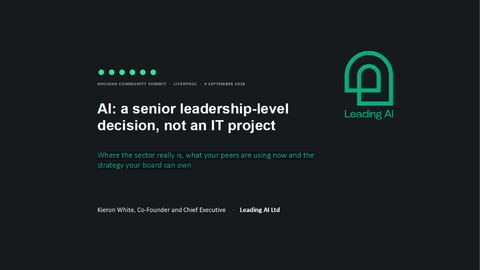
Free webinar – AI in Housing is a senior leadership decision, not an IT project
Events