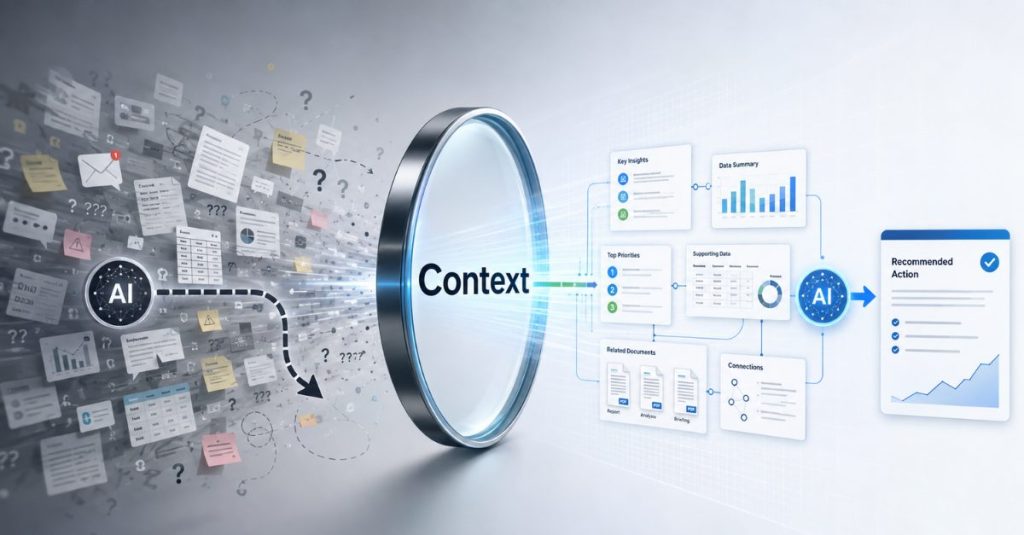
“Context is everything” is one of the most commonly used phrases in our house.
Usually because one of the children has said something absolutely hilarious at the dinner table, but you know it will become considerably less funny if it’s repeated to their teacher the next day. The words would be exactly the same, but the audience wouldn’t be amused. You had to be there.
Sometimes it’s a reminder that teasing only works when everyone knows it’s teasing; otherwise it’s bullying. Sometimes it’s explaining why a sarcastic comment lands differently in a WhatsApp group than it does in a meeting, however carefully you choose your emoji. And sometimes it’s just trying to persuade a teenager that “everyone knows what I meant” isn’t the cast iron defence they think it is.
Context changes meaning.
Humans are remarkably good at filling in the gaps: we know who is speaking, what happened five minutes ago, the relationship between the people involved, whether someone is joking, whether they’re upset, whether they’re quoting somebody else or speaking literally. We barely notice ourselves doing it. AI doesn’t have that luxury.
It’s not really about prompts
One of the biggest misconceptions about generative AI is that it’s all about prompts. It isn’t. It’s about context.
A better prompt is really just a way of providing more or better context. That’s why the same model can produce something insightful one minute and spectacularly unhelpful the next.
Imagine asking a colleague: “Write me a briefing note.” Without more detail, they’re guessing. A sensible colleague would want to know: who is it for, what’s it about, how long should it be, what’s already happened, what decision are they trying to make? If they don’t ask, you get whatever they think “briefing note” usually means. Sometimes that’s fine. Sometimes it’s wildly off. AI is no different.
A simple before-and-after
Take something closer to home: “Write me an improvement plan for my department.”
A general AI model will probably give you a decent structure, a few sensible sounding priorities, and some generic actions that could apply to almost any organisation. What it won’t have is your starting point, your regulatory context or your constraints.
Now try: “Using the attached Ofsted report and last year’s Quality Improvement Plan, and with reference to this data about our students, draft a three-page improvement plan for the FE college leadership team. Focus on teaching, learning and assessment. Keep the language suitable for governors, and highlight where actions build on existing strengths rather than starting from scratch.”
Same model. Same user. Very different output. The second attempt hasn’t made the AI more intelligent; it’s just stopped it from guessing in the dark.
Most AI progress is context
Once you start looking for it, almost every advance in practical AI over the last couple of years has been about adding more context: uploading a document before asking a question, letting a chatbot remember previous parts of the conversation, using a RAG system to search internal policies before answering and giving an assistant some background prime prompts so it knows your role, your team and your systems. Making sure, while you’re at it, that it doesn’t overstep its mark.
One of the clearest examples we’ve seen is in Further Education and training. Leading AI has worked with FE Associates to develop assistants for FE leaders and managers in England: tools for quality improvement planning, access and participation plans, staff knowledge and HR work.
In theory, you could ask any big general AI model to write you an improvement plan. And it will. What you get, though, is just a clever-looking guess. A general model will assume a generic college context, use the right buzzwords, and miss the regulatory nuances. It won’t know your best data, your previous plans, or the real difference between the bits that are working well and the bits that need attention. So it gives you something that looks fine, but still needs heavy rewriting and might not be much practical use.
By contrast, the FE-specific quality improvement assistant starts with sector-specific templates and language, is designed around Ofsted, DfE and FE regulatory expectations, and is connected to the organisation’s own documents and evidence, not just the public internet. The model isn’t necessarily smarter – in fact it’s using the same underlying tech as ChatGPT – it’s just better informed (without you having to pop your data through something less secure) and more focussed. That’s the difference between a generic starting point and a draft you can actually discuss and refine.
Generalists and jackbots
This connects to another problem we’ve written about before: the jackbot of all trades. Big models trying to do everything can be useful generalists, but when you ask them to act like specialists in your organisation, with good knowledge of your policies, processes and unwritten norms, they hit the limits of what they know.
When organisations say “AI doesn’t work for us”, what they often mean is: “We asked a system with almost no knowledge of our organisation and some confused source material to answer questions that depend almost entirely on organisational knowledge.”
That’s a bit like asking a brand new employee to explain your expenses policy on their first morning and then being surprised when they get it wrong. If they guess, that’s a problem. If they admit they don’t know, that might be frustrating. If you give them the policy and a couple of examples, they become much more useful.
Inference, briefly
Under the hood, this is all happening during inference: the stage where a trained model takes your input and generates output. It isn’t retraining itself every time you talk to it; it’s using what it has already learned to predict the next word, and the next, until it has produced an answer.
That matters because vague input forces the model to fill in the gaps with whatever seems statistically likely. If it doesn’t have access to the right information, it will still try to answer. That’s where hallucinations come from. So controlling hallucination is not just about telling models to be accurate: it’s reducing the amount they have to guess.
Context as advantage: What to do next
As foundation models become more similar in capability, context will become the real competitive advantage. Most organisations won’t distinguish themselves by having a marginally better model. They’ll distinguish themselves by how well they’ve connected the right model to their own knowledge, processes and people.
The organisations getting the most value from AI won’t necessarily have the smartest AI according to an abstract metric. They’ll have the best-informed one with the sharpest understanding of its job.
The practical takeaway is simple: spend less time chasing the perfect all-purpose solution and more time improving the context you give the models you already have. In practice, that means having adaptable solutions and tech partners who understand what you’re trying to do, then:
- Choosing a few real use cases where organisational knowledge matters.
- Making the relevant documents and data accessible.
- Designing assistants around your templates, language and workflows.
- Using retrieval and other context-building tools to connect models to what your organisation actually knows.
The next breakthrough model will arrive, as always. It will be faster, cheaper or better at reasoning. But for most organisations, the biggest leap in usefulness won’t come from the next model at all: it will come from giving today’s models enough context to get to know you and stop guessing.

Latest posts


Free webinar – AI in Housing is a senior leadership decision, not an IT project
Events