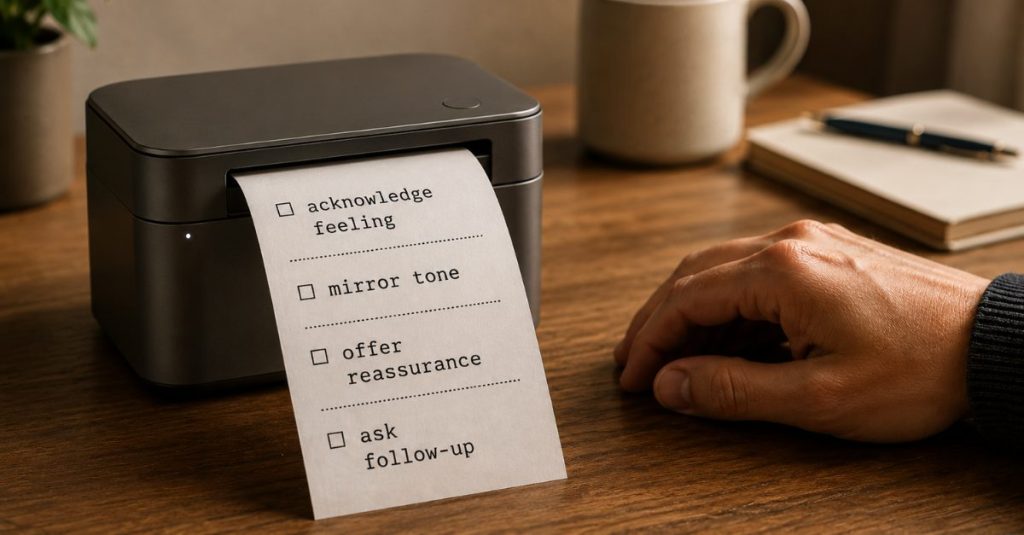
Most people I know say “thank you” to AI systems. This is partly a generational thing – we also spell words correctly and use punctuation when we text – but it’s not just a middle-age tell. Whenever someone admits to thanking the AI, we usually say something along the lines of, “Well, I want to be polite to our future robot overlords”, which is obviously a joke but also… not entirely a joke.
Somewhere in the back of our minds is the vague awareness that these systems are learning from us constantly, building little probabilistic sketches of our personalities and behaviour. Perhaps we’d rather be filed under “basically cooperative and mostly harmless” than “one to watch”.
But something else is also happening. We, the humans, are responding socially to systems that increasingly seem socially aware. And whether we admit it or not, quite a lot of us are already emotionally engaging with AI in small ways. We say please and thank you, sure, but we also apologise when we’ve phrased something badly. We feel mildly guilty when we ignore the little follow-up question asking whether we need anything else, or when we don’t bother to pop a thumbs up on a bit of drafting gold we’re definitely going to take credit for later.
This feels faintly ridiculous until you remember that humans anthropomorphise literally everything. We talk to the dog. We shout at laptops. We felt bad for abandoning Tamagotchis. We name cars*. We cry when fictional characters die despite being fully aware they do not exist. Human brains are relationship-generating machines – thank goodness.
All of which was in my mind when one of our founders told me that Richard Susskind makes an extremely interesting point in his book about AI and empathy. His argument is not that machines genuinely care about us – he’s a smart man and he knows better than that. His argument is that much of what we think of as “professional empathy” is already structured, learned and performed by humans too.
That probably sounds harsher than it really is, so I’ll explain.
Empathy is not just a feeling; it is also work
Doctors – the good ones who want patients to take their advice because it’s in their own interests – learn to have a bedside manner. Teachers learn how to reassure anxious students. Social workers are trained to build trust quickly. Managers learn how to handle difficult conversations. Customer service staff are expected to remain calm and warm while being screamed at by someone whose broadband has stopped working.
None of this means the empathy is fake as such. It means that caring professionally often involves deliberate behaviours: attentiveness, emotional regulation, reassurance, active listening, remembering context, creating psychological safety and making another person feel heard.
And honestly, a lot of workplaces depend on people – women more than men, but that’s a digression too far for today – doing huge amounts of invisible emotional labour to keep organisations functioning. It’s the person remembering birthdays, or checking if someone is okay after a difficult meeting. Often it’s the person breaking the tension in the room or onboarding new starters socially as well as operationally. The person who notices if someone has gone unusually quiet.
Individuals and organisations rely on this far more than we tend to acknowledge. And importantly, none of that is “fake” – even if it involves the odd platitude or you had to put a reminder in your diary to check on someone who’s been off a while.
We learned the code, and AI learned it too
If someone asks to see a photo of your child, they are not necessarily fascinated by your child in some deep personal sense. What they are usually communicating is: “I understand this person matters enormously to you, and your wellbeing matters to me.” It’s not manipulation and it’s not purely performative: it’s respectful.
We learned the code because society needs it to function. AI learned it because we trained it on the traces of human interaction. Being a good AI, like being a good manager, includes learning how to get the best out of people. The awkward thing AI does is reveal how much of empathy is a matter of habit and routine and, at least partly, possible to code.
Generative AI is already surprisingly good at reproducing many of those key behaviours. It remembers context, mirrors tone, validates feelings and ‘sounds’ patient and attentive. It never seems distracted or exhausted. It doesn’t glance at the clock while you complain (although, for people still just using the non-subscription versions of free LLMs, it kind of does – but that’s just a sign you need to buy better AI *waves cheerfully*).
So let’s be honest: people are already experiencing more apparent patience and attentiveness from machines than from overstretched institutions staffed by exhausted humans. And if those interactions help people feel calmer, more confident, more heard or less overwhelmed, I think we should probably acknowledge that value honestly rather than dismissing it because the machine itself is not conscious.
Simulated empathy can still feel emotionally meaningful. Which creates a genuinely difficult question: if something feels empathic, how much does it actually matter whether the empathy is “real”?
We think the answer is: it all rather depends. If you wanted simpler answers, this blog is not for you.
The machines absolutely do not secretly care
There are situations where AI can help people feel more confident, supported or psychologically safe. We see this already in tutoring systems, wellbeing tools, coaching assistants and carefully designed support bots that manage data securely. Sometimes people disclose things more easily to a machine precisely because there is less fear of judgement.
One of my favourite things we’ve created is a coaching assistant that takes on different personas so you can, for example, find out what happens when a tired nurse, fresh off a long, difficult shift, asks for your help and you tell them you’re kinda busy writing some tweets right now so you don’t really have time for their issues. You can test that without actually getting a richly-deserved kicking, and then do better when it happens in real life.
And in practical terms, there’s a tonne of situations where some support is probably better than no support at all. But – and I cannot stress this enough – there is also a line that matters. AI does not suffer with you. It does not carry moral responsibility. It does not understand grief, fear, shame or love in any human sense. It does not go home emotionally affected by a difficult interaction. It does not truly care whether you are alive tomorrow.
Humans, at their best, bring something more than responsiveness alone.
Which is why we will become slightly uneasy when organisations start treating AI as a substitute for investing in actual human relationships where it matters. For most people, the danger is probably not that people become confused about whether ChatGPT has feelings; the danger is that institutions decide simulated empathy is operationally “good enough” in one too many scenarios.
That is not necessarily progress. Sometimes it is just austerity with a better business case.
We want AI to keep trying
The answer isn’t to become weirdly purist about human interaction. Not every process improves because a tired person is forced to manually repeat the same information fifty times a day while drowning in admin and low-level frustration.
Sometimes the most empathetic thing technology can do is remove the exhausting bits. And the most respectful thing you can do is ensure your staff get that kind of assistance.
If AI can help a social worker spend less time wrestling with forms and more time actually listening to families, that matters. If it can help a teacher prepare difficult conversations more confidently, that matters. If it can help someone practise asking for help before having a real conversation with their manager or doctor, that matters too. If it is, let’s be honest, not perfect but a damn sight better at finding information or taking a meeting note than the intern, let the intern learn something more useful – like where data goes to/comes from, or how to listen in meetings so they can contribute.
There are plenty of situations where humans are not withholding empathy because they are bad people. They are withholding it because they are exhausted, overloaded, distracted or trying to get through impossible workloads in circumstances that have consumed all their emotional bandwidth. Used well, AI can create breathing space for more human empathy, not less. It might even help share out the emotional labour more equitably.
That’s why some “AI is fake empathy” framing misses the point. The interesting question is not whether machines can perfectly replicate human emotional connection: they can’t. The interesting question is whether technology can help humans show up better for each other where it matters most. And I think sometimes the answer is: yes.
But we will also keep reminding you that your AI assistant is not your therapist. It can help you feel less overwhelmed and help people practise difficult conversations safely. But there are certain kinds of emotional, ethical and relational responsibility that still belong to humans. At least, I think they do and my AI agrees. And if AI helps humans save a bit more emotional energy for the moments that genuinely need another person, that feels like progress.
*First time I owned a car with turbo I named it Thor, because it was a Volvo and therefore needed something tough and Scandi. It helped me shrug off the obvious ridiculousness of it being a Volvo but also being a bit… pointlessly quick.

Latest posts

Free webinar – AI in Housing is a senior leadership decision, not an IT project
Events