Buzzsprout Description
Buzzsprout Description
Episode 12: Sir David Attenborough, Magic Wands, and prep for the Glasto of AI 🍺
Week 12. The pantomime horse of a podcast is back. Kieron is heading to David Attenborough’s 100th birthday picnic after this. Sort of. It’s at his son’s school, 100 metres from Sir David’s house. There is a non-zero chance of Sir David making an appearance. Neil wants photographic evidence if he does.
Next week: both of them are off to the Glastonbury of AI — the Gartner Data and Analytics Summit in London. The Leading AI team back is bracing itself for what whacky ideas they come back with.
Neil’s uncle — 100 years, a minesweeper and a ZX Spectrum 🎖️ Neil lost his uncle two weeks ago — one month short of his 100th birthday. A man who served on a minesweeper in the Pacific in the Second World War and saw huge technological change in his lifetime. . Neil reflects on the pace of that change: TV took 13 years to reach 50 million users. The internet took four years. ChatGPT reached 100 million users in two months. AI isn‘t slowing down.
Shadow AI — the problem that won’t go away 👤 If your organisation is forcing people to use the “default AI” (yes, you Copilot) and it keeps stopping halfway through a task, don’t be surprised when they quietly spend $20 a month on Claude and get the job done properly. The shadow AI problem is real, and it’s growing because the default can’t do the job. Microsoft has been quietly removing Copilot from places where nobody’s using it. A deleted social media post says it all.
Safeguarding — its important!🔒 Neil flags two major developments this week. Meta has just lost a case in New Mexico over making their tools addictive for young people. And Google and Character.AI settled out of court in January with families suing them over the role AI played in the deaths of young people. Neil recommends a piece by Nate B. Jones (now on his fourth mention — no, still not on commission) on why parents need to talk to their children about AI relationships. It’s not a chatbot. It doesn’t understand you. And if you don’t explain that clearly, the consequences can be devastating.
Product of the week — the Agentic Bid Writer goes live 🎉 Donald created a working prototype this week which Kieron and Neil have both been demoing… but ‘forgot’ to tell Donald. I guess they didn’t want to bother him… 😂 Kieron said: “What if the first time you even saw a new opportunity, you already had an 80% complete bid ready to go?” Which led to…
The billion-pound consortium bid 💷 A consortium of seven organisations has approached Neil about using KnowledgeFlow BidWriter to write a £1 billion bid together. Seven separate KnowldgeFlow assistants, each loaded with their own technical docs, marketing material, insurance certificates, and case studies. Press the button. First draft in ten minutes. For anyone who’s ever spent three weeks chasing consortium partners for content they should have sent on day one, this is the dream.
ROI — if you switched off your AI today, would anyone notice? 📊 Neil poses a question someone put to him this week: if you cancelled all your AI subscriptions tomorrow, would your business notice? The answer for most people is: immediately and painfully. That’s your ROI right there. And it links back to the social workers turning down jobs at councils without AI tools. The gap is real. It’s widening. And the organisations still asking “but what’s the return on investment?” are the ones who’ll find out the hard way.
Kieron may or may not meet David Attenborough at a school picnic this afternoon. Neil wants a photo. We all want a photo.
Two mates. A bar. Thirty years of business between them. And all they want to talk about is AI.
Pull up a stool — we’ll get the beers in. 🍺
TRANSCRIPT:
This week in Leading AI…-20260508_125930UTC-Meeting Recording
Neil Watkins
Shall we? Shall we get started with this pantomime horse of a podcast? And I’m going to say, yeah, I’m going to say it one more time, because last week the transcript said pantyhose podcast, and that’s a very different thing. And we’re definitely not doing that. So just to be absolutely clear,
Kieron White
You get in the front.
But.
Right.
Neil Watkins
pantomime horse of a podcast. That’s what we’re doing. It might be a rambling shambles, but it’s our rambling shambles, Kieron. So here we are for week 12. So
Kieron White
Very good.
Week 12, here we are, we still got things to ramble on about.
Neil Watkins
Yeah, me too. I’ve got quite a few. What’s on your list for this week?
Kieron White
Yeah.
Well, I’ve had a ridiculously busy week of meeting lots of customers and potential customers, so I’m looking forward to sharing some of that and some of the things we’re working on. I want to talk a little bit about the product of the week, which I have touched on before, but I want to bring that back up again because I think we’ve got something that is really quite exciting.
Neil Watkins
Mmh.
Kieron White
And we’re obviously going to the Glastonbury of AI, Gartner Data and Analytics next week. So I’m very excited. That’s 3 days of kind of filling your head full of new exciting ideas and no doubt the whole team back in base going, oh God, what’s it going to come back with?
Neil Watkins
Yeah.
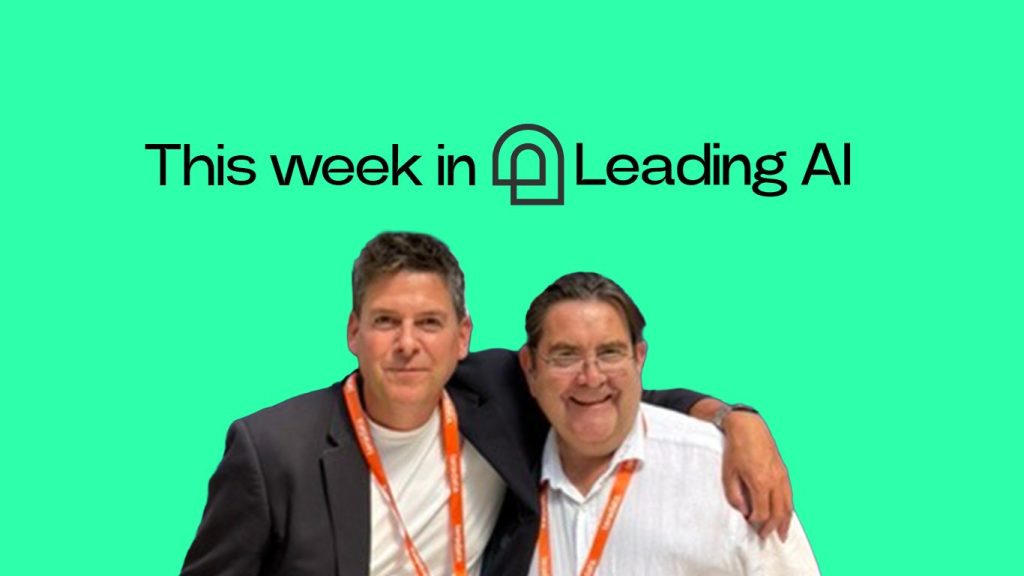
Yeah, embracing themselves. What are they going to do next? And nonsense. It’s bad enough when we go to the pub for an evening and they don’t like that. So, three days at Gartner, they’ll be they’ll be proper cross with us. We need to get our we need to get our picture taken at Gartner, because the picture that’s on the podcast is was actually taken there last year. So,
Kieron White
Indeed, they will be. I look forward to it.
That’s true, yeah.
Neil Watkins
we need to get, we need to get a better picture. So we’ll work on that. We’ll accost some random person like we did last year and get to take a picture of us. Cool. Well, I want to talk about that. I’ve got a few other things I have. Well, I’ve got a little bit about, it’s a sort of a personal story, but sort of about the pace of change.
Kieron White
Haha.
Yes.
Yeah, what’s on your mind?
Neil Watkins
A little bit about customers and a couple of customer type stories. I want to talk about safeguarding because that’s back in the news again. I don’t know if it’s ever going to go away is the honest truth, but a link to that will be cybersecurity and all the stuff around that that’s going on. So let me start with my personal story and I’ll get that out of the way because it’s a little bit emotional, but
Kieron White
Yeah.
Neil Watkins
Uncle died a couple two weeks ago, and it was his funeral on Tuesday. And he was alive one month shy of 100 years. And yeah, and I was thinking about, I mean, he served in the Second World War in a minesweeper in the Pacific. So he
Kieron White
Wow. Amazing.
Neil Watkins
you know, he was a really interesting chap. And I was thinking about all the technology that he’d seen in his time, you know, everything from television starting to the moon landings to mobile computers, mobile phones, and all of that stuff. And the kind of the pace of change. And he was quite, he was quite geeky, really. So he,
Kieron White
Yeah.
Neil Watkins
He, even when he was in his, must have been in his 50s, I guess. He had this BBC computer and a Sinclair ZX, which some, yeah, some really old people like us will remember.
Kieron White
Spectrum now.
You could take the keys out of the ZX Spectrum and use them as an eraser.
Yeah.
Neil Watkins
OK, did you put the?
Kieron White
Which is obviously a great use of a computer.
Neil Watkins
Brilliant. Yeah, yeah. Did you take them out and then put them back in the wrong order at school so that people hit me?
Kieron White
Good idea. That’s why that’s why I’ve always got typos in my typing.
Neil Watkins
Yeah, yeah, that’s probably why I got kicked out of the computing classes for doing dumb stuff like that. But I was thinking about AI and the changes that we’ve seen in the last kind of 12 months and just that whole kind of, apparently TV took 13 years to reach 5
Kieron White
Yeah.
Neil Watkins
sorry, 50 million users. The internet took four years and Facebook took 3.5 years. ChatGPT reached 100 million users in two months. I was blown away by that stat. It’s just like, oh my goodness. And now we’ve gone from an AI that could kind of write a decent e-mail or
Kieron White
Yeah, yeah.
Neil Watkins
response for you all the way through to you can make Agentic AI run parts of your business without a human ever touching it. So that just the pace of change is just absolutely, absolutely tremendous. And that, and that’s a good thing and a bad thing. And keeping people up to, as you know, there are certain people close to me who are AI deniers.
Kieron White
Yeah.
Neil Watkins
And struggling with the whole.
Kieron White
Don’t go back in the doghouse again, Neil. Stay, you’re out of it at the moment. Don’t get yourself straight back in.
Neil Watkins
Okay.
She’s not here, so she’s gone out shopping, so I’ll be fine. She’s going to spend my money on plants because it’s gardening time of year. Anyway, that was my little reflection, was the pace of change is just incredible. It’s not slowing down. And I’m really interested actually to see what kind of things come up at Gartner next week.
Kieron White
Yeah.
Big climate.
Neil Watkins
We’ll no doubt talk about that in a little bit. But one of the sessions that I’m really keen to see is, I don’t know if you’ve seen this on the list, but it’s Maverick AI suggestions, completely random stuff, which will be really interesting to see what they’ve made-up. But that’s all for next week.
Kieron White
Nice.
Yeah, that’d be very good.
Neil Watkins
So yeah, there you go. That was the start of my week. It was nice to see family. It made me think about family, friends, my mortality, all of that stuff. Yeah, it’s really cheerful, but there’s a change. There’s a change.
Kieron White
Oh, good. Yeah, that was good.
Side brain.
Very good. And you were talking earlier about the magic wand AI challenge that we’re still seeing quite a lot of with our customers.
Neil Watkins
Yeah.
Yeah, that whole kind of, I can’t remember, it was you or somebody else said, the magic AI fallacy. It’s like, could it just do this? You know, I want toast, but could it cook me egg and chips? Or could it make me a, or as I put in one of my posts, the ham, egg and chip sandwich that you bought at Glasgow, which
Kieron White
Yeah, exactly.
I did.
Neil Watkins
Which sounded great, but tested pure disappointment, and was really…
Kieron White
It was pretty mediocre. No, indeed, and people are still doing the, well, surely AI can just do that. Surely it can go find the data it needs and sort out the thing to do this. And, you know, that’s AI, isn’t it? And it can in some extent, but not accurately. That’s the challenge. Anything time you’re kind of just searching the internet or searching your entire SharePoint folder in Copilot 365.
Neil Watkins
Yeah.
Yeah.
Yeah.
Kieron White
ways, it’s just very, very difficult to do that in an accurate way, arguably impossible.
Neil Watkins
Yeah.
Like that customer, it’s like, well, we can’t see into this. We’ve created some child folders and it can’t, it can’t see those. Well, of course, you never told it to. It was specifically, it was specifically told to go and do this thing and you’ve done something else and just assumed that it’s just magically, it’s not psychic.
Kieron White
Yeah.
Mhm.
Neil Watkins
It’s not magic, it’s not human, so that whole.
Kieron White
Sorry.
Exactly. It needs the data and it needs to know where the data is. I had, sorry, go on.
Neil Watkins
And not you.
I was just going to say that comes back to the whole piece about, you know, being very careful how you instruct it and making sure that you give it the right information in order to do the job. And if you don’t, then don’t be surprised or disappointed when it doesn’t deliver your egg sandwich.
Kieron White
Yeah. I had a conversation last week, in fact, this was with some housing association, prospective customer, hopefully. Well, they are a prospective customer and hopefully there’ll be a customer. I’m not hoping they’re a prospective customer, they definitely are. As is everybody in housing.
Welcome everyone in housing. Thank you for listening. But they very similar kind of egg on I want, you know, I like my toast with egg. So I was showing them knowledge flow. We talked about policy and a tenant inquiry manager that can handle all of those inquiries Agentic if you want, i.e.
Neil Watkins
Yeah.
Kieron White
without you, you can get me involved if you want. We talked about the repairs assistant and how that can help you with keeping the pricing down and sorting out the admin and hopefully triaging to get the right repairs done. We sort of showed them all these things and then towards the end I showed them the data capabilities and was talking about how you can put in multiple Excel spreadsheets and now you can look across your repairs
and your assets and your tenant IDs and start to kind of see what’s going on in that, you know, together. And then, so he said, well, can I do that on role-based access? Because it’s, you know, it’s important that we don’t just give that to everybody, that they can access any of our data. And I said, well, no, you wouldn’t, we can lock down the whole assistant to only
He’s a no, but we want some people to see some answers and some to see others. And that became the big thing. I was like, well, I’m not sure it’s for us because, you know, it’s important to us. And he’s like, well, don’t do that bit with it then. Or just do the bit where you give it access to people, or there are indeed other work around. But it’s just, it’s sort of annoying. I think though, because he was an IT guy.
Neil Watkins
Yeah.
Kieron White
And I think he was came to that meeting. The whole tone of everything he asked me was, how do I put this into the long grass and pour cold water all over it at the same time?
Neil Watkins
Yeah.
Yeah, we’ve seen that so many times, not just with IT managers, also business managers and senior managers where they don’t really want to do it. It’s like, oh, well, it can’t put something in cell C37 in green writing on a pink background. Well, actually, it can now. So yeah, be careful what you wish for. So
Kieron White
Yeah.
Yeah.
Neil Watkins
Yeah, it won’t be, or if it is that what that guy was asking for, well, yeah, it won’t be long before it can do those kind of things. So, but yeah, we’ve seen that so many times, haven’t we? People just saying, actually, I want it to do this ridiculous thing. But the, it’s a bit like, I’m going to be careful what I say now, but it’s a bit like,
certain politicians who kind of drive down one particular argument and to clear everything else out because they just, they don’t want to answer the question in front of them. And they want to, well, the yes minister and the yes prime minister stuff of, yes, well, I think the question you really should be asking is can it put
Kieron White
Yeah, indeed, yeah.
Neil Watkins
The pink writing in cell 37 B.
Kieron White
Yeah, no, it’s a huge challenge and very frustrating. And then we also got up against, again, the usual, well, co-pilot can do that, which comes from a place of ignorance. I’m more and more convinced. It’s like, well, I’ve seen some magic with co-pilot and did a thing for me and I could see your stuff and I’m therefore saying it’s the same and not engaging at all with actually what
Neil Watkins
Yeah.
Kieron White
What knowledge flow can do that is way beyond what co-pilot could even dream of. Interesting, Matt, our one of our audience audience, I guess that would be one of.
Neil Watkins
Yeah.
Yeah, yeah, that’s right. He’s either an audience or he’s not.
Kieron White
Yeah, indeed, yeah, yeah, a prospective audience. But he was talking about someone challenged him again as usual on co-pilot could do that. And his point was co-pilot is your general tool to do stuff, summarise your emails, whatever you want to do with it. KnowledgeFlow is about workflow automation.
and co-pilot can’t come close. If you talk about, which we might talk about in products of the week, the smart target writer for colleges, is that, I mean, you can’t even begin to imagine doing that with co-pilot, you wouldn’t be able to. And so the kind of things that we can do that are just way beyond the capabilities of it and just a bit annoying when it comes up. And it’s,
I’m a bit jaded after a busy week, so yeah, I’m on the grumpy side of life today.
Neil Watkins
Well, at least there’s only one of us because last week we were both jaded and tired and grumpy because we were both hungover, is the honest truth. So yeah, yeah, yeah. And I’m not this week, so that’s good. But just on the co-pilot thing, I know you complain about LinkedIn because the algorithms don’t serve stuff and I write stuff and you don’t see it, for example. So
Kieron White
Haha.
Right, too.
Yeah.
Neil Watkins
I actually wrote a piece on the, this, I wrote an article on co-pilot is the default answer. And actually, if it’s the default, go to AI for any organisation and it’s not doing the job you want it to do, complaining about it doesn’t help because you’re just seen as a twiner and a moaner and actually a problem in the business.
But if you could do something simple, like take a workflow or a piece of work that you know takes time and run a side-by-side comparison between Copilot and KnowledgeFlow, and let’s just take the Excel example, put these four spreadsheets in,
Kieron White
Mhm.
Neil Watkins
create a database and then be able to natural language query across those four spreadsheets. You can’t do that in Copilot. And, or somebody may be able to, but your average person, you definitely couldn’t. And so being able to create measured examples, so saying this thing takes me half an hour
if using Copilot and I have to spend another 20 minutes rewriting it, whereas this thing takes me 5 minutes in KnowledgeFlow and it’s good to go straight out the door. You know, that’s empirical evidence that you can then take to your company or to your boss or to your IT department and say, yeah, I get why Copilot.
I get it. Copilot, you’ve spent money on it. It’s costing us licenses. We’ve spent that. We need to use it. And it’s good for these things. But this particular workflow, this particular task, this particular job that I have to do is actually, if I do it using this tool, I save a lot more time. So please, can I have this tool for this specific piece of work?
Kieron White
With the solution, as opposed to the main, yeah, nice.
Neil Watkins
Yeah, yeah, yeah, pick a job and just measure the time it takes and the ********* factor of not having good quality outputs. And that’s why people don’t use it, isn’t it? I mean, we see that time and time again, and people actually moving co-pilot licences around organisations to try and get people to actually use it, because
Kieron White
Yeah.
Neil Watkins
They’re just not, and they’re not because they don’t have anything.
Kieron White
I saw Microsoft. Yeah, Microsoft have, there was a deleted tweet, or I think it was, who knows if it was a tweet, a post from somewhere from one of their senior guys saying we are actively removing co-pilot from the places where it’s not being used, because they had it on everything, but they’ve sort of, as you know, they’ve got a lot of flack from people of like co-pilots.
Neil Watkins
Yeah.
Kieron White
popping up. It’s like the old Clippy offering to write you a letter for you. But yeah, so they’re doing that again. They’ve gone back to that, but they’re now removing it currently, but it got deleted that post because it obviously doesn’t look good for Microsoft to be accepting failure.
Neil Watkins
Good.
Clippy.
Yeah.
No, it doesn’t. But he’s right. And I found it really, I mean, I’ve tried using it again this week just to test a couple of things. I thought I’d eat my own dog food and try it. And it just comes up with stuff that’s unhelpful and it just stops halfway through. So real simple example, the transcripts for this podcast.
Kieron White
Oh yeah.
Neil Watkins
they all come with, they come with your name, my name and a time stamp. And that’s, you know, it’s really annoying to read. So just, can you just remove the time stamps from this? And it literally goes halfway through and then it just gives up. It says I’m done. It’s like, well, what about all these other ones? It’s just really frustrating. I tried it twice because I thought I must have done something wrong the first time, but it just didn’t work.
Kieron White
Did you try a KnowledgeFlow afterwards?
Neil Watkins
Yeah.
Yeah, it costed.
Kieron White
I know that I did it all went for me.
Neil Watkins
Yeah, so, well, it took, it took, you know, it’s about 40 minutes and it just goes through and it think, it just says thinking, thinking, thinking, and it, you know, it probably takes a minute to run through or something, but it’s done. It’s just like, yeah, it just makes it easy. So yeah, really that, and I get why people would be,
if you’ve only got Copilot as your AI default and you’re being forced to use it, I could see why you’re an AI denier, because I’d be frustrated with it too. But then, but then people just go to shadow AI donor. They’re just like, they’ll pay $20 a month for a clawed licence because actually it makes them look good and it makes them stand out for the crowd. And 20 bucks is nothing. What’s that?
Kieron White
Yeah.
Neil Watkins
you know, 4 coffees or three coffees, depending on where you buy your coffee, of course. And actually, if it’s going to give me an advantage at work, then crikey, why wouldn’t you? And if it’s going to save you time, but then you’re back into losing your data and client security and personal identifiable information and all of that.
Kieron White
Yeah.
Neil Watkins
safeguarding stuff, which is really, really challenging. So yeah, the shadow AI problem isn’t going to go away for those organisations that don’t allow people to use tools that actually help them do their jobs, I think.
Kieron White
Yeah, indeed.
Interesting. And safeguarding you touched on there. That’s what you wanted to talk about as well, didn’t you? What have you seen on that this week?
Neil Watkins
Yeah.
Hmmm.
Well, my, as you know, my Every Child Matters to safeguarding is deeply ingrained after working with the fabulous Jeanette Pugh, who was so, so hot on that stuff. And yeah, really interesting. But I saw this week that Meta have just lost a case in New Mexico.
Kieron White
Yes.
Neil Watkins
around safeguarding and making their tools addictive for children and young people. And of course, they’re fighting it. But there’s going to be more and more of this stuff. I didn’t realise that Google and a company called Character AI had settled out of court in January for
undisclosed sums, but you can only assume it’s multi-millions for families suing them around things like suicide of young people, where they’d used AI to enable them to take their own lives or just bought them out, whatever words you need to be careful using the language, of course. But
Kieron White
Wow.
Neil Watkins
you know, where AI was involved and implicated and certainly the families feel AI was responsible. So that whole safeguarding piece, you know, it’s not going to go away anytime soon. And I’ll actually put, I’ll put in the in the post a piece that actually I got from
Kieron White
Yeah.
Neil Watkins
I actually asked Nick B. Johns, which out of the net, if I could actually use his stuff verbatim and he kindly agreed on parents, you need to talk to your children about using AI. And you could, you should not be using AI for personal relationships because it’s a bloody machine and it doesn’t understand you. And you might,
Kieron White
Yeah.
Oh, yes.
Neil Watkins
If you don’t really understand it, then you might think it understands you, but it really doesn’t. It’s just responding to the inputs that you put in and progressively ratcheting that up to the point where it can become super problematic. So I would highly recommend any parent
Kieron White
Yeah, exactly.
Neil Watkins
who is listening, if you’ve got any thoughts about safeguarding with relation to AI, then please read the post from Nick because it is really, really good. So yeah, safeguarding, that’s not going to go away anytime soon. Neither is the whole cybersecurity stuff.
I’m kind of moving towards the Glastonbury of AI next week as we prep for the Gartner conference. But I don’t know about you, but I’ve been through the agenda for the three days and I’ve texted about 400 sessions.
Kieron White
Yes.
Yeah, me too, yeah.
Neil Watkins
And there’s a bunch of them on cybersecurity and AI. And it made me think, because actually most of the people who go to Gartner are big organisations or work for big organizations. And actually, as we’ve discussed before, it’s really difficult because if you’re a small organization, you don’t have a lot of
expertise, you don’t have a lot of money or you don’t have whatever, you don’t have time. You know, what should what should smaller organisations do about about this stuff? Because you just take the whole mythos thing, you know, they made it available to 40 organisations, including governments,
you know, the big tech companies and JP Morgan. But actually, if you are Joe Bloggs or Mrs. Miggins in Bolsover High School, you know, what are you going to get? You know, you know, how do you do it? So really interesting and also interesting this week that
Kieron White
Mhm.
Neil Watkins
the National Cyber Security Centre, were on Radio 4, and I always think if it’s on the 10 past 8 Radio 4 slot, then it’s going to be important. And they were talking about using passkeys rather than passwords.
Kieron White
Oh, yes, yeah, I heard that. I heard that yesterday. They were talking about that, weren’t they?
Neil Watkins
And yeah, and they were really pushing, they were really pushing that concept of, you know, passwords no longer being secure enough. And that whole technology, which if you don’t understand it, it’s important to understand because passkey should be used because there’s a public
part to the key and there’s a private part and the private part stays on the device. So even if anybody finds out what the public part is, it doesn’t matter because you can’t connect the two. So really powerful. The other thing which I think will come up at Gartner, but I’ve seen some other stuff about it is, you know, what happens when quantum computing comes and the whole
super speed of cracking mathematical problems will, so there’ll have to be quantum preparations for the quantum cyber, as I think the latest phraseology is called. So the whole load of stuff around that, which I think is going to be both fascinating
Kieron White
Yeah, yeah.
Neil Watkins
and terrifying in equal measure. So I’m looking forward to being terrified next week on that.
Kieron White
Knocked out.
Yeah, it’s going to be interesting. And I think, I mean, I remember from Gartner the last time we went and sort of, you learn things, it’s kind of like you don’t know what you don’t know until you’re going to go into stuff. And it’s, I love Gartner, it’s the very best of all the events that I go to for sure. But it’s still got the problem of you are choosing a session largely based on a title.
Neil Watkins
Yeah.
That.
No.
Yeah.
Kieron White
And they’re obviously trying to do a little bit of encouragement and be descriptive, but you never really know what you’re in. And it’s that kind of like, should I be here or not? The wonderful thing with Gartner, as you know, is that because they run it on an app and live stream everything, you can take your headphones and be sat in one listening to another one and watching the slides.
from that other one. And it’s a really good setup because they don’t do like, it’s not a lot of video. So that’s really expensive and difficult to live stream and have it all video. They literally just have the slides and the talk track so you can follow along perfectly well. So at least it helps you when you’re there. It’s going to be a bit like cruising through TV channels perhaps. So you go like, not that one.
Neil Watkins
Yeah.
Yeah.
Yeah.
Yeah.
Kieron White
Not that one. Lock in on the one T1.
Neil Watkins
Yeah, that’s right. But I think I think it’s a really cool feature. And actually, you know, others should definitely learn from it, because, you know, if you go to a session, it’s at the Excel Centre, and anybody who’s ever been to the Excel Centre in London knows it’s absolutely massive. So if you’re in a and if you’re in a talk that actually isn’t very interesting after the 1st 5 minutes,
Kieron White
Yes.
Neil Watkins
to get to the other talk you want to, it’s like a 15 minute walk. So you’ve missed it. It’s pointless. But actually being able to just switch on and listen is really, is really cool. So yeah.
Kieron White
Yeah, exactly. Yeah. Yeah.
Yeah.
Maybe we should take multiple setups and we could sit in the pub.
Sit outside in the pub and just watch whatever we’ve tuned in on.
Neil Watkins
Now you’re talking. Yeah, we just have a bank of screens and we’ll just be.
Kieron White
Ha ha ha.
Neil Watkins
But.
Kieron White
You can be watching four or five and just tune in on the one that’s interesting. You would probably end up very drunk very quickly though because you’d be just like watching it, drinking and then…
Neil Watkins
I’m super confused, wouldn’t you? So I’d just be like, which one am I listening to?
Kieron White
Yeah, that’s true. Which one am I in? No. I once had a film, like, talk about super confusing that model, it sort of amuse you. I was watching a film with a bunch of people years ago, this was, and I went out to go and get a drink or whatever I was doing, have we or whatever. And when I came back in, I sat back down and they were, we were all still watching the film and I’m watching the film. And then I was like, after about 20 minutes,
I said to one of them, have you changed the film? And they were like, oh yeah, when you were out with Swiss, and I was doing the thing of trying to piece together, how does this plot, I just thought it was a new family was being introduced or whatever. So I’ve kind of created a different film in my head. That’s how innovation works, I always think, is crashing together.
Neil Watkins
Okay.
Ha ha ha!
Haha.
The.
Kieron White
ideas that don’t necessarily belong together and coming up with something else. So, yeah, yeah, I could have written a new film just by assuming it was the same one and creating different plot lines in my head.
Neil Watkins
Excellent. Well, we should crash some Gartner presentations together to create some new intellectual property from them, although they’ll probably there’s some probably some court clause in our contract where we can’t they can’t do that. So, so what sessions have you what other sessions have you got lined up? I’ve got a few.
Kieron White
Sure, there is.
I am sure that there will be.
I’ve got hundreds of them. The thing that I touched on it last week, I’m really interested right now in the testing and explainability part of AI. So observability is what it’s called, that world. And in the RAG pipeline, it’s more than simply cheque the answer against fact, because as we said last time, you can’t really do that. It’s more like an essay. You’ve got to mark it more like an essay.
Neil Watkins
Mm.
Kieron White
but also you have to expose each step of the process so that you can observe it. How, you know, which, what cosines immunology search did it use? What chunks did it bring back from the vector database? And then how did it rank those and prioritise those, etc, etc, all the way through. And that’s how you can kind of really understand
Neil Watkins
Be.
Kieron White
if things aren’t right, particularly where it’s gone wrong. So I’m really interested. I know it’s really geeky. I know it amazes me that when I think about, you know, if it said five years ago, you’re going to be really excited about data analytics. But that I’m really, really interested to hear what’s the latest in that.
Neil Watkins
That’s right.
Kieron White
And then the other areas is natural language querying, which is the thing that, you know, we’re really into now, which is this, as you know, stitching together Excel or whatever, APIing data directly from Salesforce and using natural language to query that. It is fraught with difficulty, that area, largely because we as humans aren’t very good at understanding how to write
without ambiguity, and particularly when that’s turning it into SQL deterministic search, really, or deterministic answers, that’s really problematic to make sure that you’ve asked crisply what you really want to know. Otherwise, you get an answer and it might not be what you really thought you were asking. So
I’m really keen to understand how people are cracking that if they are, because that’s the stuff of a lot of people with databases that are putting AI on top of it and claiming to be an AI company. That’s where they’re all falling down and why the feedback I hear from those is it’s not very good and it will be because of that problem.
Neil Watkins
And.
Yeah.
Yeah.
Kieron White
crack into a bit of it with KnowledgeFlow, but I’m sure there’s lots and lots to learn. So I’m very keen. Those are the two big themes for me this year. But then of course, you don’t know what you don’t know. So I’m looking forward to just being blown away by stuff and no doubt have a couple of sessions I’m snoozing through, wishing I hadn’t gone to.
Neil Watkins
Yeah.
OK.
Kieron White
Yeah.
Neil Watkins
That’s right, yeah. And there’s other ones where you go, crikey, that’s brilliant. And yeah, I’ve got a couple of themes, really, that I’ve picked. Security is 1, one of my themes. The second one is around Agentic. And lots of talk about Agentic. It might feel like old news. It’s so
Kieron White
Yeah.
Mm.
Neil Watkins
very 2025, isn’t it? But there’s the whole piece about automated business. And we’ve touched on this in procurement and procurement being one of the most obvious places where actually humans in the loop can be a real challenge. So I’m interested to see about that because there is a session on that.
Kieron White
Yeah.
Neil Watkins
But also, I come back to my point about the big business versus SMEs. And again, I don’t know what they’ll say about that. But I think, you know, the fact that a small team, if you read the AI wires and listen to stuff, you’ll see there’s lots of sort of three, 5, 10 person teams.
you know, cracking through stuff because they can punch right above their weight because they’re using the tools. And I was thinking about this in terms of some of our, how should we say, more challenging prospective customers and just challenging them with questions like, you know, if you
If you decide not to go ahead with the AI, that’s fine. But if a competitor, your top competitor chooses to and has a six month advantage, what where do you think that will leave you? What do you think the challenges will be? What do you think the problems will be? And I think we should be more what’s described as the challenges. So we should be more in that kind of
Kieron White
Yeah.
Yeah.
Neil Watkins
pushing back on tricky questions. And then you kind of get into the whole, well, actually, if you increase the productivity, if your team uses AI to halve the amount of hours that they need in order to complete the task, do you reward them or do you just
Cut their hours in half. There’s some really ethical, really ethical things that we need to think about. The ethics of AI is one of the subjects for next week. So yeah, interested, interested to see what they, what they, what they talk about on that. And then the final one linked to the whole kind of Agentic
Kieron White
Yeah, indeed.
Yeah.
Neil Watkins
and big business versus small business is this return on investment. You know, there was something again on the on Radio 4 this morning. I don’t just listen to Radio 4 because as you always say, if you just listen to a Radio 4, you’d be very clever but very boring. So I do listen to other things. But there was there was it was an investment. I think it might have been from
Kieron White
Yes.
Indeed.
Haha.
Neil Watkins
one of the big pension providers talking about diversifying their AI investments as companies are moving from investment based funding to debt based funding. And if you’ve got debt based funding to create your new data centres, etc, then that money obviously has to be paid back at some point in time. So therefore, you need to start generating revenues in order to make those debt repayments.
And so there’s some really interesting stuff about return on investment. And I was thinking about it from the kind of companies and organisations that we deal with that aren’t in those kind of mega billions dollar areas. We’re dealing with mainly with SMEs and public sector organisations. And for them,
Kieron White
Okay.
Neil Watkins 37:32
the ROI question is really quite tricky. And, you know, just being able to do things faster isn’t a really good, a good return on investment metric. But somebody posed a question to me, which I thought was fascinating, which is, if you cancelled all your AI subscriptions today,
Would your business notice tomorrow?
And I thought that’s that is a great question, because I know if I switched off mine, I’d be really grumpy, because I…
Kieron White 37:58
Yeah, absolutely.
Yeah, definitely. Imagine if we go back to write every word of a paragraph again and spending like 2 hours over half a page of well-written e-mail.
Neil Watkins 38:08
Yeah.
Yeah, worrying about getting the words or checking the facts and, you know, just that whole, just the bid writer thing. Actually, I’ve got a story about bid writer, I’ll tell you in a sec. But yeah, that whole kind of thing, if you switched it off, would it make any, would anybody notice and actually, Rikey? And I think that’s
Kieron White 38:14
Yeah.
I know.
Neil Watkins 38:29
That’s a really, come back to the shadow AI point that I made earlier. People are using it in organisations and actually they, yeah, they would definitely, if you actually lock them down and ban them from doing it. And we also talked about, didn’t we, the social workers who refused to go and work for the councils where they didn’t have the right AI tools.
Kieron White 38:46
Yeah, exactly.
Neil Watkins 38:49
I’m not joining you if you’re not using that. Really interesting stuff.
Kieron White 38:49
Yeah.
Interesting, exactly. And on the on the how do you use that time, because I’m very conscious that we can show people time savings, estimated time savings, and most of our tools create a huge amount of sort of time saving, but it’s not real. It’s not real time. You’re doing much. You can’t catch that.
really is what I’m getting at. And interestingly, the other social work podcast that I joined and was on a panel for, one of the questions from them was, what happens when the director of children’s services or whatever can decide that you’ve now got capacity to take on another 5 cases? Is that okay? And they’re obviously coming at it from it’s not okay.
Neil Watkins 39:12
Yeah.
Yeah.
Kieron White 39:33
And yeah, I mean, I gave an honest answer to it, as I think I’ve touched on before, which is that it’s not, it’s hard, isn’t it? That’s for your own organisation to work out. It’s kind of AI is making you have potentially have a higher quality time with the cases that you have to look after. But if you can look after another five now, maybe you should or maybe you should not. And you should just spend that time in
Neil Watkins 39:42
Yeah.
Kieron White 39:57
better quality conversations and not just, you know, make it all shallow. So I suppose it’s going to be tricky. I think that will be a tricky one.
Neil Watkins 40:00
Yeah.
Yeah.
Yeah. I know that you want to talk about a different product of the week, but I want to come back to something linked to productivity, which is BRIDGE Writer. And I’ve already mentioned before how much time it served me, but I was approached this week, really interesting conversation.
Could A consortia of…
good to say 7 organisations come together, use KnowledgeFlow in order to write a 1 billion pound bid. And I was like, that’s really interesting. We’ve not done it that way. But if you just set up seven different assistants and possibly an eighth for
things for general documents. But in each assistant, you have the company’s technical documentation, their marketing material, things like their insurance certificates, all of that stuff. And then you
could, using the new, the fabulous new tools that Donald has created just this week, stick all of those into KnowledgeFlow, press the button, and it will do the very first pass within 10 minutes. And it just saves so much time. But we’ve never done it with a consortia before. And I just thought it was a really interesting concept because
Kieron White 41:19
Yeah.
Yeah.
Neil Watkins 41:32
the real challenge, as you know, from our previous lives. Consortium is getting the bloody information out of people, getting them to cheque staff, contacting them. You waste so much time and effort. And actually, if you can give them all a first pass of the pass of the document within within two days of receiving it, then you can
Kieron White 41:39
Absolutely, yeah.
Yeah.
Neil Watkins 41:51
you can not only make sure that it’s polished to within an inch of its life, ready to go and save a lot of time, how many more can you knock out? And actually, for consortia who are working together on a regular basis, or indeed a new consortia is bringing them together and actually creating a really clever way of writing the bids.
which is accurate, up to date and just compelling, I think is really exciting. So we’ve got a first conversation about it next week. So I’m super excited about that. And yeah, I think it could be a new area for us to experiment with.
Kieron White 42:21
Nice.
Yeah, indeed. And you could, in theory, put all those documents in a single RAG index, assuming, because no one would be able to get at the document if you didn’t want people to see, if you didn’t want, if they were a bit competitive, hopefully they’re not too competitive in one consortium, but then you could still lock the RAG out so they can only get the answers.
Neil Watkins 42:33
Thank you.
Yeah.
Kieron White 42:48
It’s not going to be secret because you can ask any question you want and it will give you the answer, but it does stop you kind of stealing the whole deck and putting it in your stuff. So yeah, but really good use case.
Neil Watkins 42:51
Yes.
Well, assuming the consortium, they want to work together, you know, they’re going to be collaborative. You can’t collaborate if you don’t share stuff. So, yeah.
Kieron White 43:01
You’d hope so. No, indeed, yeah, you’d hope so. That’s a really good idea. And yeah, well, let’s talk about the Agentic Bid Writer, which last week we touched on, and now it’s a live product that we, I was demoing it this week, much to Donald Horror, when I told him he was talking about it and I said, oh yeah, I’ve got a demo in 10 minutes of that. He was like, what?
Neil Watkins 43:16
I know I did the same.
Kieron White 43:22
He called me straight afterwards. He said, right, you got this, know about this, know about that. I was like, Donald, don’t worry about it. I’m telling, I’m not going to be lying to them. I’m telling them this is literally hot off the press. And it’s got, we’ve got a load of ironing out of bugs to do. But yeah, it’s really good. And here’s the use case, which the CEO of the organisation I was talking to,
Neil Watkins 43:31
Yeah.
Yeah.
Kieron White 43:42
was like, you just saw his eyes kind of look at the screen and was like, was when I said, your, because they do a load of public sector work, this company, and so it’s forever, everything’s tendered and it’s loads of tenders coming in and you’ve got to decide what to go for and what not to go for and all that stuff. But I was like, were you, the first time you even saw the opportunity, you’d already have a bid that was 80% done.
How about that? That’s basically what we could do with it, is it runs straight through on anything new, shove it into it, let it answer it, give you, it could give you also the summary of whether or not this is for you, but it could have also done all of it. So you can have a quick look and decide immediately with a almost complete written thing in front of you as that is.
Neil Watkins 44:13
Yeah.
Yeah.
Yeah.
Did you show him the, did you show him the scores and the gap analysis? I, I demoed, I demoed online, I showed them the score and I was like, look, they’ve scored this, this scored this one at 2 1/2. And if you go to the gap analysis, it says you haven’t in the provided documentation, you don’t have enough on the financial savings. So you need to include a case of it. And it was just
Kieron White 44:28
AI.
Nice.
Neil Watkins 44:46
Brilliant, absolutely brilliant. So very clever.
Kieron White 44:47
Oh, that is cool. No, I didn’t show him that. That is very cool indeed. Yeah, it’s a future.
Neil Watkins 44:50
No, that’s like you going to that’s like you going to a bloody housing conference and not showing the picture of the mold.
Kieron White 44:55
Our audience won’t want to hear that story again. I think there’s enough stories of my incompetence in the world. No, I think, I mean, and the future of procurement is, to go back to your point about Agentic businesses, it’s the one area that I think is so rife. It is the one thing that is all about reviewing words and
Neil Watkins 45:12
Like.
Kieron White 45:18
at making judgments on stuff and trying to second guess and put your best foot forward and all that stuff. AI is better at it than any human being actually. And having the whole thing running as a kind of end to end. My automated procurement AI decides my spec, sends it to yours, yours answers it and gets it back.
Neil Watkins 45:28
Yeah.
Kieron White 45:41
you know, within 20 minutes of me needing a new thing, I’ve got the best one there is. That’s, I mean, that’d be amazing, wouldn’t it? Who would not want that rather than six months or six week procurement exercise?
Neil Watkins 45:52
I’ll tell you who, I’ll tell you who doesn’t want that.
Kieron White 45:56
Yes, quite a few procurement professionals would not be happy.
Neil Watkins 45:57
They could work in procurement.
That’s right. I can think of a few right now.
Kieron White 46:05
Well, interestingly, the kind of games you would play, so the first thought I’ve had when I’ve sort of really spent a little bit of thought time over a beer, thinking about that is, you know, if you had an Agentic answer and you knew it was being hit by AI saying, you know, other AI tools that were going to evaluate it, then there are a lot of games you could play to
to not necessarily be truthful. So I think there’s still room for people in there to do something along the way. So it’s not entirely, the whole procurement industry hasn’t been entirely wiped out just yet.
Neil Watkins 46:31
Indeed.
Yeah.
Now, it’ll be some time before that happens.
Kieron White 46:41
Indeed, and there was the article I was reading about the job apocalypse that was an FT article, which we touched on last week, was interestingly talking about anywhere where there’s a regulated sector. This was in healthcare and saying it’s all very well that AI can read your X-ray. And I’ve read some other stuff this week about AI picking up
Neil Watkins 46:46
Julia.
Yeah.
Kieron White 47:00
early cancer way better than any anybody can, any human, and indeed picking stuff up that humans didn’t, retrospectively, they’ve shown it, you know, this did turn out to be it. What would you make of that thing? But anyway, the point is you, at the moment in sort of our regulated sectors,
Neil Watkins 47:10
Yeah.
Kieron White 47:20
you need a professional to have signed off stuff, agreed stuff, and then laws the same. So it might be very, very slow to kind of completely take over anywhere where you have a need for a proper person, you know, a registered practitioner or whatever, then I suspect it’s going to be a long time before the regulation.
Neil Watkins 47:35
Yeah.
Kieron White 47:41
Allows AI to do those things.
Neil Watkins 47:43
any regulated industry. So again, the device of things like lawyers, you know, I can see, I can see admin tasks going, but not the kind of, you know, domain knowledge and expertise and all of that stuff. That’s going to take quite a little. Anybody who says there’s going to be no lawyers in 2030 doesn’t really know what they’re talking about.
About in my.
Kieron White 48:02
No, indeed, I think we’ve got a long time, a long time to go before that. Although the, if you follow Richard Susskind’s book on, which we’ve talked about before, how to think about AI, he was talking about law and how you, why do we, why do we assume that a court is a physical location? Why are we, why are we getting everybody to come together in a physical place to have
Neil Watkins 48:05
Yeah.
Yep.
Kieron White 48:24
And I remember talking to a barrister about this and he was, I remember him saying tomorrow morning he has to go to Brighton to go there to be in court, as will the defence and as will the judge and as will everyone else to say we need adjournment for six weeks. And literally all going into court to do that and because it has to be done in that setting.
Neil Watkins 48:41
Yeah, nuts.
Kieron White 48:46
They said the amount of stuff that is just mad and you could do a load of it online, frankly, that need to be and doesn’t even need to be synchronous. Why can’t I prevent present my defence now? And you look at.
Neil Watkins 48:46
Yeah.
Yeah.
You should be, you should be able to do that via e-mail, never mind, bloody teams, nuts.
Kieron White 49:01
Exactly. You can, exactly. You can look at it whenever you like. I’ll do my defence, I’ll do my prosecution bit and then leave someone else to kind of the judge to make the judgment. Don’t need to be physically there.
Neil Watkins 49:11
Well, I’m not sure we should be judging on judges or lawyers because neither of us are very qualified. Let’s just leave it. Let’s just leave it at that.
Kieron White 49:18
No, it is. Fair enough. Fair enough. I’m just here to ask the questions. The joy of being a, that’s my consulting career is brilliant. You always get to ask the questions and you don’t have to answer so many.
Neil Watkins 49:24
Correct.
Yeah.
Yeah.
Kieron White 49:33
We should bring to an end. I’ve got to go to David Attenborough’s 100th birthday picnic. I say, so David, if you’re listening, I look forward to possibly seeing you. I’m not sure he even knows it’s happening, let alone will be there, but it is not. It’s at my son’s school, which is
Neil Watkins 49:33
True.
Ha ha ha!
Yeah.
No.
Kieron White 49:51
probably 100 metres from David Attenborough’s house. So there is a, yeah, there is a possibility he might shuffle in.
Neil Watkins 49:55
Wow.
There’s a small possibility he might he might come round.
Kieron White 50:01
He may, he may, well, apparently has security sitting outside his house when he’s there in a car all the time. I don’t often walk down that road, but when he’s in.
Neil Watkins 50:07
I’m not surprised. No, it’s good job because you’d be, if you’re like stalking, remember you stalking Michael Evis at Glastonbury and you used to wear a Michael Evis t-shirt and you got a picture of him sat next to me, you should get that out, you should send that to me and we’ll post it up so people can see. So yeah, I expect, I expect a picture of you with David Attenborough bye.
Kieron White 50:15
Ah-ah.
That is a great photograph, and I have it on a T-shirt.
Neil Watkins 50:28
Five o’clock with an egg sandwich.
Kieron White 50:33
Fantastic! Well, I should see if I can get one.
Neil Watkins 50:36
Excellent. Well, on that note, fella, you have a great weekend and I will see you at the Glastonbury of AI, bright and breezy on Monday morning. I’m assuming we’re going to do the cheaty thing and go to the second entrance where the queues are much, much slighter.
Kieron White 50:39
And you?
Ian.
Don’t tell our, don’t tell our audience we don’t want to, we don’t want to create a stampede.
Neil Watkins 50:57
Correct, yeah, yeah, we don’t wanna don’t wanna rush, but…
Kieron White 50:58
Me.
No, yeah, no, I will definitely be there and I’ll aim to get there relatively early so I can get checked in and make sure we’re inside ready for the keynote kick-off because that is always the highest value because it gives you a bit of a flavour of all of the spots going to come up. I look forward to it.
Neil Watkins 51:08
Absolutely.
Yeah, yeah.
All right, fellow. I’ll see you in London on Monday morning. Until then, have a good weekend. Cheers. Bye.
Kieron White 51:17
Nice one. Look forward to it. See you. Bye bye.
Neil Watkins stopped transcription