My husband and I have an ongoing debate about what people need to learn about AI. Or, more accurately, we agree that people need to learn stuff and then argue about the stuff they need. Then we steal each other’s slides for various AI workshops, because we’re usually both right, to some degree.
For a while, the obvious answer was just to get people across the threshold and into the habit of prompting, but people are increasingly picking up those skills in much the same way they learned to use Google or WhatsApp: trial and error, copying what works or asking the nearest teenager. That is as it should be. We never expected most people to understand how Microsoft Word worked, per se. We expected them to use it.
After decades of uneven progress, we had reached a reasonably settled idea of what being able to use computers means. Most people entering the workplace can create a document, send an attachment, use a basic spreadsheet and save things somewhere they might find them again. Competence with mainstream software is a given.
Then generative AI arrived and removed more of the visible mechanics. You no longer need to know where the right function is, or which sequence of steps will produce the result. You can just describe what you want. It looks and feels like the final triumph of computer literacy: software anyone can use.
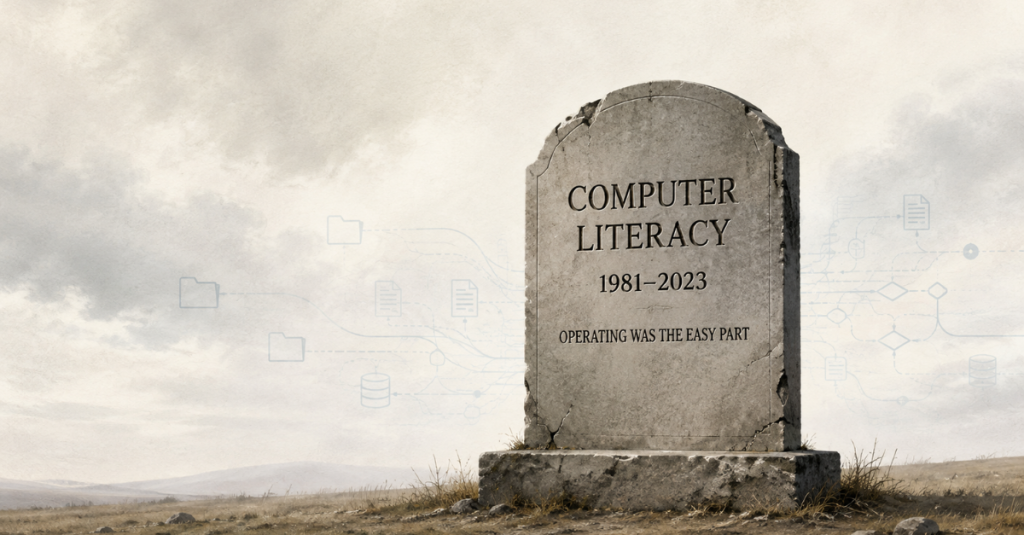
But I think it may actually be its death.
The empty box problem
Most AI tools begin with the same friendly, empty box. Type something. Ask anything. There are no complicated menus to navigate and barely any buttons to press.
The simplicity is deceptive. Nobody mistook Excel for Photoshop, but it is easy to treat ChatGPT, Copilot, Claude, an AI search engine and a specialist organisational tool as interchangeable versions of the same magic box. Which they aren’t. They draw on different information, store what you enter in different ways and places, have access to different systems and are good at quite different things. Even “Copilot” can mean a workplace assistant or a specialist coding tool, depending on which Copilot you have. The name — and increasingly the interface — tells us almost nothing about the tool behind it.
Don’t panic. This does not mean everyone needs to understand neural networks, model weights, tokenisation or what is happening in the back end. Most of us didn’t understand the code behind Word, but civilisation lumbered on more or less intact.
Here’s where my husband and I agree: we do all need to understand a bit about systems and functions we could previously afford to ignore. What information am I putting in? Where will it go? What is the answer based on? What is this tool designed to do well? What record will remain? Who is responsible for what happens next?
You don’t need to understand how every engine works; engineers exist for a reason. But you do need to know whether you are driving a car, buying a bus ticket or putting your confidential documents into a vending machine at the railway station.
The filing cabinet has become invisible, and you’re not sure if you locked it
We were never universally brilliant at filing. Shared drives across the land contain documents called FINAL, FINAL v2.1 and FINAL FINAL USE THIS ONE. But most of us did acquire some good basic habits around information management. We understood that some information needed protecting, and that people documenting spending decisions or recording what happened to a patient needed to be much better at keeping records than the rest of us.
The structure of the software helped: there was a document, a folder, a database or a case-management system. You could usually see where information had come from and where it was going.
AI makes it much easier to move and transform information without seeing much of that structure at all. A document can be pasted into a generic-looking box, summarised into something plausible, combined with information of uncertain origin and copied into a new system. By the end, nobody may be entirely sure which system now holds what, where particular claims came from or whether the reasoning behind an important decision has been preserved.
The filing cabinet didn’t just become digital; it became invisible — even more invisible than when we moved it to ‘the cloud’, which is really just a remote location where land is cheaper.
From computer literacy to systems literacy
If I were taking my education curriculum wishlist to a government today, I would be arguing that technological or systems literacy needs to become a core part of the curriculum. But I would also be arguing that our existing IT or computer science curriculum is completely wrong, and probably needs a new name. We can’t just expand what we have, apply it to everyone and call the job done.
Coding is a nice specialist skill, but most people will no more need to code an AI model than they needed to programme Microsoft Word. Prompting matters, but it is rapidly becoming an ordinary part of using the tools. Online safety matters, but this is bigger than staying safe online. And a little module explaining bias, transparency and responsible AI will not necessarily help someone recognise the point at which an apparently helpful tool begins to shape a professional decision.
What we need is closer to systems literacy: an understanding of how tools, data, human judgement and accountability interact to produce an outcome. That means knowing enough to ask the right questions. What is this system for? What information does it use? Where did this answer come from? What might be missing?
We’re reasonable people: we know the curriculum cannot move at AI speed
Your national curriculum cannot evolve in real time, and that’s okay. Curriculum change needs evidence, subject expertise, teacher development and assessment. In England, for example, by the time we add a GCSE module on the current generation of AI tools, the tools will be two generations old. The reasonable ask is that we move the learning up a level: away from particular products and interfaces and towards habits that remain useful when the products change.
Some of that could sit within the good old computer science GCSE. Much of it belongs across the curriculum. In history, it means interrogating claims and sources. In English, authorship and interpretation. In maths, it’s about models, probability and what data can and cannot establish. In citizenship, it’s power, accountability and automated decisions.
A small group of readers might be thinking: this feels a bit like the scope of Theory of Knowledge, which is already a core subject if you do an International Baccalaureate. Why don’t we just do something like that? That’s an excellent question.
Parents cannot keep ahead of every AI tool either. Pretending we can will mainly encourage children to stop telling us what they use because explaining things to us is so annoying. But we can ask better questions. What information did you give it? What is the answer based on? How did you check it? Those questions will outlive whichever app is currently causing panic in the class WhatsApp group.
What employers do while we wait
So, we can’t wait for the national curriculum to catch up and a perfectly prepared generation to enter the workplace. Nor is the answer to put every employee through the same introduction to AI, with a list of ethical principles and a prompt-writing formula. Most professionals don’t need tech experts to teach them ethics. They need help applying what they already know when tech changes the conditions in which they exercise their judgement.
Leaders can start with the work rather than the technology. What are people responsible for? What does good look like? Where could AI help? What are the risks? What must remain visible?
We can also explain why an approved assistant, a public chatbot and a specialist tool are not interchangeable. We can use real scenarios, provide safe systems and some sensible defaults. For years, computer literacy meant knowing how to make The Machine do what you wanted. The next form of literacy is knowing what the machine is doing with your information, your judgement and the work itself. Operating the technology is getting easier; understanding the consequences is getting harder.
The death of computer literacy is not the death of the need to understand technology – I was being a bit dramatic. But it is the point at which knowing how to operate the software becomes the least interesting thing about using it. For most of us, this is excellent news: AI has made tech much, much more interesting.