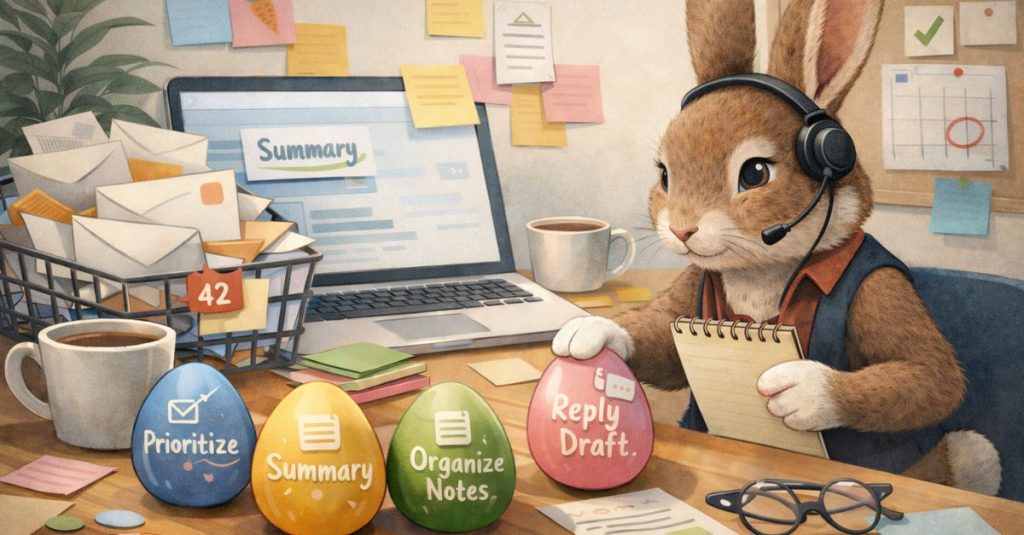
If you’re reading this after a bit of an Easter break, there’s a good chance you’re doing at least one of these three things: eating chocolate, basking in the rare treat of a few days away from your inbox, and/or quietly wondering what state that inbox will be in when normal life resumes.
We all like a break from work – and our brains need those breaks from work – but they do tend to cast a bit of a psychological shadow: somewhere out there, messages are accumulating in the inbox of doom.
In our most tenuous analogy to date, we want you to imagine your AI assistants as Easter bunnies and ask yourself: WWTEBD?
What would the Easter bunny do?
Santa versus the Easter bunny
I’m not suggesting a Street Fighter-style face-off – no one wants to see that happen to a cute little bunny rabbit – but I have been thinking about two seasonal productivity models: the Santa Fallacy and the Easter Bunny Strategy.
Regular readers will know we enjoy exploring how a well-tested model can apply to AI adoption – Gartner’s Hype Cycle, the Productivity Paradox, the Diffusion of Innovations – but we think it’s time to establish some new ones.
The Santa fallacy
The Santa Fallacy is a simple idea: the story we tell children only works if you believe that one magical figure appears overnight and delivers everything to everyone, everywhere, more or less all at once.
It’s easy to say and makes a good story, but it’s also wildly unrealistic and more than a bit creepy. The first time I read The Night Before Christmas to my kids, the youngest had nightmares for days about hearing footsteps on the roof and a man creeping around the house.
And if this is the first you’re hearing that there may be a flaw in the narrative, I apologise.
But if we’re honest, quite a lot of AI strategy conversations – and even more AI procurement exercises – are still a bit Santa-esque.
Somewhere out there is the perfect AI solution. When it arrives, already magically installed exactly where I need it, it will transform productivity across the entire organisation in one go. Workflows will change, efficiency will soar, and everyone will suddenly be enjoying a brave new world by Monday morning.
I’m sorry to tell you that real life – and real AI adoption – are somewhat less dramatic.
The Easter bunny strategy
Incredibly, in a massive seasonal coincidence, a good AI strategy is kind of like the Easter bunny.
Instead of putting our faith in one day of magical deployment, we already understand that the bunny quietly hops around leaving lots of small chocolate eggs in different places. It happens over days or even weeks. You don’t find them all at once. You find one here, another there, and then suddenly you realise you have a full basket that will keep you happy for a very long time.
Different people use different hunting skills to find different eggs too. My friend Jess has a particular talent for hedge-diving, while Dan is really good at getting the high ones down from tree branches. The kids mine-sweep the lawn pretty successfully.
An Easter bunny trail is a cracking way to spend a long weekend – but it’s also much closer to how people actually start getting value from AI, one piece of joy at a time: a quicker summary of a document, a draft reply to an awkward email, a better way to organise messy notes… a few minutes saved here, a few more there.
The Easter bunny, as AI productivity models go, is hugely underrated and rarely talked about* – but we think it’s the perfect foil to the Santa Fallacy: a little win here, another one there.
Before you know it, you’ve made quite a lot of progress while a lot of organisations were still waiting for the “giant chocolate egg” version of AI — the magical system that completely transforms productivity in one go. They’ll still be chewing on theirs long after it’s passed its use-by date, hoping they can save up for a new one next year.
Your after-the-break reality
This idea works for you at an individual level as well as for your organisation.
When people return after a few days away, we tend to do the same thing: open email, scroll, start reacting, scroll to the next email in the post-holiday inbox of doom.
AI is particularly good at helping with this moment by doing the first pass on the noise. Ask it to summarise the themes across a group of emails, identify anything that probably needs a decision from you, and draft quick replies to routine messages.
You might even manage to get back on top of things faster than new emails start coming in.
None of this is revolutionary. But if you save a couple of minutes on each small task, those minutes start adding up quickly.
And that’s another little Easter egg discovered.
Turn the backlog into a plan
The second problem after a break is the feeling of being slightly overwhelmed or just plain forgetful. What was I worried about before I ate all that chocolate? Everything looks like it might be urgent. Maybe. Who can tell?
Ask your AI assistant to help organise the chaos. Paste in your notes or the key items from your inbox and ask: “Help me organise these into a simple plan for the next two days.”
You’ll often get something surprisingly sensible, even if you have to use Copilot: a rough prioritisation, a logical sequence, or a reminder that some things can probably wait.
Again, it’s not magic. It’s just removing some of the cognitive load from the moment when you’re trying to reorient yourself.
Another egg.
Or just delete everything and assume that if it was really important they’ll probably come back to you again. But that’s more of a “back from a year-long sabbatical” kind of solution tbh.
The real lesson
The real lesson from all of this is that AI value rarely arrives in one dramatic moment. It arrives quietly, through dozens of small improvements to how your work gets done. Individually, each one is minor. Together, they start to make a noticeable difference to how quickly you get through the day.
Which is why the Easter bunny fans may have been onto something all along: lots of small eggs, delivered consistently and across a wide area.
Before you know it, like that second bag of mini eggs, you’ve devoured them all.
*Probably because we just made it up, but you have to admit it’s a more adorable concept than that red-faced man in hobnail boots, tethering those poor reindeer to his sled for 24 hours straight.

Latest posts

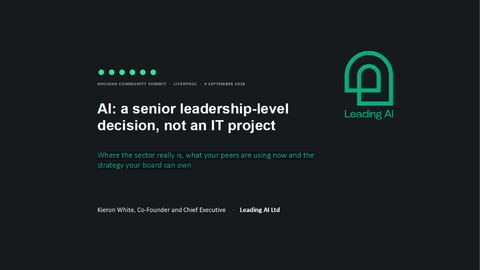
Free webinar – AI in Housing is a senior leadership decision, not an IT project
Events