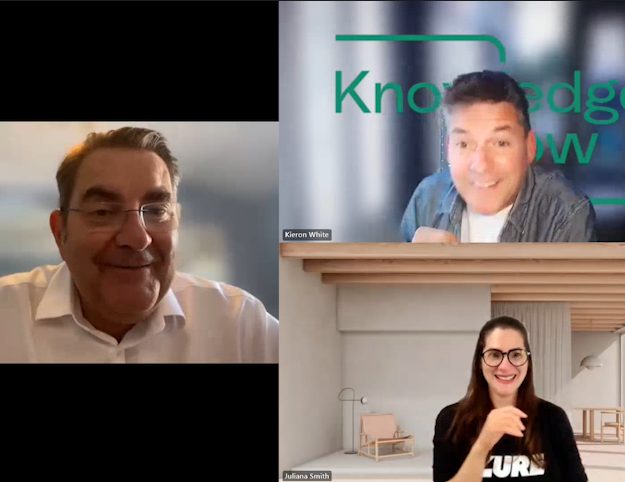
Six legs on the pantomime horse, and this time we didn’t have to explain what a pantomime is because Juliana Smith who is from Brazil, now lives in Manchester and has a seven-year-old in a Manchester primary school, so she’s already sat through Aladdin.
Juliana’s route here is unlike anyone we’ve had on. She’s from Salvador on the northeast coast of Brazil, studied oceanography and physics, and started out validating ocean circulation forecasts for a South Atlantic research project run with the Brazilian Navy and Petrobras.
Then years offshore as a navigator in oil and gas, including getting halfway through a crane operator certification because offshore you can’t helicopter someone in to do it for you so someone had to drive the crane, and that someone was Juliane. An injury ended the navigating, and she arrived in Manchester with one obvious problem: I’m an oceanographer. There is no ocean here.
Then AI arrived and she shut down completely.
This is the bit that will resonate with anyone managing a resistant colleague. Juliana had done machine learning. She’d been building and validating models for years. And when the hype hit, her reaction was, why is everyone talking as if we’ve just invented the wheel? She stopped reading about it entirely. What brought her back wasn’t a demo or a business case, it was the ethics. Transparency, principles, responsible design. That’s what made her curious again.
The question nobody asks about vibe coding.
Juliana now builds tools with Lovable and Claude Code. But her point is one we hadn’t heard put this clearly: you can vibe code anything — and you cannot see the back end. Export the code and you still won’t understand it. So how do you know it’s ethical? Her answer is properly practical. She asked the model which functions might unintentionally capture user data, got a list, and wrote a prompt to strip them out. No tracking, no ads. And she states publicly on her site that the tool was built with AI, and that no AI runs inside it — because she assumes her user doesn’t know what that means unless she tells them.
Why accessibility is personal.
The injury left her with nerve damage in both hands and reduced dexterity. Back at work she was handed a standard mouse she physically couldn’t use. She talks about the day she got new glasses after a year of blurry vision and could see people’s faces again, and makes the point that you can explain that shift to someone for an entire day and they’ll sympathise but never quite get it. Which is why she gives her accessibility work away free: charging for the features people depend on penalises the people who need them most.
Also, the red-amber-green problem and why you can’t find three colours that survive greyscale. Being told “you’re not very technical, are you — you just do design,” and building open-source tools partly to answer that. The mortality-rate spikes she assumed were data errors until she matched them to a Haitian earthquake. Fortran 77, MATLAB, VBA and why transferable skills still matter more than any one language. Her charity work as a trustee of Technology Books for Children. And Kieron’s four hours in Salvador, courtesy of a 747 that diverted with a medical emergency and then couldn’t find a fuel nozzle that fitted.
Her line on the whole thing: we should spend less time trying to do bad things with AI, and more time doing something that actually helps humanity.
Two mates and a new friend on the third stool. A bar. And all they want to talk about is AI.
Pull up a stool — we’ll get the beers in. 🍺
TRANSCRIPT
This week in Leading AI…#26 – 25 Aug 2026 – Juliana Smith
Right, let’s get this, let’s get this pantomime horse of a podcast underway. And anybody who’s watching will see that once again, we have 6 legs to our fabulous podcast, to our fabulous pantomime horse of a podcast. But Julia, we were introduced to you by our good friend Nicole Alos.
and a little shout out to her. But one of the things Kieron said to me was that both Nicole and Sue, who we also spoke to, they didn’t know what a pantomime was, but they’re based in the US. Now you, by your accent, are not English or British, but you live in Manchester.
Juliana Smith
I do.
No.
But I still, but I have a child, yeah, so at school they they have pantomime, so we had one now, it was Aladdin, but…
Neil Watkins
Brilliant. Brilliant.
Kieron White
Ohh, nice.
Juliana Smith
I know, because in Brazil, we don’t have that. I don’t even know. I wouldn’t even know how to translate it.
Kieron White
I think it’s uniquely British. I think pantomimes are literally only us. Well, they’re probably a bit of Australia and New Zealand, I imagine, the sort of old British colonies. But yeah, I think we are the only people stuck with it. And they are huge money-making machine every year. It’s crazy how much money comes over the counter. I’d love to know.
Neil Watkins
Excellent.
Juliana Smith
And.
Neil Watkins
Oh no it’s not.
Kieron White
Look it up. Hey, ohh, yes it is.
Neil Watkins
Oh, no, it’s not. It’s behind you. Anyway, enough of that stuff. Let’s talk about you, Julia. We’re here to talk about you. I’ve already mentioned you’re not from the UK. So please, would you be so kind as to share with our audience where you’re from and a little bit of your background and your journey to this point in AI land. So over to you.
Juliana Smith
Yeah. So I’m from Brazil, from the northeast coast in a city by the sea called Salvador. And my background actually is oceanography. So I went to university and I majored in physics. So I started my career in data science. And so I spent a few years at uni working with research projects.
use Matt Lab. And then when I graduated, I was invited to join a research project. It was like a few different universities in Brazil. And we have Navy and the oil gas company called Petrobras. And we’re creating, so this project was to create a ocean circulation model for the south.
athletic. And my, what I had to do, I had to validate the forecast output. So they were modelling, you have people doing all the machine learning. And I was, okay, let me see if this makes sense or not. So I started working back
Neil Watkins
Okay.
Juliana Smith
not creating the models, but validating. And AI for me, it was not AI. We knew about machine learning. After that, I moved to oil and gas industry. For many years, I was a navigator. And we also have a model. So we have certain…
position notes in the ocean and it would model where it was to create like a map what we’re doing offshore. And that has been, you know, part, it wasn’t nothing like extraordinary. It was just, you know, part of the job. And then I had, unfortunately, I had an injury.
And then I had a career break of two years. But because of this injury, I couldn’t go back to be a navigator anymore. I wouldn’t pass my medical. So I got into corporate. So I started working initially. It was a journey because I wasn’t sure. I wasn’t at that time. That’s when I moved to Manchester.
And I was just like, oh, wow, I’m an oceanographer. There is no ocean here. I left off. I spent all these years as a navigator. And then I considered becoming a train conductor or a trunk, like trying to do something like that. I considered becoming a crane operator because I could operate a crane. I was like,
I was pretty much halfway for the crane operation certification.
Neil Watkins
As you are, yeah, just as you do. I just happened to just do a bit of spare training in my spare time.
Juliana Smith
It was just one, so just one more thing of my past daily job, because it was like, oh, we need someone to do it. We couldn’t just helicopter someone down. We have to do it ourselves. So I always been like, that kind of mentality came with me to my current jobs or what I do currently. It’s just like, don’t wait.
Don’t, you know, go and get it. And when I started, and then I ended up working with Power BI and reporting data because my background was initially in data. And then all these AI craziness came about and I was extremely overwhelmed. I was like, why are people talking about something as if?
Neil Watkins
Excellent.
Juliana Smith
We just invented the wheel. We just learned how to make it clear. Because for me, it wasn’t anything new in terms of what it is. Of course, there are different types, you know, generative AI, or, you know, what I worked was mainly machine learning. But even though I felt really overwhelmed, so I shut down.
I shut down in a way that I didn’t want to know about it. I don’t care. I just didn’t read anything about it. And I had a mentor, he told me, you know that you’re going to have to, because that’s what the workplace nowadays, you’re going to have to. And then I took my time. So I did a bit of learning.
Neil Watkins
Yeah.
Juliana Smith
on the ethical side, you know, the, you know, transparency, all the principles to ensure that we have ethical build AI. And that’s what actually made me feel more interested about AI. And then I’m not, I’m not an AI engineer. I don’t code anymore. Right.
I don’t, you know, back then I used to do MATLAB. I don’t do Python. I felt like I don’t want to go back doing that. It’s not what I want. But I learned about Vibe coding, right? And then I was like, oh, wow, hang on a minute. Vibe code seems to be something very, very interesting. And that’s something that I can look into.
and perhaps stop my, you know, aversion to AI. And that was a really interesting process because in theory, you can vibe code anything. But then if you look from an ethical perspective, you have to think a lot about what you’re doing because we don’t see the back end.
Even if I export the code, right, I’m gonna look at the code and I’m not gonna have a clue what it is. So I start looking to, okay, what kind of functions or, you know, what can, for example, pull out.
Neil Watkins
Mm.
Juliana Smith
client data when I’m actually not intended to. So start thinking about that and I built a few solutions using Lovable and one of them was a Power BI accessibility cheque. I think I’m going all over the place.
Kieron White
Ha!
Neil Watkins
Right.
Kieron White
It’s good.
Juliana Smith
So I currently work developing analytical solutions, including Power BI. So I’m a data engineer at UK and I’m a speaker. So I speak a lot about accessibility, digital accessibility within Power BI and data visualisations.
Kieron White
And.
Juliana Smith
And then, you know, a lot of people ask, oh, well, how can I cheque? How can I, you know, see what I’m doing is right? Because people may not understand or don’t have time to learn the accessibility framework. And then I found that was a big opportunity for Vibe coding.
because I had spent like two years or more learning WCAG and then translate what is actually applicable to Power BI because Power BI, it’s not like I’m developing a website or a software. And I wrote down, I wrote down all the texts that I wanted, all the texts that I thought this
is the bare minimum we can do, considering the constraints of the application itself. And then I asked Copilot, I put in Copilot.
Based on the format I explained, the constraint, I cannot see client data. You know, I just want to see the metadata. Is it possible?
To create these accessibility checker using Lovable, and Copilot told me, yes, it is right. So, I start by coding, I start explaining, and then I will get back to Copilot, who will help me that specific application. I use Copilot a lot to help me understand what I’m doing. I had a few, you know, at beginning.
I was quite clumsy, prompting. You don’t understand, you know, ideally you should break into smaller prompts and be careful with the memory of what you’re doing. So I learned a lot in that process. And
Kieron White
Interesting. Can I ask you a couple of questions about it? Because I know that the whole sort of vibe coding part, our CTO, we obviously use a bunch of those, a bunch of the tools to shortcut massively any kind of coding task. But I love your point you made is if you don’t have any kind of
the knowledge of the underlying architecture, because you’ve just vibe coded some app, and how can you ever know if it’s ethical and meets any other standards? In Leading AI, we have the ISO 42001 standard, which is the AI standard, and it’s for ethical AI. And so on our tools, each of our tools has an AI impact assessment.
Juliana Smith
Yeah.
Kieron White
So a document that describes kind of what its risks are, what we’re doing about those, where the data is, how we protect that, and all of those things. But I think, yeah, I had never really thought about the fact that, yeah, if you’re just vibe coding something, it’s just like, whatever, no idea. I don’t know how it works.
Juliana Smith
It.
Neil Watkins
Yeah.
Juliana Smith
Yeah.
And you can actually export, I can ask a lovable, can you export all my code? I do, but I don’t understand that.
Kieron White
Yeah.
No, exactly. If you don’t know that, and our CTO talks about the fact that in his world, there’s so much, you end up with what they, I think they call it technical debt, because you’ve coded all this stuff. And when you’re then going, actually, I want it to be blue, so that gets added, and you end up with like kind of so much code that half of it is not really doing anything anymore, because you’ve added bits and overwritten bit. But unless you
Juliana Smith
Yeah.
Kieron White
have any idea, which I don’t. You’re looking at this stuff going, I don’t know.
Juliana Smith
Not at.
But I think there is a bare minimum that we can do. I think I start looking into it, right? I also ask a pilot and at the time I start using cloud. Are there any kind of commands, functions that is used that may accidentally grab, you know, unintentionally, unintending, grab the user’s data?
Kieron White
Yeah.
Juliana Smith
what is the limitations that I have? And then actually listed quite a few different things that I had to be worried about. And then I actually created a prompt and there were quite of these, these functions were removed. So
Kieron White
Nice.
Yes.
Yeah.
Juliana Smith
Analytics, for example, what can I do in a way? I don’t want to have all this tracking. I don’t want any ads. So there are very, you know, it has to be very conscious what at least what are the risks. And then even if you don’t know the language, you don’t know code, you ask compile flow.
Kieron White
Yeah, yeah.
Juliana Smith
What are the risks? And you have to be transparent. These application was developed using VIEW coding, right? And, you know, I put, I don’t have my website, these on accessibility. It doesn’t use, it was AI was used to
built, but nothing inside uses AI. Everything, no, it was, I forgot the technology, everything is predefined. So I, but initially I considered having AI and I actually put a prompt in for me, you’re now using AI every single day. So
Kieron White
Yeah.
Juliana Smith
even that kind of warning, I would assume that my user doesn’t know what it means. I want to make sure that that person will understand the risks of using the application. So yes, there is a lot. I learned a lot from that regard. And then there was the ship builds.
Kieron White
Yeah.
Juliana Smith
there was this programme Haton from Lovable. And so we made an idea, which was something that I created as a newsletter a few years ago on STEM, on interviewing women in STEM, you know, from different parts of the world. But I wanted, the reason that I created the newsletter was because
Kieron White
Oh.
Juliana Smith
I volunteer at schools here in Manchester. And one of the, I went to a primary school, very small, in a low income area, very needy school. And they told me, oh, we don’t have access. We don’t know what’s a role models. We don’t know, because I said, how come? Because there is so much happening. You go on LinkedIn, all these different groups, how come you don’t, you never heard about it?
So I always wanted to be able to create something and initially I thought I’m going to have a book, but I didn’t have the resource to create the book and print the book because I didn’t want to sell. I wanted to distribute for free. And I was like, why I just don’t create a digital platform? And
Kieron White
Bye.
Juliana Smith
I got into the builds and it was a completely different approach that I had to Vibe coding because based on what I learned doing the other application, I structured my prompt in a different way. I used Claude and Claude code at that time and I could see how more efficient it is using the tokens.
how it doesn’t seem to forget what I want because I wanted, for example, I want it to be accessible, double card compliance, level AA. It is for children, intended for children to use, all they got safeguarding around that. So it was a very interesting
process to go through those 48 hours vibe closing.
And I think it’s really, really nice to have these initiatives because I mean, I already had vibe coded, but there are the women that they hadn’t. And that opens up so much for your curiosity. Oh, you know, you feel that you are more aligned with what everybody else is doing. And then I decided to put him on, I have a…
A blog, and I was like, “Oh, this is an AI project. This is, you know, you go through a product development from understanding the gap in the market to all the stages I had people testing, and I think it is really good. I felt more empowered, I felt more confident.
Kieron White
Yeah.
Juliana Smith
on what I develop and saying that yes, AI, I make some use of AI. I don’t think I’m perfect. I think there’s a lot for me to learn. And I don’t want to use it for everything because I had some concerns around the use of AI still. But I think, you know, if you are planning to use Vibe coding or AI,
Kieron White
Well, yeah.
Neil Watkins
Mute.
Juliana Smith
think about the risks and the gap knowledge that you have, how are you going to all that everything’s done in a way that is ethical and your users will understand the risks.
Kieron White
Yeah.
Neil Watkins
Can I pick up on a couple of things that you’ve just said, Julie? The technology books for children piece that is on your LinkedIn profile, I’m really interested in that. And you’ve touched on it just a little bit, but please tell me more, because I think it’s one of those things, you know, I’ve got grandkids who are six and three, and they, you know, this is their world.
Juliana Smith
Yeah.
Neil Watkins
and helping to teach them about technology in general, because obviously they’re exposed to screen time. You’ll see there’s loads of stuff in the media and news about kids spending too much time on screens and blah, blah, blah. So yeah, talk to us a little bit more about your technology books for children.
Juliana Smith
Yeah.
Yeah.
Neil Watkins
Star.
Juliana Smith
So, I’m A trustee, so Technology Books for Children is a charity here in the UK. It was founded by Beverly Clark. And the idea is to have more resources. So if you go to the website, they recommend the age group, areas of interest. And it was, it is self-funded. They don’t have any major sponsor.
Neil Watkins
OK.
Juliana Smith
And at the time, they were creating, writing a book for, it was the tech career coach for teenagers. And I was one of the collaborators for that book. So when the book launched in London, it was really nice. I’m always an advocate because I’m A STEM ambassador. Before that, I’ve been a STEM ambassador for many years.
Neil Watkins
No, excellent.
Mm.
Juliana Smith
And I was invited because I introduced them to, because I’m speaking events and I knew a few companies that sponsor events. So I got them a good partnership and because I’m always an advocate and they invited me to become a trustee.
And I was really proud and honoured to be able to support that charity because it’s something that I truly believe. I also have a son. He’s 7. He loves his tablets. He loves, you know, playing with things that sometimes I’m not worried but proud because he does things that I don’t understand how he managed to do it.
Kieron White
Ha.
Juliana Smith
And important because I grew up not understanding what technology, you know, I didn’t like it. I liked at the time old books. So my mum had really old encyclopaedia and I love it. My brother, he was into, you know, he had this video game. He, you know, he didn’t finish, he had not finished high school. He could open the computer processor and change.
bits and bobs and I didn’t have a computer. I got to university, I didn’t know what PDF was. You know, people laughed because I didn’t have a computer. And I think I missed A lot. I ended up in this career in tech by accident. It wasn’t my intention at all. And I want, and I see now the technology is more and more part of all the industries, you know,
Kieron White
Hmm.
Neil Watkins
VIEW.
Juliana Smith
Whatever you do, you will work with technology. And of course, if you know that it is the future, what are the possibilities that are there that you perhaps don’t understand because you have never met anyone? The roles are evolving very quickly. So what are what they
Neil Watkins
Mm-hmm.
Yes.
Juliana Smith
Power BI, it didn’t have, it didn’t exist when I was a university.
Neil Watkins
Yeah, yeah, but one of the things.
Kieron White
Yeah, indeed, and that is, I mean, the few, sorry, go on now.
Juliana Smith
Yeah.
Neil Watkins
Oh, thank you. So one of the other things kind of linked to that is your stuff around using data to tell stories. And I was wondering what the best story you’ve ever told with data visualisation was. Can you share, can you think of something? And I didn’t prep you for that question.
Juliana Smith
Yeah, well, I can, there was something that was quite interesting. It wasn’t client work, it was a course. So I did this training on data visualisation. It was amazing. And we had a dummy data set to explore. And then of course, I explored the, it was a world indicators like mortality rates and every particular world.
Neil Watkins
And then it’s quite a big one.
Juliana Smith
And there was a lot of noise, all of these. And okay, let me philtre to Latin America, because, you know, that’s what I’m familiar with. And I saw that the mortality rate was like always decreasing. There was some spikes, spikes. And I was like, what are these like errors?
Let me see what is the year. And I could actually match the year that there was a spike in the mortality. First I did Haiti because it was a massive spike. And I was like, the year I remember in Brazil watching on the news, we sent AIDS to Haiti. I couldn’t remember what it was. And it was a massive earthquake.
that they had there, right? And then there were smaller, but two other facts, they’re all related to other natural, like there were hurricane, rainfall. And I thought it was really interesting because sometimes you just think it’s noise and we white out. And then you actually see that there are…
Neil Watkins
Ben.
Dean.
Juliana Smith
what are the stories behind those spikes, right, in terms of what happened to those countries and how it marked in my own memory, right? I remember watching the news, seeing that there was, you know, I don’t remember what it was, but I knew that there was that happening. So it was really, for me, it was really interesting to uncover
those events that happened to those countries in that specific point of time. Of course, for me, I did, I run some statistical tests, but I cannot confirm, you know, I am assuming that those events may have had some effect. So I
Neil Watkins
No.
Kieron White
Mm.
Neil Watkins
That’s a good, that’s a good mathematician’s language, isn’t it? I cannot confirm, I suspect. The data would lead me to believe. Yes, yes.
Juliana Smith
Yeah.
Kieron White
There’s a strong correlation.
Juliana Smith
Add.
Yeah, yeah, well, I did some that because this is even when you do a statistical test, you know, there are, you know, so many perhaps involved that that I could not confirm. So, but I found it interesting because I could link there was, you know, those events that happened on that timeframe. And I really liked that exercise. I found it like it wasn’t, it was just like,
I don’t think I was supposed to do that in the course on the training, but it really, it got really, really, really curious about the memories I had. And I really, I really, yes, it was not that it was nice events that happened, of course not. But when you actually see facts, I mean, hopefully facts, but something that
Neil Watkins
Yeah.
Related to real life.
Juliana Smith
It’s not just, it’s people’s lives, and you know, so yeah, I really enjoy it.
Neil Watkins
Yeah.
Kieron White
Mm.
Best kind of storytelling, making it real in that way is really good. You said a thing which one of the areas we sort of think about quite a bit is you mentioned Power BI didn’t exist when you were at uni. So that need for continual learning, lifelong learning has never been more important, I think now.
Neil Watkins
But.
Juliana Smith
Yeah, yeah.
Yeah.
Kieron White
I heard a hilarious story of someone saying when they were teaching computer science as a degree subject, a three-year degree programme, he said, by the end of the course, the things I’d taught at the beginning weren’t relevant. He said, but now, by the end of the term, the things I was teaching are no longer relevant.
Juliana Smith
Yeah.
I think there is like some foundation, right? So when I start coding when I was in university, I learned Fortran 77. I haven’t worked with Fortran 77 ever. I did Matt Lab, but I had an educational licence because it was a research project university. Matt Lab licences are quite expensive. When I went to the real world working,
Kieron White
Yeah.
Juliana Smith
I didn’t have any of those specific coding languages, but I could very quickly pick another coding language. So I have to do VBA. I never done, I didn’t even, I did not even use Excel, but I could understand, you know, open the syntax page and the code, the thought process behind it, I would understand and I could.
fix and do some bits and bobs. So there are many transferable skills and that’s what, but we have to keep our mind open. There are transferable skills, but there is a level of effort that we have to put into to keep up. Because otherwise, yes, you know, you can’t fall behind. And if you don’t keep up, that’s when you may be the…
Kieron White
Yeah.
Yeah.
Juliana Smith
I, I don’t, I don’t think AI.
is going to wipe out the jobs. I don’t think we are at that level. But if you don’t give up, you are at risk at some point to, not because AI will replace you, but perhaps someone else will have the right skills.
Kieron White
Yeah.
And that’s the reality, isn’t it? For most people in work, you’ve already got colleagues that are managing to do, if they’re using AI well, they’re going to be more productive than you. And eventually that’s going to show, isn’t it? And so I think I agree with you. I don’t see the jobs apocalypse coming, frankly, soon. Who knows with AGI, if AGI
Juliana Smith
Yeah, yeah, yeah.
Kieron White
It actually does sort of get to the world and maybe there’s a different conversation, but at the moment I think we’re very much seeing where there’s a clear role for humans, which is a good thing. I like it.
Juliana Smith
Yeah.
Neil Watkins
Yes.
Juliana Smith
Yeah, I like the idea of being the human in the loop, right? I think if you have AI systems, you have, okay, how do we ensure that this is right to help this? We should be ethical. I think we have to be there and work with it. So be more productive, more efficient.
Neil Watkins
Yeah.
Yeah.
Kieron White
Yeah.
Yes.
Yeah.
Juliana Smith
But don’t forget to be the human in the loop.
Kieron White
And we talked, and interesting, we talked to Sue, Sue Bellago. I think that’s the correct pronunciation. Bellago do. And she was talking about designing. When you design AI in the workflow, you’ve got to be consciously designing in the points where human needs to cheque. Because, and I think this is really interesting because you see it everywhere,
Neil Watkins
Hello, go, David.
Juliana Smith
Yeah.
Kieron White
just giving the human the final output and saying AI can be wrong, make sure you cheque, isn’t good enough really. I don’t, it’s very difficult, isn’t it? Because it’s very persuasive. You might be checking a figure, you know, a number in a response that to actually cheque, you’re going to have to dig through all the stuff, you know,
Juliana Smith
Yeah.
It is.
Kieron White
I think it’s tough.
Juliana Smith
Something that I noted, because I remember testing several times in application, and then it was fine, it was fine, and then I used another file to cheque, it was not fine, right? All the the ifs that are by, so that’s why I always say, if you find any error, any issues, reach out, and I need, can you give me a screenshot, describe what the error.
Kieron White
Yeah.
Yeah.
Yeah, yeah, exactly.
Juliana Smith
I…
Because even when you code, I remember the Power BI was coding something to flag some inconsistencies. I had a very small data sample, right? And it was working with that data sample. When more real data start coming through, I start to find, oh, hang on a minute, it’s missing. It’s not right. The calculation is not.
complete, I have to add more statements into it to cover the new circumstances of the data that was coming through. So even if you are working, if you don’t, you may forget, you may not have seen a specific case and it may come through. So you have to constantly monitor
You know, what’s the output, even though that you already tested it, it’s OK, so there is that risk, even even if you, I think, yeah.
Kieron White
Yeah.
And.
Can we can we talk about your work, your focus in accessibility, because you’ve got I love your you I looked up and your tool, what is is it PA11Y, which has been very successful, lots of people using it. I hear as a free tool that lives in your browser that can cheque Power BI reports and tell you how accessible they are. In the conversation, I’d love to get your.
Juliana Smith
Yeah.
Yeah.
Yeah.
Kieron White
Your thoughts on is the world of AI. You know, every every major kind of software provider now will have an AI overlay, and it’s sort of chat with your data style thing. Do they ever think about accessibility? Do you know how we looked?
Juliana Smith
So there are things happening. So for example, I have WordPress. Whenever I do any additional WordPress, I have a pane with AI that helps me. If I don’t put alternative text, for example, it will generate. It does the cheques for me. It flags if the contrast is not good. So I think
Kieron White
Yeah.
Juliana Smith
AI can help a lot. What it takes is people to want to invest into it because unfortunately people think that accessibility is, oh, AI, it’s enough and it’s just to make things. But we forget that
you have people that to be able to live their lives or work, you know, they will rely on certain features. So I remember once I wanted to have an accessibility plugin website and I had to pay for it. And I was like, I can’t pay because this is my blog. And I was like, we are penalising people who rely on these features because we created something that helped them, but we want to charge.
Kieron White
Mm.
Neil Watkins
Mm.
Kieron White
Interesting.
Juliana Smith
So that’s why everything that I do on accessibility, I want to make sure that it’s free, because I don’t want that to, I don’t want just privileged people to be able, you know, all right, I can afford to pay, and then my user will be able to see it. So we should spend less time trying to do bad things with AI, right?
fake news, all those horrible, do something that actually help humanity. AI has got a massive potential in terms of accessibility. I’ve seen it working with WordPress and I think we just have to be more aware because I think there is a lot, there is a lack of awareness and then people think that accessibility, oh no,
Kieron White
Yeah, yeah.
Yeah.
Yeah.
Juliana Smith
just for website developers. Little basic things. And for me, it’s quite personal because when I had my injury, I ended up with nerve damage in both of my hands. And I have a less dexterity, mobility, strength. So I have a motor disability on my hands. And when I got back to work, I was given a normal mouse that I couldn’t use.
Kieron White
Mark.
Right.
Yes.
Juliana Smith
do your job. And I bought a different, got this mouse, right? I just used my thumb. And the change that you have, I spent the entire day here explaining to you, you would be able to emphasise, but you would never fully comprehend how it changed your relationship with, I don’t know, for me, it was using my mouse computer, right?
Kieron White
Oh yeah.
Yeah.
Juliana Smith
I recently got new glasses.
And I for the past year, I couldn’t see, everything was blurry. And when I put these glasses on and I could see people’s face, I was like, oh my God, look at this.
Kieron White
Oh, on the team’s cool.
Neil Watkins
Cook.
Yeah, that’s right.
Juliana Smith
It’s so clear. It’s amazing when you go for that, you just feel like, what is it? Now when I take my glasses off, I struggle because everything is black and blurry.
Kieron White
Yeah.
Ha ha ha.
Juliana Smith
So, you know, and when you create accessible experiences, you’re going to improve usability for everybody. Because, so for example, sometimes you’re viewing, I don’t know, you’re looking at your mobile phone, so everything is small. If you design for accessibility, your font size is going to be larger by default.
Kieron White
Yeah.
Juliana Smith
So you’re going to have a better experience using your phone. If you have a good colour contrast, it’s going to be better if your users’ screen settings too bright or too dim, right? So all those seconds, you’re looking, can you imagine looking into a report, you’re tired. At the end of the day, you worked all day, you had to make decisions, everything’s overwhelming. So
Kieron White
Yeah.
Juliana Smith
That improves usability, improves user experience. So don’t think that it’s just, oh yeah, I’m going to make it accessible. And it’s funny because a lot of people used to tell me, oh, you’re not very technical, are you? Because you just do design. And I was just like, so I actually stopped, yeah, yeah, I’m not technical.
But because I got tired of being told that, oh, you’re not very technical, are you? But there is, and then I actually start creating now open source tools to show the level of technicality you need to have to be able, for example, to do a colour contrast cheque. So
Kieron White
Yeah.
Neil Watkins
And, um, and you’ve won some.
So that kind of thing I mean.
Juliana Smith
So I, for the PBX A11Y, has been nominated for an award, the Inclusive Award here in the UK now for 2026. So within the two weeks that I launched, it was nominated. I have won a few awards individually. The latest one was the future, it was the Northern Power Women Awards.
Neil Watkins
Excellent.
Juliana Smith
That was on the future list, but that’s for my work overall, you know, with digital accessibility and also as a STEM ambassador working to bridge the gender gap in STEM, overall STEM and, you know, technology. So I’ve won these awards. You don’t do that to
Kieron White
Congratulations.
Neil Watkins
Yeah.
Juliana Smith
to get in your ward. I think for me, community work, it is that invisible work you should do because it satisfies you and you see that you’re helping your community. So it feels weird to have a recognition for something that I want to do because I want to help.
right? But if it gives more visibility to the cause, that’s when for me, okay, I’m going to use this platform to raise more awareness, to have opportunities to speak, interviews and you talk about it. So that’s what it’d be whenever I win an award, that’s what I used to.
Kieron White
Yeah.
Juliana Smith
But I’m a firm believer that community and outreach work should be kind of invisible. You know, we don’t need to use that help.
Kieron White
Nice. Yeah, it’s nice. It’s nice. I say on your accessibility side, I saw that you were talking about the challenges of red, amber, green, which is used so often and not so difficult for people with blind challenges. Have you interestingly, I get cross about it from an AI perspective because it’s when we get clients sort of presenting spreadsheets to our tools and knowledge
Juliana Smith
Yeah.
Yeah.
Kieron White
Flow, and they might have red, amber, green in themselves, and they like hasn’t seen that. You’re like, “Well, we could, we have OCR capabilities in those, so you could see that, but it’s actually that would be very tricky for it to do well. It’s like, so it’s a kind of frustration from an AI perspective, because it won’t naturally see it. What do you do in its place, though?
Juliana Smith
Yeah.
Yes.
Kieron White
What, what are you using instead of red, amber, green, and what are the different colours that you should be using?
Juliana Smith
So I chose, so ideally we should never use colour alone. So if there is a way to add an icon, texture, in Power BI I cannot add texture, for example. It’s not all the visuals that you can add a second way to differentiate elements other than the colour. But then there is a definition of accessible colours. So the accessible colours are colours that they are together, they have enough
so you can see that there are different colours. And then you assign a legend. So you say, you put a little square, this colour equals good performance. This one and performance. So if you don’t see as blue, if you don’t see, you know the meaning. So you get the colour and the meaning. Now what is very difficult is having three colours that have enough colour.
Kieron White
Yeah, OK, right.
Yeah.
Yeah.
Juliana Smith
contrast. For example, think about if I print these in grayscale. Am I going to see the three different colours? It is very hard. I could not find 3 colours to replace rag that could be seen clearly as three distinct colours in grayscale.
Kieron White
Yeah, yeah.
Interesting.
Juliana Smith
So I have that caveat. What I use nowadays is like a navy for good performance, a lighter blue for like…
A grey school will be the amber and orange I use for like that performance will be the yeah, but if you print those colours in grey scale, it’s you know you’re going to see two. The other very close, so yeah.
Kieron White
OK.
Yeah.
Yeah, indeed, yeah.
I used to, that reminds me many moons ago when I was consulting in programme management and putting programme management offices into businesses. And I used to do exactly, because it was the days really before colour printers, they were very rare. And so I used to use a very light green, a medium amber,
Juliana Smith
Yeah.
Kieron White
and a dark red because then printed, they did differentiate, but otherwise they don’t look any different.
Juliana Smith
Or there is another catch because the colours, they also have to have contrast against the background. So if you have a light background, the colours, if it’s not text, your colour contrast ratio should be a three to one.
Kieron White
Okay.
Yeah.
Juliana Smith
So you’re going to have to find 3 colours that together, they all have 3.1 contrast ratio against the background. Yeah, this, yeah. So that is the other level. And if it’s text, if it’s not, if it’s not shape or if it’s a text, the contrast ratio should be of at least 4.5 to 1.
Kieron White
Yes, and against each other.
Juliana Smith
So, increase your contrast ratio, so it’s not even if you try to do that, you should be failing accessibility because the colour contrast ratio.
Kieron White
Okay.
Yeah.
Yeah, wow.
Juliana Smith
So it is a difficult one. So whenever I can, I add this series on the chart. I add icons. If you have a line chart, you can use line styles. So you can have a solid line, a dash line. You can use different markers. There are some that you don’t have that all.
Kieron White
Right.
Juliana Smith
option. And that’s why we have to be very, very sensible in that regard. And also, don’t try to use 10 different colours in a chart, because that is going to cause another issue. Because how many colours you can distinguish, how many of them in a chart without struggling, right? How many?
Kieron White
Yeah.
Yeah.
Ohh yeah, exactly.
Juliana Smith
So we have to be mindful on how we select colours and how we use colours.
Kieron White
Yeah.
Yeah.
Neil Watkins
Cool. I’m mindful we’ve asked you lots of questions, Julie. Sometimes I worry that these things always seem to turn into an interrogation. So apologies for blasting your questions, but you’ve got loads of really interesting stories. Have you got any questions for Kieron, right? Is there anything that we can answer for you? Any topics of interest to you that we’re involved with?
Kieron White
Interesting.
Juliana Smith
Just want to know your honest opinion about if you had looked at my work, is there a way that I can improve it? Because I’m always looking to improve whether it’s designing, whether it’s something that I missed, whether you had experience or had this idea, because I can try to implement. So this is, I think,
Feedback means how I improve and keep GROUP.
Kieron White
Mm.
Neil Watkins
Cool. Well, there is a lady that we work with called Julia Yong who is really big on the accessibility stuff. She worked in central government, the Department for Education for a long time, other places as well. But accessibility is one of the big topics and she me often for using things like capitalization in sentences when I shouldn’t and making sure that the fonts are right and
and all of that good stuff. And then I put her in touch with Nicole because I thought they had quite a few things in common. So what I will do is I will put Julia in touch with you and your work and she is our kind of go to expert on that. So I will happily put her in touch. But
Juliana Smith
Yeah.
Right, yeah.
Neil Watkins
Yeah, that’s that’s an easy, that’s an easy task that I would love to do, so happy to do that.
Juliana Smith
Well, thank you. That’s lovely. And I don’t know if I can say that, but if anyone is looking for a charity to support, I am a volunteer, so I don’t make an income of it. But please support, consider supporting technology books for children because they’re doing amazing work and it’s all self-funded. So support is very much appreciated.
Neil Watkins
Yeah.
Yeah.
Juliana Smith
Ohh.
Kieron White
Nice.
Juliana Smith
Connect.
Neil Watkins
Any final questions for Julia?
Kieron White
I was going to just share a story. When you opened and you said you were from Salvador, I went to Salvador once for about four hours because I was on a flight to Rio and it diverted. Somebody had had a heart attack on board and it was a 747 and they diverted into Salvador. And there was a bit of a…
Juliana Smith
The.
Kieron White
I remember sitting next to this couple who were going to Salvador for their end trip, but their bags were in the hold. And because Salvador had never seen a 747 before, they had nothing to be able to open the door with. So they couldn’t get the bags out. And this couple are sitting there, the door is open and the steps. And I keep thinking, if I was them, I might just run.
Juliana Smith
Did how did it?
Big.
Kieron White
Because they were going to miss, they were going to miss their connexion by 24 hours and have to be like, lose a whole day because of the diversion and the delay to arriving.
Juliana Smith
That is for crazy, yeah.
Neil Watkins
Yeah.
Juliana Smith
International flight, they want to collect the luggage in Rio, go through custom passport, and then rechecking the bags.
Kieron White
Right, there you go, so they had all that, they could have just done a runner and left their luggage behind, and but they they also couldn’t fuel the.
Juliana Smith
To ship it.
Kieron White
Yeah, you bring it. We’re here. They were right, they couldn’t fuel the plane, so we were there for quite some time because they hadn’t didn’t have the nozzle that fitted a 747, so they had to go and dig around in the shed or whatever and go and find it, but it was…
Neil Watkins
A really big funnel with a big just pouring down.
Kieron White
Yeah, that’s right. Yeah, we just got to make something. So it was really, it was, that was my, that was my one visit to Salvador. So I didn’t really see it very well. I was looking through an aeroplane window.
Juliana Smith
It’s a nice place to visit. Definitely worth that if you had a chance.
Neil Watkins
Yeah.
Kieron White
Yeah, well, next time.
Neil Watkins
Excellent. Well, well, we’ll add that to the tourist board for Salvador. We’ll get a little plug for that. Brilliant. Well, Julia, thank you so much for spending the time with us. It’s been a great, fun talking to you, really interesting. And I hope you have a great rest of the day and I hope to speak to you again soon. Thank you very much indeed.
Juliana Smith
Yeah.
Kieron White
Yeah.
Juliana Smith
Thank you very much.
Kieron White
Cool, nice one. Thank you, Julia. Keep in touch. Bye bye.
Neil Watkins
Alright, goodbye now.
Juliana Smith
Hi.
Neil Watkins
Bye.