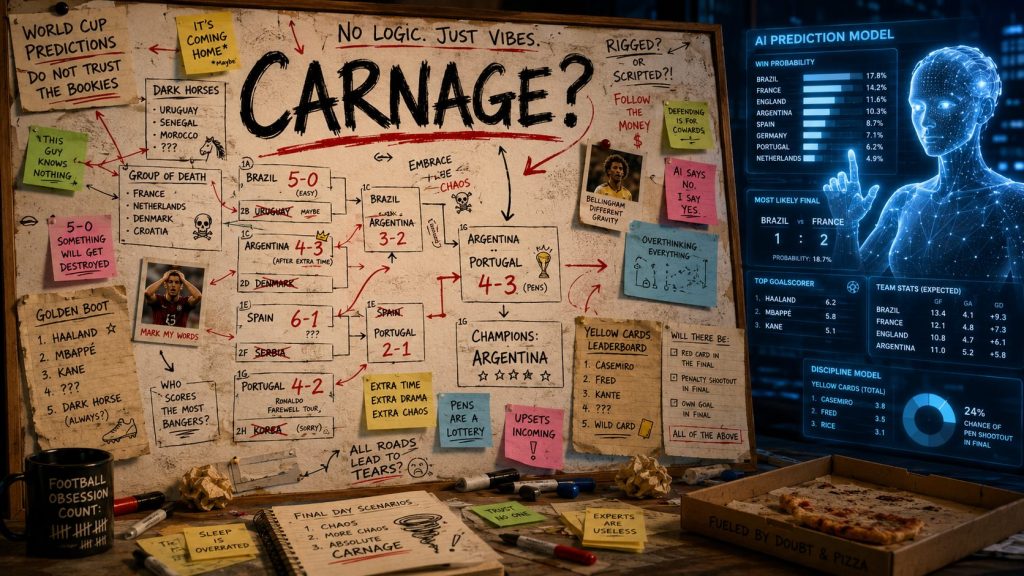
Like thousands of other people, I’ve ended up taking the World Cup more seriously than I intended because of a sweepstake. It’s affectionately called the WC 26 Soccerball Sweepstake, and I am forever grateful to my friend Jonas for corralling 40-odd participants into a group chat of total joy.
The sweepstake itself is only a tenner. The real competition is the prediction game that goes with it: our joy has been extended with side quests to each predict the tournament winner, Golden Boot, total goals, yellow cards and all the other things that allow perfectly sensible adults to become deeply invested in teams like Cape Verde.
Naturally, I decided to cheat rather than do any real research. Or at least I asked AI to help me out, so I wouldn’t look as ill-informed as I am in practice.
It felt like exactly the sort of thing it ought to be good at. AI can absorb betting markets, prediction models, historical World Cup data and expert commentary in seconds. Surely this is the perfect little AI task, I thought: far too much information for me to synthesise after a few pints, and not especially high stakes.
The answers were, unsurprisingly, very sensible.
Spain looked like a strong pick for winning team. Kylian Mbappé was an obvious Golden Boot contender. The suggested total number of goals was based on previous tournaments, adjusted proportionately for the expanded 48-team format, up from 32 teams and 64 games in Qatar. Everything was logical, well explained and backed by evidence.
When maths is confronted with reality
Then I mentioned it to my husband: a mathematician and a man so immersed in football he can’t play any football-based computer games because he becomes too emotionally invested and forgets to eat.
His immediate reaction to my predictions wasn’t to disagree with the AI per se, but he questioned a key assumption. “There should be more goals?” he asked, rhetorically. His reasoning was simple: this is the first 48-team World Cup. There are more matches, more debut nations and therefore, inevitably, more mismatches. The historic average goals-per-game shouldn’t really be the right starting point at all because the tournament itself has changed. If weaker teams are more heavily represented, particularly in the group stages, perhaps we should expect more one-sided matches and more goals overall. Portugal’s 5-0 defeat of Uzbekistan is a prime example.
Or, as Jonas neatly put it: you’re betting on carnage.
It wasn’t that the AI had made a mistake. It had done exactly what it was designed to do: start from the available evidence and produce a very reasonable answer. But my data-driven other half had done something slightly different; he knew the underlying system had changed because his head was already wondering where the surprises and memorable moments would come from. Because he’s a true fan.
I asked the AI if he might have a point and it, inevitably, agreed with him.
There’s a blog in that, we thought
That small conversation reminded me of something I see repeatedly when organisations introduce AI. Or it did when I remembered I needed a topic for this week’s blog.
We often ask AI questions that sound as though they have objective answers, when what we really need is someone to challenge the assumptions built into the question.
The AI was excellent at breadth; it pulled together enormous amounts of good information in seconds (Perplexity, obviously). It summarised probabilities far better than I could have managed over a third pint. The human contribution wasn’t more data: it was a different perspective. One person asking, “What happened before?” The other asked, “What if this time is different?”
That’s not unique to football; it’s exactly what happens in organisations. AI can quickly tell you how similar people have designed their service, how previous feedback was summarised or what research says about a particular activity. What it can’t know is that your context has just changed, your chief executive has different priorities, half your senior team are new and motivated by different values.
Context still belongs to people.
The first World Cup in an AI universe
The funny thing is that this year’s World Cup is itself becoming a showcase for AI. FIFA and its partners are using AI to process tens of petabytes of match data in 2026, from smart balls with embedded sensors to semi‑automated offside systems and AI‑powered performance analysis. Alongside official systems, a cottage industry of AI football prediction platforms like Predictify now offers fans match probabilities, in‑play analytics and even accumulator suggestions. AI is becoming part of the infrastructure.
Meanwhile, I’m using much the same technology to try to win a ten-pound sweepstake.
And how’s it going?
Rather better than I expected.
Lesson one: Chance still bosses the narrative. By complete chance, I drew Portugal in the sweepstake (my friend got Iran and feels less invested already, so it’s good he’s got the prediction game to keep him going). Portugal wasn’t the AI’s first choice before the tournament began, but they’re looking rather more convincing now, so pure chance is working out pretty well for me and still makes a better narrative than watching the favourite win. The tournament goal rate also seems to be supporting the human instinct that an expanded format might produce more scorelines. I’m not at the 396 goals I need, but at time of writing we’re not out of the group stage and I’m not off-track either.
Lesson two: Humans are still better at context, values and knowing what matters. Another friend let the AI talk her out of Messi for golden boot – it had read reports he was past it – and encouraged her to pick Martinez. That’s worked out less well and she’s annoyed – with herself as much as the AI. None of us knows whether we’ll end up being right. But that’s almost beside the point.
Lesson three: AI is brilliant at breadth and baselines. The exercise wasn’t really about predicting football stats. It was about understanding what different kinds of intelligence contribute to the same problem. (It wasn’t, really; it was about adding to the fun so we have something else to think about when England make us too anxious to watch). That kind of intelligence is why it was never going to suggest Scotland for the win, despite the hopes of a passionate nation.
If I were doing the prediction sheet again, I’d still start with AI. It gave me a remarkably good baseline in seconds. I’d just make sure the next conversation was with someone who understands the subject well enough to ask whether the baseline still applies.
AI is brilliant at answering the question you asked. Humans are still much better at noticing you’ve asked the wrong question.