Episode 13: Live from the Glastonbury of AI — Our Gartner Debrief 🍺
Week 13. Unlucky for some — but not for two people who’ve just spent three days at the Gartner Data and Analytics Summit, AKA the Glastonbury of AI. Neil says he was nearly as exhausted after three days sitting down as after five days at the actual Glastonbury. What goes on at Glastonbury stays at Glastonbury. But what goes on at Gartner comes out on this podcast!
The emotional rollercoaster 🎢 Monday evening beer: both of them felt reassured. Everything they’d heard confirmed Leading AI was on the right track. Tuesday: Kieron doubted everything — tech bro language, acronym soup, imposter syndrome at full volume. By Wednesday: unpack the jargon, and it turns out they already knew most of it, and in some cases were ahead of it. Neil’s summary: two separate meetings with Gartner specialists, both said we were on the right track. Donald’s response to Neil’s email was along the lines of: “I’m on it, stop hassling me”… only ruder.
Context is king 👑 Kieron’s biggest takeaway. The context layer — telling your AI what your organisation is, what your data means, and how different teams need to use it — is the difference between good retrieval and bad retrieval. The example: ask an AI “how many sales did we have this quarter?” Without context, it doesn’t know what “sales” means (invoiced? agreed? handshake?), what your financial quarter is, or which column in your MIS system to look at. KnowledgeFlow already builds data dictionaries automatically when it loads data — but there’s more to do. Knowledge graphs are the next step: storing context so the AI can pick up the right layer depending on who’s asking.
Ontology, knowledge graphs and semantic layers — explained for humans 🧩 Neil was confused by the three terms being used interchangeably at Gartner. He asked Perplexity to explain the difference like a 15-year-old. The answer: think of a school. The ontology is the rule book (what is a teacher, what is a pupil). The knowledge graph is the directory (Bob is a teacher, Alice is a student). The semantic layer is the notice board (how many pupils are in Year 10?). Get all three in place and your retrieval gets dramatically better. Turns our they’re already doing a lot of it — they just didn’t know it had a name.
Feedback loops — the missing piece 🔄 Kieron’s second big theme. The agentic email system works — it reads inboxes, triages, drafts responses, handles routine inquiries automatically. The next challenge: capturing what happens when a human looks at the draft. Did they send it unchanged? Edit it slightly? Rewrite it entirely? That data, captured over hundreds of interactions, tells you which types of email to fully automate and which ones still need a human. For a Housing Association, if 297 out of 300 pet policy inquiries sent unchanged are sent unchanged, automate your pet policy. The challenge: you only capture that feedback if the human stays in the platform rather than copying and pasting out of it. Which leads neatly to…
How do you make KnowledgeFlow so good people feel stupid going anywhere else? 💡 Neil’s challenge to the team. Inspired partly by Gartner’s focus on designing solutions that disappear — like the GP recording consultation tool that lets doctors look at patients instead of screens. And inspired partly by the stat that doctors interrupt patients after an average of 18 seconds. If the technology is invisible, the human interaction improves. Ibby and Donald are already building something. Watch this space.
Human in the lead, not human in the loop 🧠 One of Gartner’s sharpest lines. Don’t just put humans in the loop to click okay, okay, okay — they’ll stop paying attention and let everything through. Use humans where human judgment actually matters. Pet inquiry? Automate it. Mould report or smell of gas? Human in the lead, immediately.
The Gartner stats (cos Neil’s a stato at heart) 📊 Only 6% of AI leaders surveyed believed their organisations and people were AI ready. Only 12% felt their data was properly secured and governed. And fewer than 50% of organisations currently track their AI costs. Gartner’s framework: are you AI cautious, AI plus, or AI first? Because if you’re cautious while your competitors are AI first, you’re already losing ground you may not get back.
The bonkers corner 🤪 The futurist with purple shoes was very entertaining. Neural prosthetics already exist that let you move a hand by thought. But would you take a cheaper version if it played ads? (There’s a Black Mirror episode about this.) Would you let your employer connect to your neural network and pay you for time spent thinking about work? A woman in the audience laughed so hard she got the microphone. Her response: “If that happens, I’m screwed. I don’t think about work all that much.” Final thought from purple-shoes: would you want your wife to connect to your neural network? Neil’s verdict: the doghouse would be permanent.
Product of the week 🎵 (hum the jingle) KnowledgeFlow now has memory. Kieron tested it by telling it to start every response with “Hey dude.” Forgot he’d done it. Later asked it to analyse some data. It said: “Hey dude, here’s the analysis.” The serious version: memory means KnowledgeFlow can remember your role, your preferences, your output formats — securely, inside your own Azure tenancy. Something Claude can do publicly, but not securely. KnowledgeFlow now can.
Neil is in Scotland in the sunshine. He’s knocking the top off a beer and going into the garden. Neil’s wife Helen should probably (definitely) not connect to his neural network.
Two mates. A bar. Thirty years of business between them. And all they want to talk about is AI.
Pull up a stool — we’ll get the beers in. 🍺
TRANSCRIPT:
This week in Leading AI… #13 – 19 May 2026
Neil Watkins
So shall we just dive in then and get this pantomime horse of a podcast under way. Now week 13, Kieron, week 13 isn’t unlucky because we spent it together at the Gartner
Kieron White
Oh.
Neil Watkins
data and analytics conference, or as you like to call it, the Glastonbury of AI. And I don’t know about you, but I was almost as exhausted after bloody three days at Gartner as I thought was at five days at bloody Glastonbury.
Kieron White
Ohh, we did.
Ha ha ha.
That’s right, it was, yeah, it was exhausting. It’s interesting because it’s quite different, obviously, like what you’re doing, mostly sitting down all day at Gartner, although fair few steps. Glastonbury would be 25,000 steps a day, so I think Gartner wasn’t even getting to 10,000, including the commuting. So, but yeah,
Neil Watkins
Not walking, yeah.
Yeah, but I’ve seen you dancing at Glastonbury and that, I mean, that’s more shuffling than the steps, isn’t it?
Kieron White
Yeah.
I doubt you’ve seen me dancing at last to me, my doubt.
Neil Watkins
Having the silent disco.
Kieron White
Oh yeah, oh okay. Indeed, yes, you have seen me there and I shall not share the photographs of me in the silent disco.
Neil Watkins
Ha ha ha!
It’s best not, it’s best not. What goes on on Glastonbury stays in Glastonbury. However, what goes on in Gartner comes out in this podcast.
Kieron White
Yes, indeed, yes, and I…
Neil Watkins
So, what’s on your list from what’s on your list from the Gartner Conference for 2026?
Kieron White
My big feedback points, which will be no surprise to anybody that was there, which our listener probably wasn’t, is no, is context is king. That was a big phrase and weaved through a lot of what they did there. Interestingly, there’s a little aside here. I think one of the really good things that Gartner pull off
Neil Watkins
He definitely wasn’t.
Kieron White
which I have never seen happen at any other conference or event, is they clearly say these are the Gartner thought positions, thought leadership positions, and they force every one of their speakers to include something about it. Even the sort of storytelling guy at the end was talking about the context layer.
Neil Watkins
Mm.
Kieron White
and it was a real quite a side piece for him. But I think that is why it works really well as a conference, because you get that constant of theme or story arc through it. Anyway, that was my, congratulations Gartner on doing that. So context layer, which we can talk about, knowledge graphs, which we’ve done a bit with already, but more to do.
Neil Watkins
Yeah.
Yeah.
Kieron White
and feedback loops. Those are the three biggies. But my overall reflection, as I’ve shared, is on Monday, you and I went for a small beverage to reflect on the day and download and strategize.
Neil Watkins
Mhm.
Kieron White
And I think you really were probably more on this than me, but we both felt that, firstly, we felt reassured and confident by what we’d heard, that what we’re doing in Leading AI is kind of along the right line. There was nothing we heard that we weren’t either aware of or working on or have already cracked. So that was really powerful and good.
And then Tuesday happened, and by the end of Tuesday, I was doubting everything. I was thinking, I don’t know anything. So it was really interesting. And then through Wednesday, I think the reflection was there was a lot of language on Tuesday that was that tech bro language, which made it feel like you didn’t know anything. And actually, when you unpack what they were saying,
Neil Watkins
Yeah.
Yeah.
Kieron White
Which it wasn’t, I felt much more reassured, but it was it was horrible, emotional roller-pacing.
Neil Watkins
Yeah.
It was a roller coaster, an emotional roller coaster. Hold that thought for a second.
Kieron White
Okay.
Neil Watkins
I had just had to shut the door because it was noisy downstairs. I’m in a noisy spot. So yeah, I, yeah, I did, at the end of day one, I did think actually, last year it was like trying to drink from a hosepipe. It’s like a sip of water from a hosepipe. It was like, it just felt like it was full on.
Kieron White
Okay.
Ohh.
Neil Watkins
And this year it felt very different. At the end of day one, I was quite not disappointed. And I’ll come on to why in a second, because it’s one of my themes. And the other thing is my themes will show very clearly the difference between the way that your brain works and my brain works. And you started with the emotional rollercoaster piece. I’ve gone with a quite a structured thing, which you will laugh at.
Kieron White
Ha ha.
Neil Watkins
But yeah, so by the end of day two, I thought actually, no, there is some really interesting stuff here. We’ve got some things to think about. But my overall reflection on it was at the end of it was good. There’s nothing there where we thought we were on the wrong track. And we had two meetings with one which we both attended, but one I attended.
with a Gartner specialist and neither of them told us we were doing anything wrong or going in the wrong direction or anything else. That we’re definitely going in the right direction. We’re working on the right problems. We’re actually ahead of most people because some of the things that they talked about and saying, you need to think about this, you think that, but we were looking at each other and then going, are we doing that already? And then I sent something to Donald yesterday.
Kieron White
Yeah.
Neil Watkins
And he sent me this huge response back and I was like, have you just put that into Claude to produce confusing language that I don’t understand, which basically says, I’m on it, Watty, will you just stop bloody hassling me? So that was funny. But yeah, it was, it was, it was, it was reassuring. We definitely learnt A lot.
Kieron White
Ha.
Mm.
Neil Watkins
And yeah, it was it was it was good value, but I I took I took six things away, six things away from from.
Kieron White
That’s too many; you should only have three, surely.
Neil Watkins
You should. I mean, it’s one, two, three, many, right? And some of them are linked. So let’s, I could probably get them down to four, if not three. Anyway, the first one, here you go, is, not many people know this. I’ve actually got a degree in mathematics, which most people can’t bloody believe. So stats is my, there were a lot of really interesting stats. So I’ve got some stats to go through.
Kieron White
Yeah.
Neil Watkins
Second one was about governance and trust, not just in the data, but also in the decision making from AI, etc. And how do you improve that trust? Well, context, context is king. You’ve already mentioned that. So I’ve got and context adding meaning. So I’ve got some thoughts on that.
Kieron White
Yeah.
Neil Watkins
The next bit is, something you’ve already touched on, I think, is the change management piece, because that was up front and central and big. And I think that was the reason I was disappointed in day one was because they majored so much on change management that I thought, well, we’ve heard all that stuff before. I mean, you know, we’ve
Kieron White
Yeah.
Neil Watkins
Our background is programme project and change management. It’s just, you know, so we’ve been doing that for 40 years.
Kieron White
If in doubt, blame it on the people. What do you mean my technology is not being used? That’s shocking. It must be your must be your people.
Neil Watkins
Yeah, that’s right. But there was one of the…
Yeah, adoption’s the problem, so therefore you, and one of the things I said right at the start was, you’ve got to spend twice as much on the implementation, on the change management as you do on the implementation effort. And I was thinking, none of our customers are going to want to hear that message. You know, they
Kieron White
Right, exactly.
Neil Watkins
already are worried about AI costs and actually, you know, making it three times as expensive because you’ve got to add the change management piece. But we know for a fact it is a challenge. You know, we’ve got that problem. We’ve got some customers who are doing a brilliant job of it.
Kieron White
Yeah.
Yeah.
Neil Watkins
Um, you know, Ambition Institute, and that’s because people like Sue are leading on it, but…
Kieron White
Yeah.
Lincoln Bishop University got an appointed person, they’ve got champions, they are doing training.
Neil Watkins
Yeah.
Yeah. So there are people that are doing it and that can do it. But I think what, yeah, it was that whole kind of a bit frustrated that that seemed to be their big push. And it turned out that it wasn’t the big push because they did come back to the context and the knowledge graph and we’ll talk about all that in a second.
Kieron White
Yeah.
Neil Watkins
Anyway, #5 on my list, actually five and six are more were more kind of cheerful witches around. There were a lot of quotes, some of which were humorous and I’ll share some of those. And then my final one, I’ve got a I’ve got a what I’ve described as the bonkers category, because there was some there was some bonkers. Every year they have a couple of futurists talk and
Kieron White
Yeah.
Bye.
Yeah.
Neil Watkins
A couple of them were hilarious and other ones were terrifying. So I’ll share some of that stuff. So yeah, where should we kick off? I mean, we’re already about bloody 10 minutes in, aren’t we? So yeah, let’s say kick off.
Kieron White
Ha.
We are indeed, yeah. Gosh, we got, yeah, loads. But let’s talk, I’ll kick into the context layer stuff, because this is, I think, probably the most important one, actually feedback is. But anyway, context, let’s start with context. Context is all about telling your AI that LLM is sort of shorthand, really the large language model,
Neil Watkins
Okay.
Kieron White
more about your organisation so that it can help you. The example and a bunch of the work that we do in natural language querying or text to SQL as its sort of shorthand phrase for it is more challenging than kind of unstructured rag documents looking at
just looking into policies and pulling answers. And one of the reasons that it’s more challenging is that when you present it with a load of data in Excel, there’s very little context. Even the headings of the data, and this is something we ran into, gosh, two years ago, is that the headings in your, if you pull data from your
MIS system, you will have columns which are just meaningless codes, SPL 4, whatever. And the AI, the large language model, can only guess what they are. And it’s pretty good at working out the context that it’s looking in, but it is only pretty good.
Neil Watkins
Yeah.
Kieron White
And therefore, it’s also pretty bad because within that kind of model, what you’re doing in text to SQL for our audience is you write a natural language question, i.e. how many sales did we make this quarter? The large language model has a look at that and goes, okay, I need to go, I can see the data set here.
Neil Watkins
Yeah.
Yeah.
Kieron White
and it’s got some figures in it. I’ve got to find the relevant columns and then write an SQL query to go and get the answer. And then it writes that answer back to you in natural language. So beautiful when it’s working and you can get into predictive stuff with it and all kinds of amazing, really, really good. And we’re doing some of that with Lincoln Bishop on their own.
learner analytics. So that’s really, really useful. However, just go back to that question I just posed of how many sales have we had this quarter. Sales, first definition problem. Do I mean that I am a shop discounting products and doing Black Fridays? Or do I mean
Total invoicing, and do I mean number?
Neil Watkins
Or, or is it like, is it like when Kieron White says, I’ve sold something and I say, where’s the signed contract? And you say, oh, I haven’t got that yet, but it’s definitely a sale. No, it’s not until I get the signed contract. That kind of thing you mean?
Kieron White
Yeah.
You’re very black and white about these things. I like to get, I like to be a little bit more grey about sales and once they’ve shaken my virtual hand, but then it’s a sale. But yes, but they say even sales, even if you say, well, it’s clearly financial data, what do I mean number of sales or do I mean the total value of the
Neil Watkins
Yeah.
Yeah.
Kieron White
number of sales or something else. And quarter is not exactly clear, is it? Because you can have a financial quarter that starts any month you like. It’s down to whenever your financial year is. So just those two tiny examples alone show you adding some context to how you define a quarter, how you define sales, if the people are asking it.
Neil Watkins
Yeah.
Kieron White
helps. The challenge is there is lots more than just a bit of nomenclature. And even that would be hard. If you think about an organisation and all the different acronyms and the different things that are just baked in, it’s a hell of a lot to try and capture. So that’s one challenge. The second part is then in the data, how you
present the data with a data dictionary. And then you’ve got the kind of different teams within the organisation that might have a different way of looking at it. Finance probably want something a bit different to the head of sales. So all of those things are about context and many more. Rag indexes, as we would call it, that’s the document sets that
Neil Watkins
Yep.
Yeah.
Kieron White
so that every time someone asks a question, what actually the LLM is seeing is their question, and then a big, can be very big, set of data dictionary information to tell what it all means. But you can’t do that with everything, because you’ll end up with like 10,000 word prompts every time, which costs a lot of money, but also…
Neil Watkins
Yeah.
Kieron White
just is a lot of information in there that is not relevant and not relevant information in a prompt will always create some problems for you.
Neil Watkins
Yeah.
Cause problems.
Kieron White
So that’s context and we are pretty good at it in that we have been building them into system prompts and KnowledgeFlow when it loads data, creates a data dictionary, it’s a schema itself. So we’ve got some of it cracked, but we’ve clearly got some more stuff to do here.
and then how you kind of store it, which is a graph is the way to go, because then you can have, I think as I understand it, you can have the LLM kind of go to the relevant part. The finance team are asking this question, therefore pick up the finance context and do that. So there you go, that was context.
Neil Watkins
Yeah.
It.
Oh yeah, I didn’t, I, I…
Kieron White
Probably pretty dull for our audience, but useful for me.
Neil Watkins
Well, I don’t know, because it’s the difference between good retrieval and bad retrieval. I mean, that was one of the key lessons I took out of it. And I didn’t really understand it because they were talking about three things. One was ontology, second was knowledge graphs, and the third was semantic layer. And I was like, they were implying that those things were certainly overlapping.
Kieron White
Yeah, yeah.
Neil Watkins
but interchangeable and it didn’t make any sense to me. So I did the usual thing and I went on to perplexity and stuck it in. I said, can you explain this stuff to me in what the similarities and the differences are and explain it in words that a 15 year old
could understand. And it came back with an education context for me. I said, it’s a bit like a school system where the ontology is the rule book. So it’s got the data definitions and it defines what a teacher is, what a pupil is, what a classroom is, et cetera. The knowledge graph is the directory.
Kieron White
What? Yeah.
Neil Watkins
So it will say Bob is a teacher, Alice is a student, etc. And then the semantic layer is like a notice board, or it’s where you go for information, like how many pupils are there in year 10. And just thought it was a really interesting simple explanation of between kind of rule book, directory, and notice board of being able to explain to people.
that if you’ve got those three things on top of your data, then it allows you to get much better retrieval. And I think what Donald was trying politely to say to me in his long hand note was, yeah, I know, I’m on a…
and is what we’re already doing. And it turns out we’re actually doing quite a lot. So and we didn’t we didn’t really know because we were using different language. And it’s a bit like we were talking to who we were talking to. But it was like we didn’t we didn’t know it was rag until like 18 months into we were doing it.
Kieron White
Yeah.
Exactly.
Exactly, yeah.
Neil Watkins
Just because we didn’t know what the words were or what the what the what the industry was saying, we were actually doing lots of it. So, I was I was reassured once I understood it better then, yeah, and that context, that adding meaning is really interesting because that adds to the governance piece that I wanted to do.
Kieron White
Matt.
Exactly, M.
Neil Watkins
To touch on, which is the kind of how do you add trust, and one of the…
Kieron White
Mm.
Neil Watkins
Gartner liked to put up a leading question, don’t they, when they get a controversial question, you know, and one of them was in one of the presentations, I don’t know if you were in it, but it was, would you trust the system that gets the answers wrong 70% of the time? And somebody else said, you know, you wouldn’t get on a plane where there was a 70% chance of you not making it.
Kieron White
Yeah.
Yeah.
Neil Watkins
Taking it to the other to their end, would they? So, and and one of the things that one of the challenges that we’ve had, in fact, I had it on a call with a customer this afternoon. I don’t know why I’m pointing over there because that’s where I was at. Was that how kind of how do I trust the information and…
Kieron White
Yeah, they, yeah.
Neil Watkins
One of the lines from the Gartner piece was that LLMs are non-deterministic. Indeed, they are consistently inconsistent because they are bringing back different information each time if you don’t have that context layer, if you haven’t got the context piece in place. And of course, business is entirely deterministic because you have to have the right answer
Kieron White
Mhm.
Yeah.
Neil Watkins
in the right format, at the right time, in the right place, etc. So us being able to master that, I think, is what gives us the edge of certainly over the public models, but I’d also argue against some of the, don’t want to be competition bashing, but you know what I mean. I think we’re getting,
Kieron White
Yeah.
Neil Watkins
we’re getting ahead of the curve on some of that stuff because we’re dealing with those problems. Indeed, we both saw an e-mail this morning from a slightly disappointed customer who was, if he’d just started his e-mail with the word sigh, you could have picked up the tone and he said,
I’m sorry, I can’t go ahead with KnowledgeFlow because I’ve been told the internal team want to have a bash at it with our existing vendors. And I was thinking, well, we could go back and say, right, here’s all the things that your team are going to probably get wrong, but I really didn’t want to give them the account. So bad on me for not wanting to help them. But yeah, they will make a bunch of mistakes. From what he said, they will.
Kieron White
Oh, yes.
I agree.
Neil Watkins
Definitely make mistakes on on what they’re gonna do.
Kieron White
Yeah, so it turns out their own IT support has decided that they’re going to support them in building some of these products that we’ve talked to them about. And the reality is, I mean, if you’ve only just started out and learning about that stuff, you haven’t got like expert people in your team, then you have no hope. And here’s what I think is the real challenge is there was a quote, wasn’t it? It was either Arthur C. Clarke or someone else
Neil Watkins
Yeah.
Kieron White
said, all new technology looks like magic. And that was a quote we saw at Gartner. And it’s so true. And I think what happens more than anything is why people say I can do that with Copilot or Copilot Studio can do that is because it is coming from a place of deep ignorance. And it looks like magic. And therefore, you’d think you’ve weaved together a couple of things, pressed a couple of buttons, and the magic is now happening.
Neil Watkins
Yeah, that’s right.
Yeah.
Kieron White
And the reality is, it is dependent on the data and how that data is presented to the LLM. That is how RAG works. And if you don’t know anything about that, you should not be running your business on a RAG model where you literally have no concept of how it’s working. It’s, yeah, not clever.
Neil Watkins
Yeah.
No, no, I don’t think so. And yeah, I think they will find out the hardware, but then that’s their choice and that’s fine. I think the other thing that I saw in a couple of the stuff, a couple of the presentations from Gartner was that whole, that
Kieron White
Date.
Neil Watkins
technology gap, you know, and it talked about people who are, I didn’t call them AI skeptics, AI curious, and are you a…
Kieron White
Yeah, cautious, curious, and…
Yeah, cautious ladies, AI cautious.
Neil Watkins
Yeah, they did. And then there was another one where it said, are you AI plus or AI first as an organization? And if you’re cautious and you’re not doing anything, you’re waiting and seeing, then you’re getting left way behind. If you are AI plus, then you’re falling behind those that AI first.
Kieron White
Yes, yes.
Neil Watkins
because the pace of change, just that, you know, we’ve talked about it every week on this bloody thing about, you know, there’s a new model out this week, you know, we’ve just done some testing, you know, we’re moving to the newer models in KnowledgeFlow on a regular basis and things are getting better, cheaper, faster.
So just people will get left behind, there’s no doubt about it. And one of the quotes that I wrote down was, not enough people have FOBO. And I was like, I don’t know what FOBO is. It turns out fear of being obsolete. And I think we have a FOBO, definitely. Yeah, it keeps us on the edge, doesn’t it?
Kieron White
Huh.
Huh.
Oh yeah, definitely, jeez.
Comfort.
Neil Watkins
So, Donald, and there’s another thing I’ve seen, there’s another thing, there’s something else. He was funny on, I don’t know if you saw his message, he was like, oh God, I’m sat waiting for the 100 bloody feature requests to come in from YouTube.
Kieron White
Yeah, yeah. I tried to be restrainful. Is that a word? Restrained this time. Yeah, to try not to hit him constantly. I remember last time I’d phone him about every two hours and go, Donald, Donald, this is the thing, we’re going to be doing this. That’s really funny. Let’s talk about feedback loops because it’s also related to
Neil Watkins
Yeah, yeah, restrained, yeah, yeah, well.
Yeah, yeah, yeah.
Yeah.
Okay.
Kieron White
The change, you’ll see why I think the change management challenge.
We, as you know, in our Agentic systems, our Agentic solutions, are looking, have built a tool that will read an e-mail inbox and it will respond to that in the appropriate way. And it can automate a response back or it can put a draught in front of a human or it can do a combination of that depending on how much risk it thinks is the
Inquiry, et cetera.
Works brilliantly, really good. And the plumbing, if you like, works now, which is a fantastic, that’s the hard bit. The next part is how do you improve? How do you make sure that those emails are, you’ve got a tracking record so that you can make it be better?
and that you can look at the areas that you can automate and the areas that you can’t. And the feedback loop is all part of that. So being able to capture the suggested e-mail, the AI’s first draught response to a tenant inquiry or a student inquiry or a procurement inquiry, and a human looks at it,
says, yeah, good, no change send. That being captured as a no change send or a small edit, make it a bit more friendly or whatever, capturing that or a massive edit, factually incorrect sort of point. What we have to do is be able to capture that.
so that you’re starting to move further down the chain towards the actual sort of decision and outcome. But a first step, once you’re capturing that, that’s when you can say, we’ve seen 300 requests from your tenants about pet policy, can I have a pet? In 297 cases, the user decided that they should just send it as is, no change.
Three were adjusted and it was tiny adjustments. We then suggest automate pet inquiries going forward. Data to do that are amazing. And then of course the fixing of things where you’re seeing there aren’t errors and being able to get into the rag pipeline and work out why things aren’t behaving as they should. So
Neil Watkins
Mm.
Kieron White
I think it’s everything. And the change management link is that to do that, you’ve got to get the user working in the platform.
Too much AI, including the earlier versions of KnowledgeFlow, require it would do you the e-mail, then you take the e-mail and put it somewhere else, adjust it and send it. The taking it somewhere else, now there’s no feedback. So, so building that, so the challenge becomes making a really slick user interface that
Neil Watkins
Yeah.
Yeah.
Kieron White
to your, I don’t want to steal your thunder, but the question you’ve posed the team at Leading AI to think about, I’ll leave you to say it, but is how can we make that user experience on working in the platform with the e-mail so easy and nice that it’s an obvious thing that you’d want to do?
Neil Watkins
Yeah, well, the question I posed was how do you, how do we make knowledge flow so helpful and enjoyable that people would feel stupid going anywhere else to do their work? And it kind of links to another thing I saw at Gartner, but has been reflecting, I think I’ve said before, I’ve been talking to a bunch of people in the medical world.
GPs, for example, and a really good example of this concept of designing solutions that disappear. That whole piece where the doctor is recording the session, the transcript, it means they can actually look at the
Kieron White
Yes.
Yes.
Neil Watkins
look at the patient and actually interact with them, engage with them and the patients then trust the doctor more. There was a brilliant stat from one of their people that said the doctors can’t help themselves. Their very first question is what appears to be the problem and the average amount of time they can restrain
Kieron White
Yeah.
Neil Watkins
interrupting this idiot in front of them is 18 seconds. So you’ve got 18 seconds where they’re not really thinking about what you’re saying. What they’re really thinking is, I’ve had a quick look at you and I’m pretty sure you’re drinking too much, you’re smoking too much, you’re eating the wrong food, whatever it is. So they just don’t think about it. But actually, how do you design a solution which
Kieron White
Ha.
Neil Watkins
takes the information and deals with it while the human to human interaction takes place. And I think for us with our KnowledgeFlow platform, we’ve got to do something similar so that it is the place where they start their work. And, you know, we can do lots of the things already, like the voice, etc. But, you know, how do we make it so enjoyable?
that they just don’t want to go anywhere else. That’s a really interesting challenge for us.
Kieron White
Yeah.
Yeah.
Definitely. And yeah, looking forward to it. We’ve got a, we’ve got some we’re working on. We’ve got the team looking at it. Ibby and Donald are both looking at building something that might well capture hearts and minds in it and achieve those aims of capturing the feedback.
Neil Watkins
Excellent.
Oh, cool. I didn’t even know about that. That’s good.
Kieron White
Oh, I’ve been pushing them. I’ve been, well, I say I’ve been pushing them. That’s not fair. They’ve, as always, been straight up for it and are very keen to take it to the next step. So it’s really exciting. And on that, very briefly, the thing that Gartner talked quite a bit about is this concept of, I’m going to get that they didn’t.
Neil Watkins
Yeah.
Yeah.
Oh, good.
Kieron White
They probably did have a name for it, but they would have definitely had a name for it. I don’t remember it. But it’s like an outcome based teams or outcome based organizations. And their point is that with AI, you should and can reorganise yourself to be kind of linear in the workflow, i.e. starting from here again to the outcome or decision.
Neil Watkins
Mm.
Kieron White
And one person, one team is responsible. And it’s such a hybrid of people and agents is what they think the world of the future is. But you’re responsible for the end to end from start to finish one thing. And I think that is a really interesting concept of getting people to be more locked into the kind of outcomes they drive rather than
Neil Watkins
Yeah.
Kieron White
I just do the invoicing, it’s a bad example, but you know, I, or I do the product specification and then after that I hand it to someone else who deals with the actual work. I think it’s a really interesting, I think it’s quite a tough way to envisage everything. I’m not sure it works or everything, but.
Neil Watkins
Mm.
It is, it’s not a new concept. The outcomes-based organization’s been around for 20 years that I can remember. But the real challenge was people. And actually the change is now agents. Agents don’t care. Agents don’t get promoted. Agents don’t have egos.
they just get on with the job. And actually, they just, so actually you can be much more workflow and outcome focused. Interestingly enough, we talked about this, I think, last week was, you know, if you think about the pricing for AI, do you move to an outcomes based pricing model?
Kieron White
Indeed, yeah, yeah, interesting.
Neil Watkins
And it’s really hard to do when people are involved. Just take sales, for example. You know, if there’s a sales bonus, how many people were involved in that sale who have got their hand out? Success has many parents, fairly as unfortunately are orphans. So a real challenge, but that whole piece about…
Kieron White
And they.
And.
Neil Watkins
outcomes based. If you’re using Agentic systems to do the workflows, then it becomes much, much more feasible.
Kieron White
Yeah, yeah. And that idea of the way that a few of the different Gartner presentations talked about the future organisation of being, instead of having a team of eight people doing something, a team of one or two with an agent or two, as an AI agent, doing work together and augmenting the human. That’s exactly how Gartner kind of see the future.
Neil Watkins
Yeah.
Yeah.
Yeah.
Yeah.
But one of that big, yeah, one of that big, one of that big…
Kieron White
Not funerals.
Neil Watkins
Lines was human in the lead, not human in the loop, wasn’t that? You know, how do you, don’t just give humans.
Kieron White
Yeah, exactly.
Exactly.
Neil Watkins
things to just keep pressing okay, okay, okay, because they just won’t pay any attention and they’ll just let anything through. But actually, if you’re using humans, a bit like your example on the pets e-mail, you know, you don’t need a human in the loop for a pet inquiry. If someone’s got mould or can smell gas, that’s very different. You definitely need
Kieron White
Yeah.
Yeah, exactly.
Neil Watkins
You need a human to lead on that, going, oh my goodness, we need to fix that instantly. The clock’s ticking. So let’s get on with that one.
Kieron White
And there’s so much in the housing world that is the new increased neurodiversity needs of tenants. So people sort of no longer meeting the bar or indeed have waited long enough to get the sort of a diagnosis, but they still have all of the challenges. And now those challenges sort of land in the lap of housing associations to manage and they want to manage them.
Neil Watkins
Yeah.
Yeah.
Yeah.
Kieron White
They really keep, of course, they’re inundated with pet inquiries and what time do you open so I can drop the keys off and all those kind of stuff. So yeah, I’m excited about the potential of it. And I think as I say, with that feedback loop data, having some real data to look at and see and to monitor how you’re doing and even the ones that have now been automated to keep checking in.
Neil Watkins
But.
Yeah.
Kieron White
On those, it, that’s really interesting, and there’s go on.
Neil Watkins
But there’s some challenges with all of that, which lead on to some of the stats I noted because I’m a bit geeky like that. But only six, and these are Gartner, just for in case anybody from Gartner’s listening, these are Gartner stats, not mine either.
Kieron White
Yeah.
Yeah.
Neil Watkins
6% of AI leaders they surveyed, only 6% thought that their organisations and their people were AI ready. That was really interesting. But only 12% of those leaders felt that their data was secure and good.
Kieron White
Mhm.
Neil Watkins
Governed correctly, so that whole data, I mean, data has always been a challenge in IT, ever since, ever since we were kids in shorts, Kieron.
Kieron White
Ever since they were carving on stones.
Neil Watkins
Correct. Yeah, yeah, yeah. He’s got milestone data. So yeah, that is a real, the whole data is a massive challenge as we know. And structuring it and actually making sure it is trusted back to the governance thing, back to the context thing. It’s all interconnected.
Kieron White
Yeah.
Yeah, no, it is.
Neil Watkins
But interestingly enough, less than 50% of organisations track their AI costs currently, according to the Gartner survey, which I thought was amazing, especially given the thing, I don’t know if we talked about this last week, but you know, people in Silicon Valley turning up for interview and their first question is,
Kieron White
Yeah, yeah, it’s interesting, isn’t it?
Yeah.
Isn’t it?
Yeah, no, indeed.
Neil Watkins
Yeah.
Kieron White
Very good, right. You’ve got some funny quotes from Garner, haven’t you, that we should talk about.
Neil Watkins
Well, some are some are funny, so I mean, I’ve used a couple of them already, but there was, you know, back to the people thing. There was a quote which said, people don’t fear AI doing their jobs. They fear their bosses thinking that AI can do their jobs and firing them and then their bosses finding out that they can’t. And there are examples of that on the wires of organisations that are having to rehire people because they
They fired them because they found out that AI couldn’t actually do the job in the way they wanted. So that was funny. But my favourite daft quote was, you don’t want to end up with a zoo of AI products. And that is really interesting to me because, you know, part of our knowledge flow that you can have as many assistants and we’ll separate them and then we can link them together, etc.
Kieron White
Uh-huh.
Ohh, very good.
Neil Watkins
But that company that turned us down this morning, you know, they mentioned at least two products in that e-mail. And they are going to end up with a zoo of AI products. And it is going to be difficult and awkward. And you can just guarantee there’ll be vendors going, oh, it’s not us, that’s the problem, it’s somebody else’s fault. So yeah, there’s going to be.
Kieron White
Yeah, so your data over there, that’s the challenge, yeah.
Neil Watkins
Yeah, yeah, yeah. But there was, I was going to finish on the bonkers thing. So unless you’ve got anything else, I’ll move on to the bonkers bit. Have you got anything else on your list?
Kieron White
I love the product of the week. Well, I just wanted to share product of the week because I think it’s let’s capture it in our in our ramble. So, are you going to play your jingle in your head? Good.
Neil Watkins
Oh yeah.
Hang on a sec, put the theme tune in your head.
Yep, done it right. Okay, good.
Kieron White
Good, right, perfect. Memory. KnowledgeFlow now has memory. And I amused myself because testing it just today. I said, I want you to start every response by calling me, hey, dude. And now it does it. And it’s really funny because I’ve forgotten that I’ve done it. And later in the day, I’m doing something quite serious, analyse this data for this thing. And it goes,
Neil Watkins
Oh yeah.
Ha ha ha.
Kieron White
Hey dude, here’s the. So it’s quite fun. So yeah, being able to, and I mean, the more serious side of that is being able to catch preferences, roles. We can already pick up entry ID information, but it’s normally so out of date, it’s not that helpful. But certainly being able to know that your finance and your CFO and you’d like to have this kind of structure to your stuff.
All of that is going to be really helpful and bring knowledge flow really alongside what some of that Claude is able to do, but you can’t do it securely. We can do it securely. So that’s an exciting little piece. So that’s the product of the week for us this week.
Neil Watkins
Yeah.
Very good. Well done, dude. Well done, Donald, I should say, shouldn’t I? Yeah. Let me finish then on a bit of a bonkers thing. And this made me laugh. So some of this is the futurists always start with something that’s kind of in play now and then move to the extreme. And this chat was talking about
Kieron White
You know, Donald, Donald date.
Neil Watkins
prosthetics and how you can move a hand just by thinking about it, if you’ve got the right neural implants, etc. And he said, what would happen if, would you be prepared to take a cheaper version if it played ads? And he said, and he said there was a Black Mirror episode where
Kieron White
And yes, yes.
Yeah, yeah.
And I love this.
Neil Watkins
somebody had an upgrade and it was, and then they just started saying, and this pen, it’s brilliant at 299. You should have one. And she rings up to complain. I can’t stop trying to sell things to people. Well, you can upgrade for a fee, you can upgrade to the non-ad version, which made me, which made me laugh.
Kieron White
Yeah.
It’s hilarious.
Neil Watkins
But then he said, if you’ve got a neural network, and do you allow your employer to connect to it? Because then they could just pay you for when you’re thinking about work. And this lady in the audience laughed so loud and he got the microphone, she said, why are you laughing?
And she said, she now she used these words, she used the worst language, she said, if that happens, I’m screwed. Because I don’t think about work all that much. So that made me laugh.
Kieron White
You haven’t got paid again today. You didn’t think about it at all, did you? Fabulous.
Neil Watkins
That’s right, I didn’t get paid. Yeah, yeah. And interesting if he said, I said, he said, I’d quite like it because I lay at work at night worrying about work. So and I think about it and I dream about it. So I want to get paid for when I’m dreaming. I was like, you’re a bit weird for that. He did have very purple shoes. He was interesting chap, though, very funny, very funny chap. But he left, he left with this final thought. He said,
Kieron White
Yeah, yeah.
Ha ha.
He was very, very funny.
Neil Watkins
Would you, would you want your wife to connect to your neural network? He says, I don’t think many marriages would last more than 5 minutes if your partner knew what you were thinking all of the time. And I think that’s probably right.
Kieron White
Haha.
Yeah.
Well, I’m sure yours would. You’d be just, Helen would feel the love flowing from you.
Neil Watkins
Hang on a sec, it’s not two episodes since I was in the doghouse. So if we, I just be, I may as just get a kennel.
Kieron White
Oh, yeah.
Very good.
Yeah, that’s it, stay there, make it nice, get an extension belt.
Neil Watkins
I go live, I go live with a kettle in the garden.
Ha ha ha!
Kieron White
Stay in the dog house. Yeah, very good. Lovely to see you. Look forward to a further week of wonderful work and we can see you on the podcast next week.
Neil Watkins
On that note.
I’ll see you on the podcast next week and I’m back in London. I’m currently in sunny Scotland and despite all of the weather forecasts, it’s lovely and sunny. So I’m now going to knock the top off a beer and go and sit in the garden.
Kieron White
Yeah.
Very nice indeed. What a wonderful way to end a Friday afternoon, or Tuesday if you’re listening to this podcast live.
Neil Watkins
Excellent, alright.
Yeah, Tuesday, be a Tuesday, alright, dude.
Kieron White
See you later. Thank you. See you later. Bye.

Latest posts

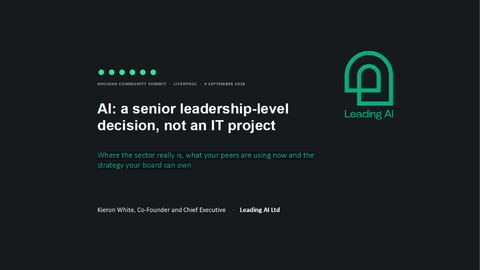
Free webinar – AI in Housing is a senior leadership decision, not an IT project
Events