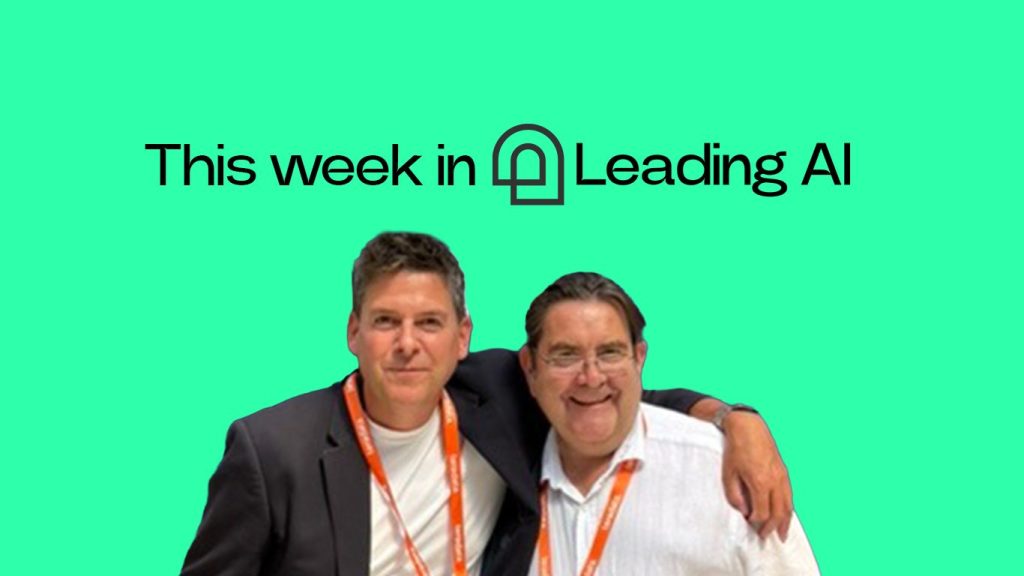
Episode 10: TechUK Recognition, You Get What You Pay For & The Very First Cyber Attack 🍺
Ten weeks. The longest either of them has been consistent at anything. Neil’s briefly out of the doghouse. Kieron’s on squash instead of beer. And Leading AI has just had two case studies published in one of the most important AI reports of the year.
Pull up a stool.
TechUK’s “From Pilots to Practice” report — and we’re in it. Twice. 🏆 TechUK — the UK’s leading technology trade association representing over 1,100 member companies — published their landmark report From Pilots to Practice: Using AI in the Public Sector with 19 real-world case studies showing how AI is genuinely transforming public services. It features not one but two KnowledgeFlow implementations: the FE college quality assistant and, in housing, Taff Housing. Being independently selected by TechUK as an example of AI that actually works in practice — not just in pilots — is a significant validation.
Agentic AI for housing — getting serious with Taff Housing Kieron was with the Taff Housing CEO, director of technology and senior team this week — a monthly meeting they hold to track progress and plan what’s next. On the roadmap: a fully agentic tenant inquiry system that triages and instantly answers routine emails, freeing frontline teams for complex cases. And an AI-powered repairs checker that reads job descriptions, checks them against schedule of rates codes, and flags when a contractor’s invoice looks a little… creative. Yes, Kieron finally remembered to show the photograph this time.
First draft of a £500 million bid written in 4.5 hours Neil used KnowledgeFlow’s BidWriter to produce the first draft of a 7,500-word tender response for a £500m contract in four and a half hours. What would have taken a week landed at 80% complete before Tuesday lunch.
McKinsey now tests candidates on AI prompting Not whether they know about AI — whether they can prompt well, challenge outputs, and think critically alongside it. Social workers are already turning down job offers at councils without AI tools. Now the world’s top consulting firm is screening people out if they can’t work with AI. The direction of travel has never been clearer.
The IQ of your AI depends on what you’re paying for Anthropic’s Opus 4.7 has an estimated IQ equivalent of around 140 — top percentile of humans. The free tools? Closer to 100. It’s like hiring a £20k accountant versus a £100k one. If you tried AI and thought it wasn’t impressive, you were probably using the wrong model. You get what you pay for.
The $150,000 overnight token bill A company set an AI agent running overnight. By morning, Google presented them with a $150,000 token bill. KnowledgeFlow is now building automatic kill switches for all client deployments. And a brilliant tip from Nate B. Jones (third plug this series, still not on commission): convert your PDFs to markdown before loading them into AI and you’ll save up to 87.5% of your token costs. Most people don’t bother. Most people will when it starts hitting them in the wallet.
The first ever cyber attack — 1834 Neil drops a history bomb: the first recorded technology attack happened in France in 1834, when two men hacked telegraph wires to manipulate financial markets. Kieron’s response: what’s actually changed?
Ten weeks in. Still going. Still on squash instead of beer. Apparently Kieron has “aura” though, so things are looking up.
Two mates. A bar. Thirty years of business between them. And all they want to talk about is AI.
Pull up a stool — we’ll get the beers in (even if we’re not drinking them ourselves). 🍺
TRANSCRIPT:
This week in Leading AI…-20260423_150925UTC-Meeting Recording
23 April 2026, 03:09pm
Neil Watkins 10:10
All right, should we get this pantomime horse of a podcast underway again for week 10? Ten weeks, Kieron, we’ve been doing this. That’s the longest we’ve done anything like this. I think. It’s the longest we’ve been consistent.
Kieron White 10:14
And.
Ben.
Yeah.
Ha ha.
Is true, that’s because of…
That’s because of that single piece of feedback we got to encourage us, you know, one piece, one piece in 10.
Neil Watkins 10:30
That’s right. Very good.
Kieron White 10:34
Well, here we are, our 10th anniversary. Can you call it that? No.
Neil Watkins 10:39
No, you can’t. Not just 10 years, you fool. There’s no such thing. It’s like those people who celebrate, it’s like our six month anniversary. It’s like, no, no, you’ve been going out for six months. It’s not an anniversary. Oh, this is a year, you idiots. So anyway, anyway, enough of that old nonsense. How was your week?
Kieron White 10:41
Ha ha ha!
Yeah.
Yeah.
Yeah, I want to know, did you get yourself out of the doghouse? Last weekend, you were firmly in the doghouse. You went away for a weekend with Mrs Watkins and I’m assuming you’re now out of the doghouse and happily living your life.
Neil Watkins 10:57
Ahh.
What?
Well, what can I tell you? I can tell you that I was out of the doghouse for the weekend, but it turns out it turns out like it’s really easy to get back in the doghouse.
Kieron White 11:12
Yeah.
Haha.
Much easier to get in than out, I find.
Neil Watkins 11:21
It turns out once you leave the four-star hotel, after spending a fortune on fine dining and champagne flowers, that actually when you get back to reality, it kind of, it all goes. I used to joke that my wife, Miles, not Brownie Point, wife Miles,
Kieron White 11:36
Haha.
Neil Watkins 11:41
have the half-life of Uranium 232. They just disappear there. So there’s no getting them back once they’re gone. So never mind. Enough about enough about that old nonsense. Anyway, what was the big highlights from your week?
Kieron White 11:44
Ha ha ha!
Phone P.
Yes, right.
My week, well, my highlight, I’ve had a very busy week, which is great, talking to customers, which is even better. I have been talking to multi-academy trusts. I’ve been talking to housing and university. So today was university day, where we were training AI champions.
Neil Watkins 12:09
I have education week.
Kieron White 12:15
in knowledge flow and just giving them the kind of overview of how it works, how it can help them. And really good that they’ve identified, the university have identified a bunch of AI champions to help drive what we’re doing. So that’s really, really cool. And interestingly, on the other side, I also had a meeting today with the executive leadership team of the university on the
driving a bit of accountability into for forcing through some of the things we’re doing with them, which is interesting. One of the things that often turns up as we, as you’ll be very painfully aware, is we get someone that buys knowledge flow and then in some cases they’re like, they’re using it and their team are using it.
Neil Watkins 12:39
Mm.
Kieron White 12:53
but actually it’s not being used more widely. So trying to drive a bit more accountability into some of the projects that we’re doing with this university. We’ve got amazing specialist tools for the uni, I think, as you know, it’s helping them with their compliance, annual monitoring reviews, being able to effectively do that with
Neil Watkins 12:57
Yeah.
Kieron White 13:13
You throw the raw data at Knowledge Flow and then Knowledge Flow has been trained to understand how to do an AMR, which is an annual monitoring review and a report that you have to write. And Knowledge Flow does that for you. You give it the data, it tells you, here’s how it stacks up and here’s the things you need to focus on.
Which is brilliant, because…
And similar to the Ofsted quality tools for colleges, what happens when you talk to people who actually do this job, and they might be director of quality in a college or they might be CEO, when they sit down to have their review with someone that’s produced a report, they tell me often
that 3/4 of the time this Ben is trying to work out what on earth you actually meant when you wrote down these things. What are you getting at? Because the writing’s so bad and describing data in words is like hard. And Knowledge Play does all that for you. So they’re loving it because you can now actually have the conversation you would hope to have.
Rather than 45 minutes of like, what do you mean there? Really? Why?
Neil Watkins 14:18
Yeah, yeah, yeah. Did you know, you might not know this, but today I got information from Tech UK. And for those of you who don’t know who Tech UK are, they’re an organisation, I think they’re supported by the government, to promote technology in the UK.
Kieron White 14:20
Really interesting.
Neil Watkins 14:39
And they are a very well known and respected organisation. And they’ve just published, yes, very respected, and they have just published a report on AI, practical transformation of AI in public services. And 2, not one, but two of our case studies are in there. And one of them
Kieron White 14:44
Very respected.
Neil Watkins 15:00
is the quality assistant for FE colleges. So a big shout out to our one audience. If he’s still awake, Matt, you did good. Yeah, well done, Matt. So, yeah, brilliant.
Kieron White 15:03
Okay, yes.
Yeah, yeah, well done, Matt. He’ll wake up now. He’ll have jolted him awake, you’ve heard his name.
Neil Watkins 15:20
What was that? So that was great. So that was one of the cases. The other one actually interesting, you mentioned housing associations, the other one was for tap housing. So really pleased for all of those guys, but also the fact that knowledge flow has been
Kieron White 15:32
Yes.
Neil Watkins 15:41
touted as a good solution by one of the most respected tech organisations in the UK. So that’s delightful.
Kieron White 15:48
Yeah, that’s amazing. That is cool. And I was with TAF on Monday. Yeah, they’re really good in that they’ve got like proper senior engagement. We get the CEO, their director of technology and some of their other senior team around. We get every month we meet them and talk to them about like what, given the feedback of how things are going and talk about the next bit. And they are really keen
Neil Watkins 15:50
Yeah.
Are we?
Kieron White 16:12
to push with us, which is brilliant because we’ve been trying to get this into housing. Two things, a agentic solution for tenant inquiries. So that is being able to immediately just letting knowledge flow answer the emails rather than having humans do that, which is fine. And particularly when you
Neil Watkins 16:23
Yep.
Kieron White 16:31
triage first and you take all the easy stuff. You know, what time do you open? When do I drop the keys off? How do I fix a boiler? All the stuff that’s just really straightforward to answer, let it answer it and it gets instant answers. So that’s really cool and should be, I think, will give a better tenant experience and relieve a bit of pressure on the team that can then deal with the much more complex.
challenging areas where they have tenants with additional needs, put it that way, so they can handle those and spend their time on those instead of the sort of more mundane stuff, which is great. And then the other thing is using our API agentic version of Knowledge Flow with their repairs, and that being
Neil Watkins 16:54
Meet.
Cool.
Kieron White 17:14
to be able to look at their repairs and prioritize, triage, and yeah, just be able to update, you know, take the data directly from the system and be able to immediately flag up those things that are urgent, those things that haven’t been done as they should be, and all of that. And then I was talking to another housing association who are in a similar space,
They spend, apparently they’ve just changed their contract for reactive repairs, so that’s fixing the stuff that’s broken today rather than planned for. And they say they’ve got a contract between two and a half and 3 million they expect to spend. They would like it to be two and a half, not three. But
Neil Watkins 17:45
Mm.
Of course.
Kieron White 17:56
But trying to get kind of accuracy from contractors, it’s a bit of a challenge because you can imagine some of the some of the reasons why that might be, but they have a schedule of rates codes within housing that helps you set the price that things should be. Those are a very lengthy Tom of a document.
which we’ve got TAF have a version of that that runs automatically so they can use our AI to get answers. Where we’re looking to go with this other one, though, is an experiment to say, can we take previous actuals and use that alongside this schedule of rates codes to be able to be really quite precise?
and to say, we think that leaking tap is 28 pounds 95 or, you know, whatever. And so that would be really fascinating to do a sort of live cheque of actual what jobs actually cost. And of course, using the AI ability to read properly the job. And so it can do a close match of like, this is a leaking tap in a third floor tower block.
Neil Watkins 18:47
Mm-hmm.
Kieron White 18:58
blah, blah, blah, and then being able to pick up the costs from that or for many of those and give a really accurate view. So that would be really interesting. I’m really excited.
Neil Watkins 19:08
Did you, did you, seen as I’ve chided you on this podcast before, did you show them the photograph? Did you actually get right? Did you remember to do it this time?
Kieron White 19:15
Uh-oh.
I did.
I did.
I did and I even told the I told him that because he was in the audience. That’s how he found us. He was in the audience for that session and I said to him that I have been ridiculed by my team for not showing you probably the most impressive thing because exactly that and as you we were talking about if the contractor says well that three metre piece of fence.
Neil Watkins 19:25
Oh, was they?
**** that.
Yes, you have.
Yeah.
Kieron White 19:41
actually wasn’t 100 quid, it cost 300 quid because we had to dig a bit of this and put a foundation in there. You could ask for a photograph and run that straight into knowledge flow and probably, firstly in the diagnostics, it could maybe give you a view on that. Secondly, it could probably cheque and give you a bit of a, it doesn’t look like that, son. Looks like you’ve just nailed that to the tree.
Neil Watkins 19:56
And yeah.
You should take before and after pictures in store them and say, there you go. Yeah.
Kieron White 20:08
Well, exactly, exactly. Spot the difference. You’ve just you just stood that fence up, haven’t you? That’s not a new fence at all, but…
Neil Watkins 20:11
Haha.
Are we going to be targeted by fencing contractors whose income are going to drop significantly due to knowledge flow?
Kieron White 20:19
Possibly.
Possibly. Well, that’s what this housing association was saying is they don’t, since COVID really, they’ve got into, they don’t cheque everything as much as they did. I’m sure they didn’t cheque everything. And so the propensity to, I’m trying to find the right polite word, but get it wrong, is higher now because nobody’s checking.
Neil Watkins 20:40
Mm mm.
The opportunity for accidental errors.
Kieron White 20:45
There we go, that’s the right way of putting it.
Neil Watkins 20:48
Yeah, yeah.
Kieron White 20:48
And then the last one, there’s the multi-academy trust. So our Matt client that I was with, configuring their knowledge flow to do lots of amazing stuff. So they’ve got a pastoral support assistant, which is there to help with all of those quite challenging matters. It’s got all of their policies, best practices, various things about that, so that you can interact with that ahead of or during indeed a sort of pastoral discussion with a student or staff member.
So that’s quite neat. And then they’ve got education data tools which help them, they upload their data and it tells them what things they need to go and look at, which is brilliant.
Neil Watkins 21:22
DO.
Yeah, I’m surprised we haven’t done more in multi-academy trusts is the honest truth. It does, as I think we’ve talked about before, it’s been a slow burn. I actually, I was a little bit naughty, I’ll confess to this. I was a bit naughty this week and I have.
Kieron White 21:27
Mmh.
Neil Watkins 21:42
joined a competitor’s webinar and listened to them. And it was frankly awful. It was just, yeah, well, it was awful for a couple of reasons, but the main one was, it was like really patronising about, it’s like, here’s all the things that you should be doing in schools and FE. It’s like,
Kieron White 21:51
Good.
Neil Watkins 22:02
If I, if I was in one of those organisations, I’d have been really bloody cross, is the honest truth. It’s like, thanks very much, Mister Outsider, telling us what we what our responsibilities are. I think we know better than you, and can you just get on with it and show us what you what you can do? And they and they actually didn’t show their tool at all.
Kieron White 22:16
Thing.
Neil Watkins 22:23
And I know for a fact, when you get on a webinar, you can’t wait to open up knowledge flow. You’re ridiculous for it. You’re like, oh, right. And here, let me just show you this. It’s brilliant. And so it was completely the opposite of what it was. I know you do.
Kieron White 22:33
I do it live as well. I always, and I never do video. I don’t even have a video backup because I’m that confident in our stuff. Nearly everyone I’ve ever seen has a video backup or indeed our playing don’t even have a backup. They are only running the video.
Neil Watkins 22:46
Well, not being funny, but this particular outfit, they couldn’t even get the video working on their, nor could they get the slides working for most of it. So it was, it didn’t, it didn’t inspire confidence by any stretch. So yeah, that was, that was very humorous. I enjoyed that. It was an hour I’ll never get back.
Kieron White 22:55
Haha.
Good.
Well, I’m glad. I’m glad because, well, there’s too many people out there that are not, yeah, I think our public sector ethos is important in everything that we do. It ultimately drives, doesn’t it, what we’re actually trying to do is make a difference. And that doesn’t mean a difference to the bank account. It means a difference to
Neil Watkins 23:16
The.
Kieron White 23:21
outcomes for your customers, clients, citizens, whoever they are. So good. I’m glad other people are showing themselves up for the charlatans that they are.
Neil Watkins 23:26
Yeah.
I was once told by somebody that a guru is just someone who can’t spell charlatan. So I’m going to call them gurus. Yeah.
Kieron White 23:39
About right. Yeah, watch out what you wish for. So what have you been up to this week then, apart from joining dodgy webinars and being bored?
Neil Watkins 23:42
Ohh.
Uhh…
Dodgy webinars. Well, I have been, it’s been a busy old week. A couple of things. One is, I know that you love to do product of the week. Queue, jingle.
Kieron White 23:58
Yeah, yeah.
Neil Watkins 24:00
But I want to, and you always love the new shiny stuff and you’re always moving on, on to the next, on to the next, on the next. I’d like to have a shout out for one of our very first tools called Bid Writer. So in another part of the forest, I have to, I don’t have to, but I do, I help.
Kieron White 24:14
Yes.
Neil Watkins 24:20
everything ICT, write bids, and there’s a bid out at the moment. And it just to put it into perspective, it is a 500 million pound contract value. So it’s a very big, very important piece of work. And the stage one documentation came out.
And there are all the usual questions, but there are a series of text boxes, which comes to something like 7 and a half thousand words. And I don’t know the rest of the time you try to write 7 and a half thousand words. It takes a long time. And if I’d have tried to do it, if
If I just tried to do the first draft, it probably would have taken me a week previously. And I did it in 4 1/2 hours on Tuesday. And the, it’s probably only 80% there, but it’s 80% there for a first draught that I can give to the rest of the team. And now they can take it and they can sprinkle in all of the relevant examples.
because obviously it’s pulling from previous case studies and previous bids and then things have moved on and we’ve got new and other customers that we could we could reference more recent stuff that we could put in there. So I’ve given it to the team, but I was given I was given a week to do it and I was like, I can crack this out in an evening.
So just get a couple of them fake beers in and I’ll just, I’ll just knock it, I’ll just knock it out. And it was, it was really good. There were a few, as I said, a few little little foibles, but there always are. And AI doesn’t replace the thinking, but AI gives you that first, first set. So yeah, I was really, I was really chuffed with it. And I think
Kieron White 25:51
Ha ha ha.
Neil Watkins 26:11
the new version running on 5.2 definitely gave better answers than we’ve had previously. So yeah, a shout out to BidWriter. So there you go.
Kieron White 26:17
That’s good to say.
Nice one.
And just for our listener who may or may not know about how BidWriter works in our world, in knowledge flow, and may be thinking, yeah, I use AI for bids as well. When you use AI for bids, if you use ChatGPT or any of them to answer a bid question, it will give the same answer that everyone else that’s using AI.
is doing and bid evaluators see it all the time, don’t they? They’re saying I’m getting the same thing 15 times and it’s like, how do I judge that? Yeah.
Neil Watkins 26:48
Hmm.
Yeah, and they get marked down. Yeah, you just mark it down, don’t you? It’s kind of, this is clearly generic stuff. So being able to, but I was doing, I’ve said this to you before, but just being able to kind of load it up, right? Read the evaluation, right? How many points would you give me for this answer?
Kieron White 26:57
Yeah, exactly.
Neil Watkins 27:10
and it will go. I’ll give you 4 for this, right? Well, stick in some better examples, stick in an example from this organisation or that organisation, or add in some statistics or whatever else. And you can ratchet it up, but ratchet up the answers to get even better, because it
it works iteratively. It’s that kind of it. The first passage is quite generic, but as with any of these tools, the better you prompt it, the better you question it, the better you challenge it and say, no, that’s not good enough. Actually, that’s not the right answer. That’s not what I want to say. I want to put it like this or change the answer to this kind of thing. But yeah, like I said, for 4 1/2 hours it took me.
Kieron White 27:41
Yeah.
Yeah.
Neil Watkins 27:51
And it would probably would have taken me the best part of a week to get to that if I’d if I’d have started from scratch.
Kieron White 27:57
Yeah.
And for my experience with it, it’s also 4 1/2 hours of more enjoyable time. I mean, it’s hard to say that writing a bit is enjoyable ever, but actually just trying to draught copy, unless you absolutely love to write, it is hard to try and write something crisply and you end up deleting the same sentence 13 times and then get rid of that whole paragraph anyway 5 minutes later.
Neil Watkins 28:07
Uh-huh.
Yeah.
Yeah, yeah.
Kieron White 28:21
And whereas that part goes and you can focus on, is this answering a question, which is obviously much better to do than you are, did I write that in a coherent way? So I think that there’s lots to be said for, and doing it privately through knowledge flow, so you’re not sharing your data with the world and giving it to ChatGPT so that everyone else can use it in their next bid is pretty important, I would argue so.
Neil Watkins 28:26
Yeah.
Yeah.
Ben.
And making sure you don’t miss stuff. It’s remember the evaluators in the DFE used to tell us, you know, we can only we can only evaluate what’s on the paper. That’s how our job is to whatever’s in that box is all. And if you’ve got 500 words, you know, anything over 501 after that we ignore. So
Kieron White 28:59
Yeah.
Neil Watkins 29:00
Yeah, so getting it right and getting it tight is an initiative process, but to get to the first point in, you know, the first day that we had the actual tender documentation just means that we can get on with another one. Interestingly enough, I’ve got another one came through this week for
especially for Leading AI, which I looked at and I thought, oh, crikey, look at all those questions. And I was thinking, actually, they’re really quite easy. And now, with the security thing that we set up last week, I was thinking, oh, right, that’s going to be easy. I’ll knock that out on Monday afternoon. It’ll be brilliant. I’ll do that.
Kieron White 29:31
Yeah.
Neil Watkins 29:39
Not even gonna worry about it, so that was good.
Kieron White 29:40
Well, I need to, and it’s a tender for for an AI bid writer, isn’t it? So, you gotta, you gotta respond with your AI bid writer, I say.
Neil Watkins 29:45
Hilarious. There’s a question. There’s a question there. Did you use AI in the writing of this bid? Of course I did, you idiots.
Kieron White 29:52
Yes, absolutely, thoroughly. In fact, I didn’t even have a human look at it. Interestingly, on your point about how you worked with knowledge flow to be able to get good answers, I read this week that McKinsey are now introducing into their
Neil Watkins 29:59
Correct. Yeah, yeah, yeah. I will have a human look at it.
Kieron White 30:12
recruitment interviewing process, effectively AI tests. Basically, they want to know that you can prompt, they want to know that you can challenge, and they want to know that you can critically think alongside AI, which is brilliant to see. And all these things we talked last time, or a few times ago about the councils
Neil Watkins 30:14
Yeah.
Yeah.
Yeah.
Kieron White 30:31
who have said, who have reported social workers turning down jobs because they didn’t have an AI tool that the social workers needed. And now we’re starting to see it at the front end of blocking you from getting in in the 1st place. This is the world. If you’re not on the journey, then I don’t know what, AI is going to take jobs anyway, but this right now is people with who can understand AI are going to take your job.
Neil Watkins 30:36
Yeah.
Dean.
Kieron White 30:53
And so, get going or progress your learning.
Neil Watkins 30:53
Yeah.
Can I just say that’s how I got into the dog house last time? I’m just checking Mrs Watkins in the room. Yeah, because that that was that was part of the conversation that got me at the dog house last time. Yes.
Kieron White 31:06
Oops.
You won’t have a job. Oh dear.
Neil Watkins 31:12
That’s right. I won’t go there again. It’s fine. No, but it’s not.
Kieron White 31:12
Yeah.
No, best not to. I also, I was doing some, just asking myself about, so last week, Anthropic released Opus 4.7, their latest AI model. And I was asking, what is the IQ of Opus 4.7? Because
Neil Watkins 31:27
They did.
Kieron White 31:34
people do a sort of IQ read across for a whole bunch of AI tools. So first, the first answers that you get is, well, there isn’t one, which is interesting when I read around it. There’s a thing that they, there’s an AI score that is actually more akin to what AI can do, because AI can smash an IQ test. It’s like, it’s pointless giving it to them.
do the whole thing, get 100% instantly in 7 seconds. So it’s going to outperform everybody. But it’s not a genuine test. So there’s other ways. And then you infer the IQ. But here’s the thing, Opus 4.6 has been has an IQ equivalent all over the internet, 133 IQ and 4.7 is probably 140.
an IQ of 140 and that is available to you to do whatever your bidding is. I mean, that is not many people go beyond that. You’re in the very top quartile and top percentile probably, aren’t you, of humans. So, and interestingly, I heard on a very good podcast that I listen to, AI in education,
Neil Watkins 32:25
Thing second with you.
Yeah.
Kieron White 32:36
they were talking about a similar thing. I was saying feedback from people, general public about AI, I tried it and it wasn’t really that good, was if you, the problem is you’re trying the free tools. And here’s the thing, right? If you hired an accountant for 20 grand, one for 50 grand and one for 100 grand,
Neil Watkins 32:49
Yeah.
Kieron White 32:56
you would expect very different outputs from them. And if you’re paying, you’re getting the 100 grand account on the Opus 4.7 with an IQ of 140. If you’re not, you’re on ChatGPT, whatever it might be, and you’re getting the 20 grand equivalent and an IQ of about 100, maybe 90. So that is a very big difference. So ultimately, unless you actually have tried the real tools,
Neil Watkins 33:08
Yeah.
Kieron White 33:19
The kind of thing that’s behind knowledge flow, then you’re really not really.
You’re not really playing with AI really, so it’s for capability. You’re just kind of seeing some real basic stuff. I thought I was really interested in that kind of read across into a job role and different salary levels.
Neil Watkins 33:28
Mmh.
No, so it really is just in analogy really, isn’t it? That whole you kind of get what you pay for is an old adage, but the release of new models, all the other elements had new releases last week and lots of the gossip on the wires is really about
costs increasing and not just ads starting to appear in order to generate revenue, but actually people starting to charge much bigger numbers for those litter models and actually creating a two-tier system, actually it would be a three-tier system, wouldn’t it? It would be kind of
free models, silver and then gold or whatever, those who can afford to pay 200, you know, free 20 pound a month, 200 pounds a month is kind of where the sort of standard stuff is right now, but it’s expecting those
Kieron White 34:16
Yeah.
Neil Watkins 34:31
prices will increase. And kind of linked to something we talked about last week, the rise of mythos and how that’s being very carefully handled and only 50 organisations in the world allowed to touch it at the moment.
Kieron White 34:50
Mm.
Neil Watkins 34:50
And there was a really interesting podcast on The Economist about it. And it said that it noted that Chat, ChatGPT, I think it was 5.3 cyber was released three days after Methos. So it was kind of almost like they just stuck cyber on the end and said, we got something too, look at us.
Kieron White 35:06
Yeah, yeah.
Ha ha.
I…
Neil Watkins 35:13
which that wasn’t the point of the podcast. The point of the podcast was, does the rise of Mythos and similar tools help defenders or attackers when it comes to cybersecurity? And it was a it was a there was a long conversation about pros and cons. It was talking about
Kieron White 35:25
Interesting.
Neil Watkins 35:34
cyber attacks, you know, two or three years ago, it was all ransomware. Today, it’s not. So if you look at something like the Jaguar Land Rover cyber attack, that was more of a destructive attack. That’s not about we’re stealing your data, we’re going to break things in your infrastructure and we’re going to keep punching that bruise until you pay us. So that’s the kind of
Kieron White 35:48
Yeah.
Neil Watkins 35:55
sort of destruction attacks that are being permeated these days. And obviously what they’re looking for those vulnerabilities so they can get into your systems. Mythos really helps with that. And the conversation was around who’s got the advantage, is it attackers or defenders? And broadly speaking, they said, oh, it should help defenders, you know, all things being equal, you know, defenders
be able to fix their problems before the attackers get in. But, and it’s a really big but, it’s only the kind of the bigger organisations that are going to be able to do that. Smaller, mid-sized organisations are going to always be playing catch up. So unless you’re really on top of it and understand it,
Kieron White 36:28
Yeah, good point.
Neil Watkins 36:38
then you’re going to be extremely vulnerable and it’s not going to be those, as I say, ransomware attacks. It’s going to be destructive attacks. So that’s all really quite worrying. But there was, I think you’ve already mentioned interesting facts. So I’m going to ask you, when you thought the very first recorded
technology cyber type attack was recorded in history.
Look at it.
Kieron White 37:04
I actually have to guess, so computers 19.
Neil Watkins 37:06
Yeah, you did good.
Didn’t say computing, I said technology.
Kieron White 37:11
Okay, go on then. I don’t know either. Come on. Was it a plough? They got someone put a screwdriver for a plough and that was a sign because of the…
Neil Watkins 37:17
I guess it was it was a kid and he stuck a he stuck a stick through someone’s wheel spokes and he fell off. No, no, no. So, the first the first commonly acknowledged technology attack was in 1834 when in France 2 chaps
Kieron White 37:36
Bloody hell.
Neil Watkins 37:39
hacked into in inverted commas, the telegraph wires in France to get information on the wars so that they could use market manipulation, so they could buy and sell contracts. Yeah, 1834.
Kieron White 37:52
Oh, no way.
No way for market, not even for intelligence, for military intelligence, just like to make some money, Tiki.
Neil Watkins 37:58
Yeah, yeah. But isn’t that true? I mean, isn’t that why most cyber attacks happen these days to make money? So what’s changed?
Kieron White 38:02
Wow.
Well, yeah, there you go, yeah, well.
Neil Watkins 38:09
Really funny.
Kieron White 38:10
That is funny. Your, yeah, I mean, I think that that whole kind of ransomware, the whole security, what is very evident is the world is in a high risk scenario from AI as it goes beyond Mythos’ capabilities. Who knows what you do to sort it out?
Neil Watkins 38:25
Yeah.
Kieron White 38:27
I remember when I was, I did, you might recall, I did some CIO round tables for VMware with their kind of best European customers or biggest European customers. And there was a conversation there where they brought in their head of security, who was ex-CIA. And he, the phrase I still remember, he said, he said, there’s two types of CIOs.
Neil Watkins 38:35
I think.
Kieron White 38:48
There’s those that know they’ve had a ransom, know they’ve had a cyber attack and those that, and it’s basically his point was everybody’s got this stuff lying in their systems ready to be alerted and off it goes and does its nasty things. In those days, I mean, who knows now, but the code is proliferated around your systems and just lies there. You don’t know.
Neil Watkins 38:58
Yeah.
Yep.
Kieron White 39:11
What he advised about was if you find it, it is a really bad idea to delete one because they are all trained to look for each other, programmed I should say, to look for each other and know if one’s been raised to then unleash hell. So that they, you know, ready to go, they’ve obviously been found and before you can get rid of all of them. So he said actually the first thing you’ve got to do is get hold of your security professionals.
Neil Watkins 39:26
Yeah.
Kieron White 39:34
Partly trying to drum up VMware business, but really interesting, I thought.
Neil Watkins 39:37
Both.
Kieron White 39:41
And on.
Neil Watkins 39:41
Yeah, that whole cyber stuff is is is really is really tricky and the rise of agentic and coding. I’ll come back to the the the the agentic in the same. I’ve done some coding this week for the first time in edges. I did it on claw. It was brilliant. I really loved it.
Kieron White 39:58
Yeah.
Of.
Neil Watkins 40:01
And then I just like, I’d stuck in, I’d stick in a, it’s like asking me these questions that I’d understand that I’ll just take a screenshot and show, oh, I can see the problem now. Change the code to this one. It was just really, really clever.
Kieron White 40:11
So, when you say you’ve done coding, you actually mean you actually mean Claude’s done some clothing for you.
Neil Watkins 40:13
I did come.
I did some cutting and pasting and you’ve always said AI is all about cutting and pasting anyway. But coming back to the coding issue, lots of stuff recently on the wires about agentic and getting agents to write code and
Kieron White 40:20
Yeah.
There you go, it’s colouring in.
Neil Watkins 40:37
doing stuff for you. And that’s terrifying. And there was something on the wires this morning that you saw as well, which was the whole overnight a company had done something where they’d set something running and they got $150,000
Kieron White 40:51
Yeah.
Neil Watkins 40:58
Token bill from Google the next morning, and Google were like…
Kieron White 41:01
Yeah, crazy.
Neil Watkins 41:04
That’s what you burnt. It’s like, oh my goodness. So yeah, that’s right. Google are going, yeah, whatever, where’s my money? So yeah, really, really careful about creating and setting things running without understanding. I mean, you, I think you mentioned a couple of, if it wasn’t last week before, we had
Kieron White 41:07
We didn’t mean to. We didn’t mean to. And what? Yeah.
Yeah.
IT.
Neil Watkins 41:24
a similar thing with 190,000. For us, it was like $50. It was like, it wasn’t the end of the world, but it kind of, crikey, just terrifying the way it could rack up. And come back to the cost thing, you know, if we, if you’re using those expensive models, then, you know, it could be literally hundreds of thousands. So yeah.
Kieron White 41:29
Yeah.
It could have been.
Exactly.
Neil Watkins 41:43
You’ve got to think about.
You’ve got to think about putting limits on your token burn and what that means. But most people don’t understand what a token is because it’s really difficult to explain to the lay person that, you know, it could be 4 characters, it could be one, it could be two, it could be part of a sentence or part of a word. And because of the way that works, it’s really difficult for most people.
Kieron White 41:53
Definitely.
Exactly.
Neil Watkins 42:09
people understand what the potential costs are. So they’ve got to be really careful, I think.
Kieron White 42:15
Yeah, definitely. And numbers are really so like a token is sort of broadly the way I kind of estimate if I have to. There are ways you can do it online. You can go grab the tokenizer from Open AI or any of the models and see how much a block of text will be in tokens. And it’s interesting because it shows you like little coloured splits to show you what a token is in a word. So like strawberries for or whatever it is.
Neil Watkins 42:31
Mm.
Kieron White 42:38
But numbers are really, numbers is, it burns truckloads of tokens when you start putting numbers, spreadsheets in. It’s a very different, very different thing. So yeah, it’s knowing with them, no one, and you can’t keep up with that. That’s really, really difficult and no one’s going to know. But you can have a kill switch, which is what we are now adding to all of our
Neil Watkins 42:44
Mm.
Yeah.
Okay, it’s a really big one that goes, a cartoon one.
Kieron White 42:56
Fifty, but…
Yeah, 50 odd knowledge flows, and we have currently in all of ours have a budget trigger, so we’ll get a warning if it’s above a certain threshold, so we can at least have a look and see. But ultimately, I mean, this kind of thing that Google did in nine hours, it went up 150 grand. So, I mean, you can’t, no warning’s going to probably
Neil Watkins 43:06
Yeah.
Yeah.
Yeah.
Kieron White 43:19
help, you’d already be 50 grand deep before you could stop it. So we’re going to build in some automatic kill switches at whatever threshold. We’ll probably make it suitably high, I imagine, so the clients don’t get stopped unnecessarily. But yeah, having something that does stop it if it gets fast, like 5 grand or something crazy, to switch off immediately.
Neil Watkins 43:22
That’s right, yeah.
No, because Nate’s talking.
Yeah.
Yeah, are you sure? I don’t, here’s my, this week, here’s this week’s plug for Ned B. Johns. Hello, Nate. He was talking about these rising costs and token burns and things.
Kieron White 43:48
Oh yes, good, good. Hello again, mate.
Neil Watkins 43:58
And he said, the real part of the real problem is that people have just got lazy. So they’ll just put in a PDF doc and it’ll obviously burn tokens while it sorts out the header and the footer and the pictures and the logo and everything else. And actually, if you stick in a markdown file, you can save kind of an eighth of the, you know, you can, you can.
Kieron White 44:17
Yeah, yeah, interesting.
Neil Watkins 44:18
charge it eighth of the cost or whatever. And people just got lazy by just loading up all of the documents that they think might be useful, rather than just giving it a little bit of thought, saying, actually, I don’t need that one or I don’t need that guy. And how do you train people just to
Kieron White 44:30
Yeah, that’s really interesting.
Neil Watkins 44:37
or even just do simply if you’re going to do a really big, I mean, we’ve done thousands of documents, but, you know, if you just turn those PDFs into markdown files or text files, it just serves a massive amount of token burn. And actually, if he described in one of his processes,
We’ve been drinking at the open bar and the bar’s just about to close. But you want to carry on drinking, it’s going to cost you a fortune if you don’t change your drinking habits. So that amused me given my non-alcoholic beer consumption.
Kieron White 44:59
All right.
Haha.
Yes.
Yeah, well, I’m on squash at the moment, so that’s obviously good as well. That ’cause it…
Neil Watkins 45:14
No, what’s your excuse for not having beer?
Kieron White 45:18
I think, I don’t know, there isn’t one. There is, interestingly, I was thinking about that same thing for Nate and how it, remember software would always be written to be massively, to minimise its storage impact. And then now over the last, I don’t know, probably 10 years, but certainly five years, no one cares anymore because it’s
Neil Watkins 45:21
Haha.
Yeah.
I.
Now, that is cheap. Storage is cheap.
Kieron White 45:41
largely, it’s so cheap. It used to be really expensive, then it went cheap and it looks like it’s getting more expensive again at the moment. But that was really interesting because it’s, I think we’re in that, it feels like we might be in that phase of AI of realising we have been as the euthanates drinking at the open bar and just realising there are better ways of doing it and ways of being more efficient. Maybe that’s the next wave.
for us to get and think about.
Neil Watkins 46:01
Rikey, listen to you talking about old words. Do you remember when we were back at Ford? We’re back in the in the last century, Kieron. We were in the last century. And there was a really gnarly old guy in the IT department. He was lovely, but he said to me, he said, oh yeah, I’ve seen it all.
Kieron White 46:08
Jesus, my God, Jesus, man.
Neil Watkins 46:21
We first we centralise, then we decentralise, then we decentralise. Now we’re going to centralise again. It just goes around in words. It takes about 10 years, but it’ll be another one. I’ll be I’ll be well and gone retired by then, but you’ll see, you’ll see these companies. He was absolutely right. Hilarious.
Kieron White 46:27
Yes.
Ha ha.
Yeah, the old change resistors. I remember that lots of lots of me and lots of them. I guess that’s one of the things it does get a bit hard work, you know, as you go on in your career, you kind of wiser at lots of things, less tolerant of a lot of things. But yeah, I think also a little bit more jaded about some of the stuff that probably can be made to work with the right effort. But
Neil Watkins 46:40
Hey, understand.
Queue.
Right.
Kieron White 46:58
Ultimately, it’s easier just to go out though. I saw that before. I just thought, interesting, interesting world of whether we need more people to just go with it or whether you actually just save yourself the bother and use a bit of wisdom and not bother with that. Who knows? I, what was I going to talk to you about? Oh yeah, AI ambiguity. I often talk, I was
Neil Watkins 47:03
Yeah.
Is it?
That’s right.
Kieron White 47:20
talking to the AI champions of the university that we’re working with today. And I was saying how, in prompting, one of the things that I have kind of discovered is that we are all, as humans, really bad at being clear in our writing and not leaving too much ambiguity. And
if you leave ambiguity with an AI prompt, it will fill it in. And 90% of the time, it will be bang on correct and wonderful, but 10% of the time, it’s going to guess incorrectly. And that led me to another thing I saw this week, which amused me enormously about words, English words. So teaching our six year old phonics and how to write, how to read is quite interesting reflection on how
Neil Watkins 47:42
That’s right.
Kieron White 48:03
many weird rules we have in the English language and oddities. We seem to have fewer consistencies than we have all these outliers. But here’s an interesting thing which does strike in AI ambiguity, is the word sanction has two meanings and they’re opposite each other. And that is just bananas for one word.
Neil Watkins 48:06
Hmm.
Kieron White 48:22
Absolutely crazy. One word that means the opposite of each other, if you say bananas. And I was very amused to read that the word Queue, you are queuing for the shops or whatever, is one letter doing all the heavy lifting and for silent letters all queuing up after it.
Neil Watkins 48:23
Yeah.
Kieron White 48:41
But it’s ridiculous, are they? The written language of English is so bananas. You try and explain it all. Anyway, there you go. That was my amusing part this week. And I also discovered that talking to Louis, so Louis, my 17-year-old son, is doing some work experience for us at the moment, which is great.
Neil Watkins 48:47
Yeah.
Kieron White 49:02
have him experiencing a bit of what it’s like in the world of work and getting his head further into AI, which is great. But he was talking about this, get this, having aura. And he said, my mates said, you’ve got aura, strong aura. And apparently that’s
to be cool in the modern nomenclature. So I take that to be good. You know, in so much as I care what 17 year old boys think of me, I am weird. But yeah, apparently you need to have aura. So there you go, Neil. You need you need a bit more aura in your life.
Neil Watkins 49:29
Ha ha ha ha ha!
AI.
Well, clearly, I don’t know how to do that, Kieron. I’ve never had… Hey, you’ve got it. Gordon, Gordon, yeah, yeah, lucky you. All right, right, right. Well, on that note, I need to go and I need to go and pick up my dog. I’ve left him, so it’s been such a busy day. I outsourced dog walking to my octogenarian
Kieron White 49:41
Me neither.
Well, so we’re here. There we go. We need to get some of that.
What?
You better had, I…
Neil Watkins 50:20
They spoke for me yet. I hope I’m as fit as he is when I’m 85 or is it 86 out of current.
Kieron White 50:20
Yeah.
That’s very cool.
That’s very cool. Well, I wanted to share one more amusing anecdote before we let our listener go to sleep. I was watching, it was on, I think it was Sky News, and they had somebody, some pundit about politics, who’s like ex-advisor and all that, you know, the usual kind of guy on there. And they were talking about the current conundrum of the current government in the UK and all the nonsense that they’re
Neil Watkins 50:30
Yeah, alright, go ahead.
Yeah.
Kieron White 50:49
creating for themselves, it seems to me. But he said, he said, you know what, you seen that show, The Thick of It? He said, the only difference between The Thick of It and government is that people on The Thick of It don’t walk around going, it’s like The Thick of It, isn’t it?
Neil Watkins 51:04
I…
Kieron White 51:05
I thought that was a fine statement.
Neil Watkins 51:08
Those are the good old days. There’s been a lot on my LinkedIn feed of little clips from Yes Minister and Yes Prime Minister. And I remember back in the day we used to use those clips in government to trade people on programme and project management. And that one about, yeah, how many people, how many people are we going to save? Well, we need another.
Kieron White 51:15
Yes.
Yeah.
Neil Watkins 51:27
3000 minister because we can’t stop doing anything and we need to do extras. So yes, hilarious, really, really funny. Some things just never change, Kieron, despite all the technology. People will always do dumb stuff. There’s one thing you can you can rely on in the world today.
Kieron White 51:40
Indeed.
I…
Well, back on that happy, confident thought that can send us all off to off to sleep. So, to put clump up your pillow, audience. Night night. All right, see you later. And you enjoy getting your dog. See ya.
Neil Watkins 51:52
Ah.
All right.
Yeah, that’s right. Night night, Matt. All right, Philip. You have a good evening. Catch you later. Cheers.
Oh well, bye bye.

Latest posts


Free webinar – AI in Housing is a senior leadership decision, not an IT project
Events