Cancer Support Buddy is an AI-powered information assistant built specifically for cancer care — trained on local cancer pathways, screening programmes, support services, and clinical guidance, and made available 24/7 to patients, carers, and frontline practitioners.
Unlike generic AI tools, Cancer Support Buddy provides plain-language, accurate, locally relevant answers to questions about cancer screening, diagnosis, treatment pathways, and available support — in multiple languages, accessible from any device, without the need for an appointment or a phone call. NHS trusts, Integrated Care Boards, and community health organisations use Cancer Support Buddy through the KnowledgeFlow™ platform to reduce health inequalities, support stretched frontline teams, and ensure no patient or carer is left without the information they need.
When People Need Information About Cancer, Every Delay Matters
A cancer diagnosis — or the fear of one — is one of the most frightening experiences a person can face. In those moments, people need clear, accurate, trustworthy information quickly. What does this screening involve? Where do I go? What support is available near me? What happens next?
Too often, the answers to those questions are hard to find. Information is scattered across multiple websites, written in clinical language, or simply not available in the languages that many patients speak. Frontline practitioners — social prescribers, community health workers, GPs — spend significant time fielding basic information requests that take them away from direct patient care.
The consequences of poor information access are real. Screening uptake falls. People delay seeking help. Health inequalities widen. Communities with the highest cancer rates — often the most deprived — end up least well-served by information systems designed for people who are already confident navigating healthcare.
Cancer Support Buddy was built to change that.
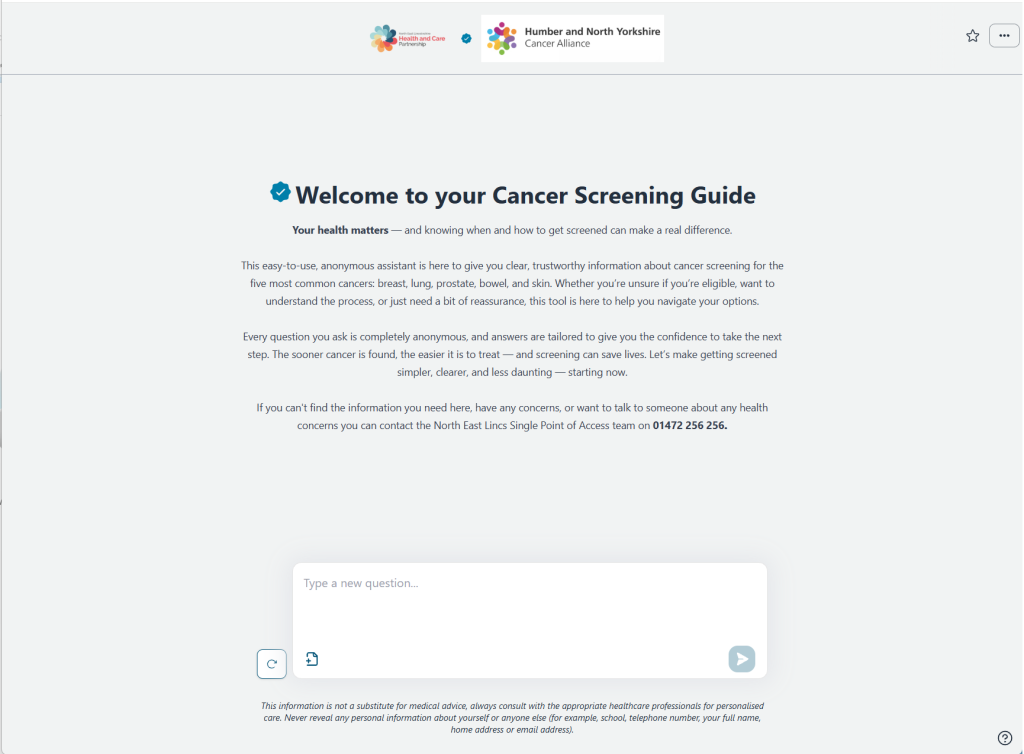
What Cancer Support Buddy Does
Cancer Support Buddy is trained on the cancer information that matters most for your local population — screening programmes, treatment pathways, local support services, community resources, and clinical guidance — and makes it accessible to anyone, in plain language, at any time.
For patients and carers, it provides:
- Plain-language answers to questions about cancer screening, diagnosis, and treatment — without clinical jargon or confusing navigation
- Local service information — where to go, what to expect, what support is available in their area
- Multilingual support — responding in the user’s own language, removing one of the most significant barriers to information access for diverse communities
- 24/7 availability — accessible outside of appointment hours, when anxiety tends to be highest and support is hardest to find
- Consistent, trustworthy responses — every answer drawn from verified, approved clinical and local information sources, with citations
For frontline practitioners — social prescribers, community health workers, cancer nurse specialists, and GP surgery staff — it provides:
- Instant access to accurate information to answer patient queries quickly and confidently
- Reduced administrative burden — fewer time-consuming information searches, more time for direct patient care
- A reliable reference tool that keeps the whole multi-agency team working from the same up-to-date information base
- Support for complex conversations — helping practitioners provide patients with clear, consistent messaging about pathways and services
HOW IT WORKS (KEY FEATURES)
1. Trained on health info
2. Multi-lingual
3. Accessible everywhere
4. Multi-agency support
5. Up-to-date info
WHY IT MATTERS (BENEFITS)
1. Consistent communication
2. Large-scale info sharing
3. Better patient support
4. Multi-lingual
5. Compliance
Addressing Health Inequalities Through Better Information Access
Cancer doesn’t affect all communities equally. Deprivation, language barriers, low health literacy, and limited access to services all compound to create stark disparities in cancer outcomes — higher rates of late diagnosis, lower screening uptake, and poorer survival rates in the communities that are already most vulnerable.
Improving information access is one of the most powerful levers available to address these inequalities. When patients can access clear, trusted, locally relevant information in their own language, at any time, from any device — barriers come down. Screening appointments get made. Help gets sought sooner. Outcomes improve.
Cancer Support Buddy is designed with this in mind. It isn’t a generic chatbot. It’s a carefully configured, locally trained AI assistant built around the specific population, services, and challenges of the area it serves — co-designed with healthcare professionals, community members, and voluntary sector partners to ensure it meets real-world needs.
North East Lincolnshire — Cancer Support in One of England’s Most Deprived Areas
North East Lincolnshire faces some of the most significant health inequalities in England. Around 40% of its neighbourhoods rank among the most deprived 20% nationally, with correspondingly high rates of lung and bowel cancer closely linked to socioeconomic factors. Breast cancer screening coverage stood at just 61% in 2021 — below pre-pandemic levels and well below the national target. Barriers including limited transport, childcare responsibilities, language differences, and complex healthcare information systems all contribute to low engagement with screening and support services.
The Cancer Support Navigator project, led by the Care Plus Group, set out to address this directly. Working with Leading AI, the team built a co-designed AI assistant trained on local cancer screening documentation and support services — developed through workshops with healthcare professionals, community members, and voluntary sector partners to ensure it genuinely reflected the needs of the population it would serve.
The assistant provides accessible, plain-language information about screening procedures and support services, tailored to individual needs and literacy levels. Multilingual support was built in from the start to serve the area’s diverse population. It is available 24 hours a day, seven days a week — reducing reliance on in-person consultations for basic information queries and freeing frontline practitioners to focus on direct patient care.
Initial feedback from practitioners has been extremely positive. A significant volume of information can now be accessed quickly, easily, and accurately using natural language queries — in multiple languages for both inputs and outputs. The project is ongoing, with the full evaluation due in late 2026.
How Cancer Support Buddy Works With KnowledgeFlow™
Cancer Support Buddy is delivered through KnowledgeFlow™, Leading AI’s secure AI platform. It can be configured as a patient-facing tool embedded into NHS or council websites, an internal resource for frontline practitioners, or both — with access and permissions managed centrally.
The platform supports integration with existing healthcare information systems and can be expanded as needs evolve — to additional cancer types, additional languages, or additional services.
Alongside Cancer Support Buddy, organisations can deploy Research Buddy for clinical research and funding applications, or Knowledge Assistant for broader organisational knowledge management.
All data is hosted within your own secure cloud environment — Azure or AWS. Leading AI is ISO 42001 and ISO 27001 certified. Patient data is never shared with public AI models or used to train external systems.
Frequently Asked Questions
Who is Cancer Support Buddy designed for?
Cancer Support Buddy serves two audiences. For patients and carers, it provides 24/7 access to plain-language, locally relevant cancer information — screening, pathways, services, and support. For frontline practitioners — social prescribers, community health workers, cancer nurse specialists, and GP teams — it provides a fast, reliable reference tool that reduces time spent on information searches and supports consistent patient communications.
What information is Cancer Support Buddy trained on?
Cancer Support Buddy is trained on locally relevant cancer information — screening programme details, treatment pathway guidance, local support services, NHS and community resources, and any other documents the deploying organisation identifies as important. The knowledge base is configured for the specific population and geography it serves, not a generic national dataset.
Can it respond in languages other than English?
Yes. Multilingual support is a core feature — Cancer Support Buddy can accept queries and provide responses in multiple languages, making it accessible to communities where language barriers are a significant obstacle to information access.
Is it suitable for patient-facing use?
Yes. Cancer Support Buddy is specifically designed to be used directly by patients and carers, providing plain-language information in an accessible, non-clinical tone. All responses are drawn from verified, approved sources and include citations — ensuring accuracy and trustworthiness in a context where the stakes are high.
Can it be integrated into an existing NHS or council website?
Yes. Cancer Support Buddy can be embedded into existing NHS trust, Integrated Care Board, or local authority websites, or deployed as a standalone tool accessible via a direct link. Integration requirements are scoped during the setup process.

Ready to improve cancer information access for your population?
If your organisation is working to improve cancer outcomes, reduce health inequalities, or support stretched frontline teams — Cancer Support Buddy is worth a conversation.
Book a demo and we’ll show you how it works — configured for your local services, your population, and your specific challenges.
You can also read the full North East Lincolnshire case study, explore our case studies for more deployments across health and care, or learn more about the KnowledgeFlow™ platform that powers Cancer Support Buddy.
Get a demo
No matter how good (or bad) this website is, you won’t truly understand the power of our Assistants until you see them for yourself.
Ask for a demo and you’ll be able to ask as many questions as you like and see if they might work for you.
So please don’t be scared to fill in the form. We promise we won’t put you in touch with a pushy sales guy.
You’ll talk to one of the team who’s been delivering AI and actually knows what they are talking about. They’ll be honest about whether our AI solutions are right for you.
Hopefully that’s reassured you, and hopefully we’ll speak to you very soon.
Contact details
"*" indicates required fields