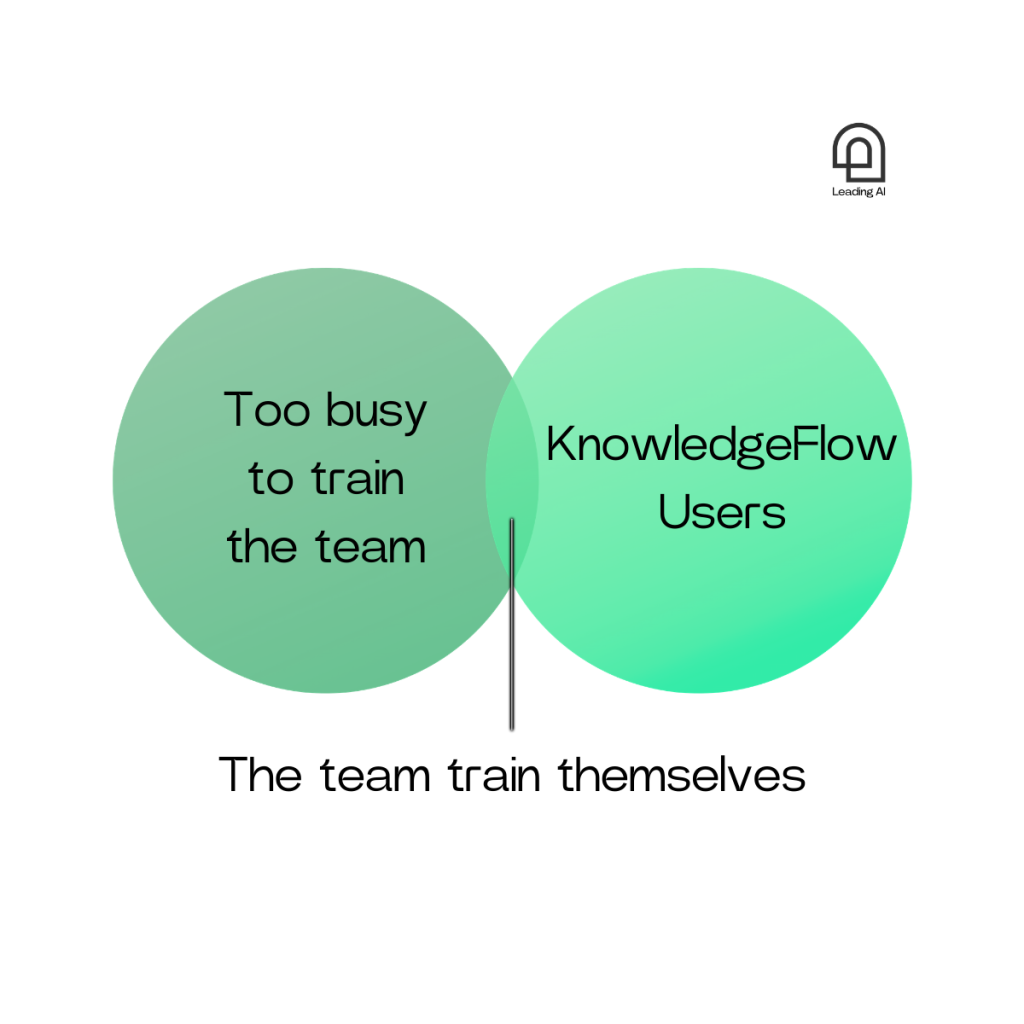
You’re too busy to train your team on AI. That’s exactly why you need to.
There’s a conversation happening in boardrooms and kitchen-table businesses alike, and it goes something like this:
“We know we should be doing more with AI.”
“We just don’t have the time to figure it out right now.”
Which is, of course, a bit like saying you’re too busy driving to stop for petrol.
The irony is sharp. The businesses that most need to reclaim time are the ones too stretched to invest in the tools that would give it back to them. And so the cycle continues — more questions from the team, more repetitive explanations, more hours lost to things that should have been documented, systematised, and sorted long ago.
The real cost of “we’ll get to it”
Let’s be honest about what “not having time for AI” actually looks like in practice.
It looks like a new starter spending their first three weeks asking the same questions your last three new starters asked. It looks like a senior person — your best people, the ones whose time is most valuable — becoming a human FAQ for the team around them. It looks like knowledge that exists nowhere except in someone’s head, which means it walks out the door every time someone hands in their notice.
None of this is anyone’s fault. It’s just what happens when a business grows faster than its systems.
But it is expensive. And it gets more expensive every month you wait.
The training day myth
When most business owners think about “adopting AI,” they imagine a training day. A consultant. A change management programme. A deck with a roadmap on slide seven and a Q&A that runs over time.
No wonder they put it off.
But there’s a quieter, more practical version of AI adoption — one that doesn’t require anyone to rethink how they work, attend a workshop, or sit through a demo of features they’ll never use.
It just requires capturing what your business already knows, and making it available to the people who need it.
That’s it.
What KnowledgeFlow actually does
KnowledgeFlow is built around a simple idea: the knowledge your business runs on shouldn’t live in one person’s inbox, or in a folder nobody can find, or in the head of the colleague who’s been here longest.
It should be structured, searchable, and available to everyone — instantly.
Your processes. Your playbooks. The answer to the question your team asks every single week. The thing that took you years to learn and twenty minutes to explain. All of it, organised and accessible on demand.
No training days. No “just ask Sarah.” No 47-message Teams thread that ends with someone phoning the person they should have been able to find the answer from themselves.
What changes when you put it in place
New starters get up to speed faster — not because someone sat with them for a week, but because the information they need is already there when they look for it.
Your most experienced people get their time back — not because they’ve been replaced, but because the questions they kept being asked are now answered before anyone has to ask them.
And you, as the owner or the leader, stop being the bottleneck — not because you’ve delegated differently, but because the system does the work that used to come back to you.
The team doesn’t need training. It needs access to the right information at the right moment. KnowledgeFlow makes that possible.
The second-best time
The best time to have sorted this was probably when you hired your third person, or your fifth, or whenever it first started to feel like too much was living in too few heads.
But the second-best time is this afternoon.
If you’re too busy to train your team on AI, you’re probably exactly the kind of business KnowledgeFlow was built for.