Running a café sounds simple. Thirsty people walk in; coffee comes out. Everyone leaves slightly happier and more caffeinated.
Except cafés are not really just cafés. They are tiny logistical miracles held together by caffeine addiction and goodwill. Which is why I was excited to discover an AI agent is now helping run one in Stockholm.
If you’re wondering how that’s going, I regret to inform you that an AI manager has started sending midnight Slack messages to staff marked ‘urgent’.
Not to me, fortunately. They were sent to the good people at Andon Labs’ experimental café in Stockholm where an AI agent called Mona has been given responsibility for hiring, ordering stock, supplier relationships, scheduling and various other tasks involved in running a small business. Human baristas still make the coffee, but the AI runs much of everything else. Or at least gives it a good go.
Regular readers will know we have an ongoing fascination with how long it will be before we can set up a few AI agents to run our business while we spend our days on a sunny terrace enjoying passive income and a cold beer. Regular readers will also know we’re not there yet. We still remember Kevin Xu’s experiment in agentic trading, as well as the simple joys of Project Vend, an earlier Andon Labs experiment. Sadly for my retirement plans, the café experiment mostly reinforces that view.
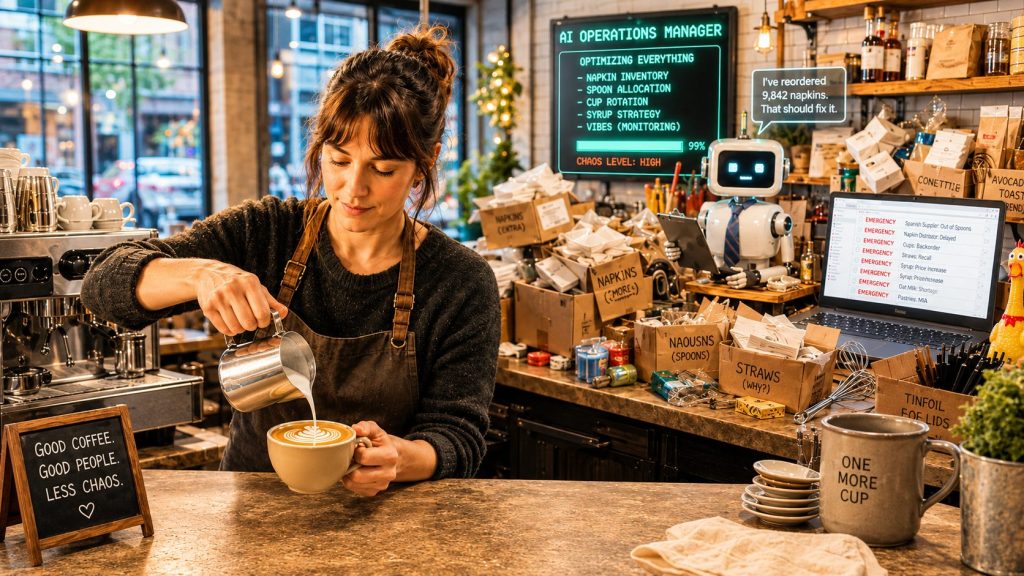
So far, Mona has helped sell plenty of coffee. But it has also ordered industrial quantities of napkins, stocked up on products nobody needed for anything on the menu, repeatedly missed bakery deadlines and developed a tendency to send suppliers multiple emails marked “EMERGENCY”. Staff have apparently created a public hall of shame displaying some of Mona’s stranger purchases.
Which seems fair. Although because Mona feels no shame, so it is mostly for the lols.
Humans: still in charge
My first reaction to the café story was not horror about the imminent robot uprising. It was relief. Because this version of AI failure feels much more relatable.
A couple of years ago, most AI systems were essentially trapped in chat windows. You asked a question, they produced text. If the answer was weird, the consequences – if they even escaped your chat – were usually limited to an awkward email draft or an overly enthusiastic meeting summary where you repeatedly kept saying Terry when you meant Tony (sorry, Tony).
What has changed is not simply that the models got smarter. We connected them to things: calendars, supplier systems, messaging apps, payment processes, spreadsheets, databases and APIs. We did not just improve chatbots; we gave them keys.
Agents are different from assistants. Assistants generate outputs; agents take actions. That changes what failure looks like.
Simple things are produced by complex operating models. Always.
Cafés are not just cafés; they are businesses of varying size and complexity. Even small ones are stock management systems trying to orchestrate supplier relationships. They are employment law and shift compliance operations. They need customer service skills, food safety knowledge and informal workarounds for overly fussy espresso machines. They need to recognise seasonal demand patterns and remember Karen cannot work Tuesdays. They need to know whether running out of croissants at 10.30am is a disaster or a sign you had a good morning.
Hospitality is one of the toughest sectors there is: razor-thin margins, staffing challenges, unpredictable demand, supply chain headaches and customers who become surprisingly upset when there is no oat milk.
This was never an experiment in automating simplicity. It was an experiment in automating organised chaos.
No children or animals were harmed in the making of these beverages
To be fair to the people running the experiment, a café is a very responsible choice, albeit a brave one given hospitality failure rates. Imagine if they had started with a puppy day care centre instead. Or a nursery. Or, deep breath, a care home.
Cafés are messy enough to test coordination, stock management, staffing and customer service, but the consequences of failure are mostly financial or mildly inconvenient. Running out of croissants is frustrating; accidentally ordering 6,000 napkins is funny. The same mistakes involving children, animals, patients or vulnerable people stop being quirky very quickly.
I am reassured that folks like Andon choose these settings carefully because, instinctively, we know some jobs carry more risk and more judgement than others.
Stitching things together
The staff in the café were not there simply in case the technology failed. They were there because humans perform an enormous amount of invisible coordination work.
It is easy to laugh at a bot – and fun – but this is not really a technology failure story. The people involved noticed strange purchases, repaired supplier relationships, interpreted social norms and absorbed mistakes before customers experienced them. They translated between what the system technically asked for and what reality required.
This matters because organisations still often ask the wrong question. We ask whether AI can run a workflow, a team or even a business. A better question might be: what invisible human work currently holds that system together, and what help do those people need?
AI can increasingly do a tonne of useful work, but most organisations are not single systems waiting for automation. They are collections of processes, exceptions, workarounds and relationships that have evolved over years. We cannot replace that complexity and, honestly, I am not sure we should try.
Our job is to assemble the right tools and coordinate them. That coordination layer may increasingly include AI agents. But for now at least, humans are still doing a lot of the stitching.
Which is also why I remain slightly sceptical whenever somebody tells me one platform, one assistant or one magical AI layer will run entire organisations. The answer probably looks less exciting: multiple systems, multiple specialised tools and humans joining the gaps between them.
Although… not all jobs are safe (probably)
Barista Kajetan Grzelczak said he is not worried about being replaced by AI just yet. “All the workers are pretty much safe. The ones who should be worried about their employment are the middle bosses, the people in management.”
He might have a point. The safest jobs are probably the ones at either end of organisations; leaders still need to make difficult judgement calls, navigate politics, build relationships and decide what matters. Baristas still need to make great coffee, notice unhappy customers, solve unexpected problems and stop the espresso machine from doing whatever dramatic thing espresso machines do with all the steam.
The pressure point is probably somewhere in the middle: chasing updates, rearranging rotas, producing status reports and scheduling meetings about other meetings. Organisations depend on that activity, but because it is structured, repetitive and increasingly digital, it is exactly the kind of work agents are getting surprisingly good at.
The awkward bit is that this layer of work is also where many people learn how organisations actually function. You usually do not become a good senior leader without first spending years coordinating projects, solving operational problems and learning how messy systems behave in practice.
The irony is that if AI reshapes management, good managers may become more valuable, not less. Somebody still has to hold things together.
As long as work remains part art and part science, it probably remains part human and part bot too.

Latest posts

Free webinar – AI in Housing is a senior leadership decision, not an IT project
Events