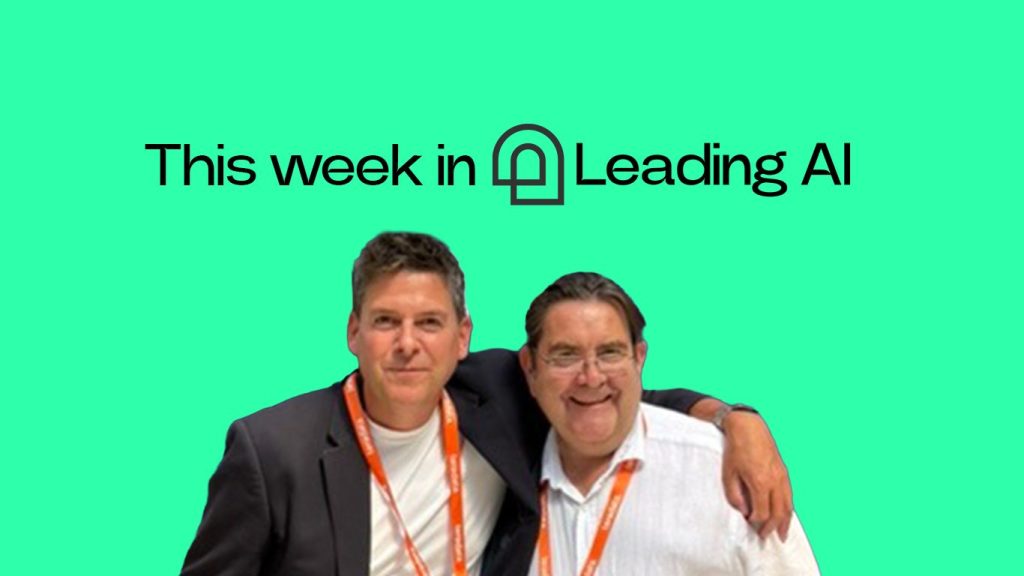
Episode 9: AI Deniers, AI Slop & KnowledgeFlow Cracks Salesforce 🍺
Neil’s on a non-alcoholic beer again — this time because he’s in the doghouse with Mrs Watkins and needs to drive her to a romantic weekend away to patch things up. It’s that kind of Friday. Welcome to Episode 9.
Mrs Watkins is an AI denier — and she’s not alone Neil tried to convince his wife of the wonders of AI. She said “it’s great but it’s not for me.” Sound familiar? Neil points out this is almost word for word from Richard Susskind’s How to Think About AI — a whole category of people who can see the value but won’t change their process to fit around it. Then again, Staples’ share price allegedly collapsed when Mrs Watkins switched from post-it notes to spreadsheets, so perhaps there’s hope.
The future of management — courtesy of Nate B. Jones Neil recommends a brilliant piece by Nate B. Jones (his second plug this series, and no, he’s not on commission) on what management is actually for. Three roles: routing information to the right place, sense-making in the noise, and accountability. How much of each is AI-able? More than most managers would like to admit.
Trust in a world of AI slop Can you trust a video anymore? A photo? A LinkedIn post? Kieron raises the uncomfortable reality that AI-generated content is everywhere — including on Instagram (those animal rescue videos? Mostly fake). The organisations that will win are those with genuinely trusted brands and curated data sets — like the King’s Fund or Stripe. Being a trusted source is now a competitive advantage.
Anthropic’s Claude 4 Opus (Mythos) — the model you’re not allowed to have Kieron digs into the buzz around Anthropic’s most powerful model, apparently so capable it performed zero-day attacks on every major operating system in its first outing. Is it genuinely that dangerous? Or brilliant pre-IPO marketing? Either way, the CEO of Barclays was talking about it on the radio at lunchtime. Mission accomplished.
Five security questionnaires, 20 hours, and a lot of AI slop Neil spent most of the week answering overlapping, partially nonsensical security questionnaires from a prospective customer — three of them about data privacy, many questions clearly generated by ChatGPT (the M-dashes are a giveaway). The cobbler’s children moment: Leading AI built a KnowledgeFlow security RAG for themselves mid-episode and were answering questions live before the call ended. Twenty hours of pain, sorted in minutes.
Outcomes-based pricing — the next frontier Goldman Sachs says AI companies are moving away from per-seat licensing toward outcomes-based pricing. Kieron has already had the first conversation about it: a college currently pays £20 per student application document check to an outsourced company. KnowledgeFlow can do the same thing for about 30p of AI processing. The maths are not subtle.
Product of the week 🎵 (build to a crescendo) KnowledgeFlow now connects directly to Salesforce via live API calls. No more exporting data, no more waiting for reports, no more paying tens of thousands for bespoke dashboards. Any staff member can now ask questions of their Salesforce data in plain English and get instant answers — across multiple data tables, in real time. Well done Donald and Ibby.
A personal moment — Kieron’s dad’s care plan Kieron’s father moved into a care home in January. The family received a 16-page care plan full of jargon and boxes nobody understood. Kieron put it into KnowledgeFlow, asked “what can I do to help?”, and got five clear bullet points back. He sent it to the family WhatsApp. Everyone said thank you. That’s what this is actually for.
Plus: house manuals loaded into Notebook LM, a frame TV that displays art when switched off, and the ongoing mystery of whether Neil will successfully escape the doghouse by Monday.
Two mates. A bar. Thirty years of business between them. And all they want to talk about is AI.
Pull up a stool — we’ll get the beers in. Even non-alcoholic ones for those who want them.🍺
Click here to see other episodes.
TRANSCRIPT:
This week in Leading AI…-20260417_130011UTC-Meeting Recording
17 April 2026, 01:00pm
Should we do it?
Should we get on with it? Should we do? Should we? All right, let’s get started. Oh, hang on a second. Here we go. Cheers. Oh, you got Corona as well. Yes, very good. Cheers.
Kieron White 14:42
Okay, let’s go.
Says.
Yeah, that’s right.
You’ve not got one of those no-alcohol ones again; I should be.
Watching. Is it? Is it in no alcohol one?
Neil Watkins 14:57
Yeah, it is. Let me tell you why. Let me tell you why. Let me tell you why. I, as soon as this, as soon as this call is finished, I have to take Mrs Watkins away on a special weekend.
Kieron White 15:01
Neil Watkins.
Oh yes.
Neil Watkins 15:16
because I’m in the dog house and it’s going to cost me a lot of money to get out of the dog house. So I’ve got to drive. Well, there’s a couple of things. One I will share with you. We had a little discussion. I’m going to say discussion. We had a discussion. And there’s a bit of a problem in
Kieron White 15:18
Yeah.
What have you done now?
Neil Watkins 15:36
It turns out Mrs Watkins is an AI denier. And I know, which is really awkward given her husband and her son both work in an AI organization. And it’s really interesting. So Ben spent ages trying to show her how to use AI. She’s like, oh yeah, I can see how, yeah, it’s really, but it’s not for me.
Kieron White 15:48
Yeah.
Neil Watkins 15:56
And it will never catch on. And so I was like, hang on a minute, it can do these things, it can do that thing. Yes, but it doesn’t do them in the way that I want them to. And I was like, well, we could do that. She’s like, yes, but it doesn’t fit my process. And I went, oh, hang on a minute.
Kieron White 15:56
It’ll never catch on.
Mmh.
Neil Watkins 16:16
Have you considered that actually it might be you that needs to change the process to fit AI or AI is going to change the process for you or it’s going to speed up? And if other people in the organisation are using AI then, and if you haven’t adapted, what are the implications for you? And I can’t tell you the exact words that came out of her mouth.
Kieron White 16:37
Haha.
Neil Watkins 16:38
Anyway, I’m going away for the weekend. But it made me think quite a bit because I don’t know if you remember, there was a really good book came out from a guy called Richard Susan, I think it was, called How to Think About AI. And he talked about different categories of people. And there’s a category of people which is, oh, AI is great, but it’s not for me. And she literally said those words. I can see how it would help other people was
Kieron White 16:47
Yeah, that’s right.
No.
Neil Watkins 17:00
And he used the exact same language. These people will say that. And we’ve talked before about customers that we’ve got or people that we’ve talked to or managers in organisations that we’ve talked to. Oh, yes, I can see how AI be really good, but not this not for us. Oh, yeah. And Helen’s view as well. I’ve got.
Kieron White 17:15
Yeah, yeah.
Neil Watkins 17:19
I’ve got, you know, on my spreadsheets, all my cells are now colour-coded and it’s like, that’s brilliant. I mean, it’s not so long since we weaned you off bloody post-it notes and coloured highlighter pens there. I mean, Staples’ share price collapsed when she stopped using them. So I said,
Kieron White 17:28
Ha ha.
I did wonder if we had to build an AI tool that will write post-it notes and stick them to our wall.
Neil Watkins 17:42
What we need is a little robot that comes down and goes and then colours it with a yellow highlighter and then a green highlighter. So yeah, I’m in the dog house and I need to go and repair my marriage. So just sharing that with the audience. So
But yeah, that’s the reason Mrs Watkins is an AI denier and she will not be convinced otherwise at the moment. So let’s see, let’s see whether a romantic candlelit dinner and a bottle of bubbly will help change her mind. But I don’t have great hopes. Even my sales skills aren’t that good, Kieron.
Kieron White 18:03
Well…
Button.
You might take…
Might change your mind temporarily, but it’s, I mean, and the changing the workflow, changing your processes, I mean, that’s the thing, isn’t it? That’s really the thing. And at the moment, no one’s really talking about that. I think, I mean, I see McKinsey are talking about that more and more, which is great to see, but that is the world where everybody needs to think about.
Neil Watkins 18:35
Yeah.
Kieron White 18:37
really, if you were redesigning your organisation as an AI first organisation from the bottom up today, how would you design it? That’s the really interesting stuff because that is also, I mean, yes, there’s going to be savings in jobs, of course there will be, but reality is you could make in housing the most amazing housing association.
Neil Watkins 18:45
Yeah.
Kieron White 18:56
As we touched on before, you could have tenants being able to interact with an app, finding their own stuff. They do their own admin a lot of the time. That’s what Amazon’s clever thing was, really. I remember in the very early days of the internet, people were talking about Amazon cleverly outsourced to you, writing your own shipping label and running your own payment.
Neil Watkins 19:14
Yeah, that’s right. Print off your own labels.
Kieron White 19:15
When you think about what was happening, you had the phone up and someone would have to take it all through and write it down and create the label. Amazon have you doing it all for them. So, but I think so some of that world, but also just that, you know, the ability just to kind of cut through all of the delays. And let’s face it, I mean, housing, education, applications for anything,
Neil Watkins 19:20
Yeah.
Kieron White 19:37
are all simply waiting for a bottleneck. The theory of constraints, I think, is the right term, isn’t it? But like, they’re just, yeah, waiting to get over this bottleneck. So I think the faster people get their head around that, I think that’s when you’re really going to see AI making a massive difference.
Neil Watkins 19:40
Yeah.
Indeed.
And I guess we’ve seen that in a few customers, haven’t we? They kind of start to wake up to it once they start to use it and they start to see the power. And we’ve got a couple of customers where we’ve just seen that usage go up and up, which is great. Even in one of the, dare I say it, AI denying manager type organizations.
They don’t know that their team are actually using it much more than they actually are. So that is fascinating to me. And it kind of links to something that I listened to, watched. As you know, we’re both fans of Nick B. Johns, who is our AI guru. And
Kieron White 20:17
Mm.
Yeah.
Hello, Nate, if you’re listening.
Neil Watkins 20:33
I bet he’s not. He’s got his own stuff that they, I can’t imagine. Yeah, he did a great little session on Substack. I’ll, when I put the poster, I’ll put the link in, but it was about the future of management. And there’s been a lot of talk this week about companies
Kieron White 20:34
Yeah, I can’t imagine listening to us rattling on.
Neil Watkins 20:53
flattening their hierarchy, getting rid of layers of management, and Mark Zuckerberg creating a virtual CEO to help manage the organisation down. And what Nate was talking about was there’s really three jobs to management. The first one is routing, so getting information in and making sure it goes to the right place, and then
Kieron White 20:55
Mm.
Neil Watkins 21:14
gets handled correctly. The second was around sense making, so that kind of idea of understanding the signal in the noise, both top down, bottom up and internally and externally. And the other, the third role of management being accountability and making sure that people do what they’re supposed to do.
the things that need to be done are done. And I’d not heard of it kind of put in that way before and obviously part of this spills around how much of that is AI able and the routing piece clearly can, you know, we’ve already done the whole kind of messages in
for housing associations and others. So how do we, how do we get messages in, where do they go, who deals with them, what categories, which ones need to be escalated to a human and all of that good stuff. I think we all, I was thinking about the sense making stuff because this is really interesting. This is back to the corporate knowledge stuff where, you know, if somebody leaves your organization, their corporate knowledge just walks out with them. There’s no way of capturing that unless you’ve
Kieron White 22:18
Dean.
Neil Watkins 22:20
Of course, you kept everything in in a rag. And then the final thing around accountability, that whole piece about, you know, can you outsource accountability to AI? And people say, no, you can’t. But interestingly enough, that whole AI human in the loop. And we’ve talked before about one of our customers that says, we want AI in the loop. We don’t want the human
sending anything out unless it’s been through the AI to make sure that it’s both sense checked correct and then the tone is correct because actually one of the challenges for some organisations is that the responses that they’re giving back to customer inquiries get them into more trouble than it actually solves because either something’s gone slightly wrong or
Kieron White 22:44
And they…
Neil Watkins 23:05
they’ve mishandled or misunderstood something and then it just escalates into a full-blown complaint that causes more cost and an issue than it should have been. So yeah, it’s been quite challenging for me on the old thought processes about organisations stuff this week, because not least, as I say, because I’m still in the doghouse, but hopefully by next week I’ll be out. I’ll let you know.
Kieron White 23:09
Indeed.
Neil Watkins 23:25
Yes.
Kieron White 23:28
Well good luck with this weekend and I think you’re right to try and throw money at the problem. At least made some of the way and then a lot of humility. I interesting on your routing point for there really this week talking to one of our large housing association
Neil Watkins 23:36
IT.
Kieron White 23:46
clients about their experience using knowledge flow and kind of seeing what we, where we can make improvements or indeed add new tools. And one of the things that is really interesting, the person that’s leading this, the rollout or the training said she observed that what happens in, and I’m sure this is very common in lots of organisations,
frontline team, customer inquiry team, comms centre team, whatever, is receiving a perhaps slightly unusual problem for a repair, let’s say. I’m just sort of an example, really. They’ve got to find who is responsible for these repairs. Boilers, presumably they know because they must happen 100 times a day.
in big housing associations. Anyway, so you got to go by who is responsible for this thing. You ask some colleagues, have a hunt about, find somebody, send them an e-mail. What she said is then three days go past and you get an e-mail back or note back saying, no, not me. They have a five day service level agreement on responding and now three days have gone.
So all of that leads to what RAG can do for that. And in my mind, it is one of the most simple things we could do to have what would be a pretty short, clear document in a RAG index that knows the team’s responsibilities, e-mail, phone numbers, whatever you want to have for contact.
Neil Watkins 24:57
Mm.
Yeah.
Kieron White 25:08
and solve that problem instantly. And then, of course, with RAG, you could either just kind of share the problem or just let it decide, let it tell you, not, you know, you don’t need to sort of say who’s responsible for repairing brickwork. You could just share the e-mail and it would go, great, I’ve notified the right person. Let’s move on. Or better still, not even bother in the beginning to have the triage happen.
Neil Watkins 25:11
Ben.
Yeah.
Yeah.
Kieron White 25:30
in the background and just no human involved in it until it gets to the right human, which is quite interesting.
Neil Watkins 25:36
But it’s back to that bottleneck thing, isn’t it? It’s how do you fix those bottlenecks in organizations, either either.
necessarily bureaucratic and sometimes those bottlenecks are in place for a reason because you need to add a bit of friction to the process to make it work. But most often than not, that’s really not the case. It’s just this, here’s some stuff that needs doing. The reason it doesn’t get done is because people are super busy and or they don’t know how to
have to prioritise or they get their prioritisation wrong or they don’t have guidance on how to do that. So automating as much of that as possible just seems common sense really.
Kieron White 26:13
Yeah, indeed, yeah, but.
Neil Watkins 26:14
But it’s not for us and it doesn’t colour code. It doesn’t put a colour coded cell into my spreadsheet. So I don’t like it.
Kieron White 26:20
And we’re not far from being able to do that. Claude Cowork could do that if you were, if you were risk, no, what’s the word? Risk, hungry? Risk, you have a high risk appetite, I think would be the right, because yeah, you couldn’t, you wouldn’t want Claude touching any of the stuff that Helen does.
Neil Watkins 26:22
But.
Yeah.
Who is hungry?
The.
Kieron White 26:38
Who knows what it will be up to?
Neil Watkins 26:38
No, indeed, not. Indeed, we’d lose all of our money.
Kieron White 26:42
I mean, on that, I mean, interesting, two conversations this week I’ve had about trust. And I think that’s really interesting to think about the future of AI slop. And I think you’re going to talk about AI slop shortly, aren’t you? But what cuts through, you know, we can no longer really trust a video, which is a kind of interesting world to find ourselves in now.
You know, I’m not a massive social media fan, but I, you know, I like to spend 10 minutes on Instagram and have a flick through and you see these videos, you think, wow, that’s amazing. And then you suddenly thinking, hang on a minute, but it’s not obvious. Hang on a minute. There’s a lot of the theme I, well, at least the theme I’ve seen a lot on Instagram is kind of animal rescue things where they kind of someone
Neil Watkins 27:05
Mm.
One minute, and…
Kieron White 27:24
personally rescues a duck and it lives with them and grows up with them and then they release it one day or they don’t or whatever. And it turns out most of those are just made with one of the AI video tools. And you’re like, oh, that’s really disappointing. But if you’re in a world where you can’t trust video, which for me was one of the last bits for, you know, a picture of 1000 words, quite difficult to
Neil Watkins 27:43
Yeah.
Kieron White 27:45
kind of to fake it too much, to harder than text. So now that’s gone. So what can you trust? And I think the answer is brand names. So, you know, as you know, the King’s Fund, who we do some work with, you know, they’re well respected in the sector. I think here is their opportunity now to cut through what
Neil Watkins 27:49
Yeah.
Kieron White 28:05
Yeah, you can be on ChatGPT and find out the latest research on hospital management and leadership and strategies. But do you believe it? Do you know if it’s true? If it came from the King’s Fund, probably you do. And that’s, I think, is really interesting for all organisations to think about is what, if trust does become important, then what’s their position in that and how do they curate a data set ultimately?
so that they own a trusted data set that you choose to use with AI or not, but just this is our set.
Neil Watkins 28:34
Yeah.
That trust thing is another one of Nate’s big themes. Here’s another plug for Nate B. Jones. I highly recommend him. He’s fab.
Kieron White 28:50
Yeah.
Have you got a referral link or something Neil?
Neil Watkins 28:53
I haven’t. I’ll do something, but no, and I’m not on commission, just to be clear. But he talks about trust and judgment, you know, in the in the current age. He talks a lot about those things and trust. So companies like Stripe, for example,
going from strength to strength because they are a trusted organization. So, you know, if you’re giving your credit card details to Stripe, then you’re not giving it to whoever else. And but that whole kind of knowledge and information, how do you how do you become a trusted trusted intermediary between effectively the data and the customer?
Kieron White 29:17
Yeah, interesting.
Yeah.
Neil Watkins 29:34
so that you’re a trusted source. So I think there’s a huge amount of work to do on that. And we talk about it a lot. We talked this week with an international organisation. We’ve got a few things to say about them. They’re really interesting. But an international organisation providing services across
multiple countries. And they’d obviously spent quite a lot of time thinking about AI and how it could how it could work for them. But what I found great in the conversation was just whenever I think I’m getting bored of Rag AI, somebody else comes up with another great set of use cases.
Kieron White 30:11
No.
Neil Watkins 30:14
Because I think it’s, you get a bit blasted on you. It’s quite simple to us. It’s just, it’s got to be trusted. It’s got to be curated. It’s got to be accurate. It can’t hallucinate. It’s got to produce the accurate information. As you talked about to them, you know, there’s probably 10 variables that we constantly tweak and adjust through the testing period to make sure it gets right. And if something goes wrong, we
We get the we get the rag whisperers on it in the background to to make sure that it does what it’s supposed. Yeah, it can’t be, and and so they’re making it a trusted source of information for the for the for the people in the organisations that are using their.
Kieron White 30:43
Shout out for Ruby.
Neil Watkins 30:57
services, I think is potentially a really valuable and really interesting use case. I thought it was a great presentation that you did and I said absolutely nothing all the way through. So thanks for making my life easier. Couldn’t get a word into it. And there’s another thing. Let me show you this thing on Safeguard and let me show you this thing and let me show you this thing.
Kieron White 30:59
Hmm.
Haha.
Oh, I know, it’s so tricky. I’ve done a lot like that recently and I kind of very conscious on blasting people with information and it’s so, I don’t know if it’s sensible or not. Ideally, I would have a really well measured and managed way through it. I don’t, I’m making it out as I go each time.
and sort of trying to read the room a little bit and sort of focus on the things I think they’re going to be interested in. But I don’t know, I kind of part of me is like, well, it’s a good way because they’ll all take two or three or four things from it and they might be different two or three or four things. So it’s helpful for that. And then the other part of me is like, I’m just giving them so much they can’t, they don’t know what to do next.
Neil Watkins 31:53
Yeah.
Kieron White 31:53
So it’s very, yeah, I struggle over the sales of this stuff. It’s very different, you know, consultants selling, selling consultancy, you know, ultimately you’re kind of selling a recommendation, a bit of a kind of model, a theory, methodology or something to solve a problem. Whereas maybe there is a sort of learning from that in trying to pitch this.
Whereas this tends to be more a kind of look what’s possible. Let me show off what our platform can do. And yeah, hopefully some of it sticks. But I think they’re interesting. Go on, sorry.
Neil Watkins 32:22
The wish is to keep.
No, after you. You think they’re interesting.
Kieron White 32:25
I was going to say, I think they’re interesting, that organisation, because what they sort of, so they’re an international funded, they’re funded by sort of charity money. I was trying to find the right word for that, but I can’t think of it. But they’re funded to then go and do, you know, various programmes in the world, and they might sort of go to sort of four or five
kind of countries that are struggling and do something in teacher education or all kinds of different areas. And the idea that potentially that came with Knowledge Flow, an AI platform, that they then are in control of the data in the background, I nearly said their name, that’s their data in the background that is trusted
and driving the right outcomes, helping people to sort of, you know, do the right thing by whatever their programme ambitions and aims are. I think that’s really interesting. And the learning that you could run across the group, if they’ve got 30 of these things at a time in different, you know, schools, universities, different countries or whatever.
you could have them all on the one platform with the right tools built within Knowledge Flow to do whatever those need to happen with the right data. Really interesting.
Neil Watkins 33:35
And you could add in things like the sentiment analysis, so you can see when people are frustrated and you can see when they when they what they like and all of that stuff. And the safeguarding piece, of course, which we’ve talked about before, which I think is just super important and not not made.
Kieron White 33:41
Yeah.
Neil Watkins 33:54
enough of. What I was just going to say was in sort of the classical software sales theory literature, it all talks about, you know, you shouldn’t say anything until you’ve understood their questions and their problems and you understand how, you know, what they’re thinking about these problems so that you can then adapt your
Tool to to them, unless it’s very different with AI, I think, just because it’s just so many. It’s a bit like the conversation we had with these guys. We were on for what, forty-five minutes, and at least…
half of that was then sort of, and have you thought about doing this and now we could do that and we could do the other. So it’s really, it’s a much more, it’s much more kind of organic than kind of a structured sales process, I would suggest. So yeah, anyway, I’m not sure you can stick to the script anyway. You’re always off all over the bloody place.
Kieron White 34:29
Yeah.
Yeah.
Neil Watkins 34:46
Talking, talking notes.
Kieron White 34:47
Indeed, I don’t know what I’m going to say next most of the time. So it’s the thought of actually trying to, and I’ll write notes down before and then completely ignore them. So it’s like I just, I really just have to just go and show hopefully my passion. And as you know, I am happy, happiest, I’ll be thinking on my feet.
Neil Watkins 34:55
Yeah.
Kieron White 35:05
Because I don’t do, I don’t really do a lot of the work outside of that, so…
Neil Watkins 35:10
You need that adrenaline rush. What are we going to do now? Yeah, yeah, yeah.
Kieron White 35:13
Right, I do, yeah. Shall I tell you about mythos?
Neil Watkins 35:20
Go on then. Yeah, let’s talk about Mathos.
Kieron White 35:20
Don’t talk about that now. That’s really interesting. So Anthropic’s latest model, Mythos, which has been in the news quite prolifically as the model that’s so powerful, you’re not allowed to have it. And I’ve been reading some stuff around that, some scathing remarks saying, what a lot of nonsense.
They are just lining up for an IPO. And it’s really interesting to know. I mean, who knows which side of that? Maybe Anthropic probably know. But what amazing marketing if it is about the IPO and you’re just basically saying, no, we’ve got this amazing model and you’re not allowed it. Because as you know, there is nothing quite as much as being told you’re not allowed something.
Neil Watkins 35:50
Haha.
Kieron White 36:03
Like, what? What is it? Show it to me. Can I just have a look?
Neil Watkins 36:06
Yeah. Well, the first thing most people want it so they get right. The first thing we’re going to do is we’re going to see if we can break into our own systems. And then the second thing we’re going to do is try and break into everybody else’s systems. Actually, some people do it the other way around, don’t they? So.
Kieron White 36:15
Yeah.
Yeah, indeed, but and that’s the so apparently for our audience, if they haven’t followed the news, apparently Mythos will did in his very first outing do a zero-day attack. So that means effectively 0 day attacks is a serious attack that you have zero days to fix.
This is where it comes from apparently. So you now have to, it’s already happened, you’ve got to fix it immediately. And it managed to do that in all of the major operating systems. So that’s Apple’s, that’s Windows, that was Google’s, everybody’s just managed to do that in minutes. So yeah, if that is true, that is
Neil Watkins 36:40
Yep.
Kieron White 36:58
Clearly quite concerning.
Neil Watkins 37:01
But even if it’s not, it’s very good for the marketing, isn’t it? I mean, I heard, at lunchtime I was, I just had the radio on while I was making my lunch and there was something on about the CEO of Barclays saying, and we need to take account of this is our new world and we need to be thinking about data security. He’s absolutely right there, but it’s all because of the mythos thing. So yeah,
Kieron White 37:04
Thank you, sir.
Yeah.
Neil Watkins 37:23
Brilliant, brilliant piece of marketing. If I, if only I was that good at marketing, then I wouldn’t be drinking non-alcoholic beer and having to throw money at my other problems. Correct. That’s right. Yeah.
Kieron White 37:32
You’d have your driver coming to collect you.
Very good. Now, you’ve been dealing with a lot of security questions this week.
Neil Watkins 37:45
Yeah, speaking of security, yeah, it’s a good dad. Look beautiful. It’s like we planned it here, which clearly we didn’t. So it’s pretty obvious. Yes, I have, and it’s kind of linked to the trust and the AI slot pieces, really, isn’t it? It’s just like, we’ve got a customer who basically
Kieron White 37:47
Ha.
Okay.
Neil Watkins 38:03
They want to use knowledge flow. They’re very keen to get going. Interestingly enough, they went through multiple demos. We didn’t think they were going to go ahead. They chose to, which is great. But we’ve had five questionnaires from three different people.
in their organization. Three of those questionnaires are related to data security. Lots of the questions overlap. Lots of the questions are clearly AI slot generated from ChatGPT. And you can tell just by a tone of the question and B, the spelling and the usual M dashes things that people just leave in. So they’re just
Kieron White 38:44
All right.
Neil Watkins 38:46
They’ve just gone on to ChatGPT or other LLMs are available and gone, right, I want to make sure that I’ve got my backside covered with these, you know, what do I need to ask? And yeah, how do I, how do I really depress their team? And seriously, we’ve, we probably,
Kieron White 38:55
Yeah.
How do I sync this company with questions?
Haha.
Neil Watkins 39:06
So there’s been at least five sets of eyes in it from our organisation. We’ve probably spent 20 hours responding to these questions. And just as an example, in three of the questionnaires, it says, what’s your data privacy policy? Summarise it and then include a copy.
Kieron White 39:15
Wow.
Neil Watkins 39:25
in the in the in the pack that you send back. And then there’s another questionnaire, which is specifically around data privacy, asking, it’s just asking a bunch of questions, which, and some of them don’t make sense to me. So for example, one of them says, what’s your data continuity
your business continuity, the disaster recovery plan, if your system goes down. And I cheekily responded saying, we’re building this in your Microsoft tenant. It’s your disaster recovery plan that you should be looking at, not ours, because once this is up and running, it’s over to you. It’s you guys who are going to be
using it and managing it. So, yeah, just that whole kind of…
Kieron White 40:32
Ha ha ha.
Neil Watkins 40:33
Main in this section, it’s got to be in red in this section, and you know, but let me just help me understand why you want to know these things, because these things have absolutely nothing to do with with the service that we’re going to provide to you. So, so help me understand why why you want to know this. So,
Kieron White 40:48
Yeah, yeah.
Neil Watkins 40:54
I’ve done it. We’ll get it. I’ll send the e-mail very shortly with the 20 documents that have been pulled together. But yeah, it’s just really frustrating. And next time, I think I would look at it and say, please can we have a conversation about this because this just doesn’t make sense to me. So
Kieron White 41:00
Wow.
Neil Watkins 41:13
I get it that they’ve got a job to do and they’re right to cheque our bona fides and, you know, happy to send them our ISO certificates and our insurance certificates and everything else. But
Yeah, crikey, it was a it was a painful exercise.
Kieron White 41:31
Yeah, and it’s interesting, isn’t it, that AI slop creating real work? It’s not, you know, there’s a lot of kind of reading of junk now, isn’t there? And so ploughing through LinkedIn trying to find the useful stuff that’s not just a AI post. But yeah, when it’s down to this kind of stuff, which is just frustrating and answering questions that are not relevant and ultimately because of
the other side being in a place where they’re not knowledgeable enough about what they’re doing or what they’re buying and therefore just making it out in belt and braces, get ChatGPT to write it for you. Interesting. But what we should be doing, of course, I believe there’s a phrase of cobbler’s children here, isn’t there? Because we have the ability to have, as you have said many times, quite
Neil Watkins 41:57
Yeah.
Ben.
Kieron White 42:12
With quite some force this week, I think we’ve got what?
Neil Watkins 42:15
He’s got more forceful as the week’s gone on.
Kieron White 42:17
I think so. I mean, how many internal rags assistants do we have? We must have 30 or 40 ourselves all built for various things to help us do our sort of prompt analysis or whatever bid response or whatever. But yeah, we definitely need a rag on just security.
Neil Watkins 42:32
We’ve got one. I’ve had a message this afternoon to say it’s up and running. So yes.
Kieron White 42:35
Is it? Is it in our knowledge flow?
Neil Watkins 42:37
I haven’t seen. I was too busy responding to the bloody river, the other documents. I’m going to cheque that out of this.
Kieron White 42:41
I’ll have a look at it.
I’ve got our noise flow up here at the moment, so, and AI security, yes.
Neil Watkins 42:49
Yeah.
Kieron White 42:50
Is our policy data retention?
See what it makes for that.
Answers me.
Neil Watkins 43:02
Thinking.
Kieron White 43:03
Yeah, there we go. Yeah, no, it’s good. We’ve got three, four sources cited in the referencing, only for the necessary period. It’s deleted in line with our retention policies. Yeah, okay. Oh, nice. Good. There you go. You’re sorted now. You’ve been outsourced.
Neil Watkins 43:18
Do you know what? I’d be delighted if I was. It’s that kind of nonsense that I should really be helping. So no, that’s good. If the team have already done that, then to be fair, I only gave them that. I’m going to say in polite instruction at about 4:00 yesterday afternoon. So if it’s up and running and they’ve done and got it sorted, then good for them.
Kieron White 43:20
Yeah, exactly.
I’m good.
Neil Watkins 43:38
So.
Kieron White 43:39
Yeah, that’s very cool. Good stuff. I’ve got a couple of other bits and products of the week, of course. So if our listener can start to think about the think about their jingle that they’re going to play, I’m going to 1st talk about something else to give you a proper time to consider your and your.
Neil Watkins 43:40
Yeah.
Same tune.
All right, okay. I was, I went too early.
Kieron White 43:56
I think you’ll need a fairly dramatic jingle this week. I think something that’s quite impactful, sort of building to a crescendo perhaps. So that gives you a clue. So I was reading an article about Goldman Sachs saying AI companies are now moving more to pricing.
Neil Watkins 44:04
Okay, cranky.
Kieron White 44:16
our ever end our problem on pricing, but pricing based on outcomes or based on usage. So usage has been around for quite a bit. Most of the AI companies have been very similar to software companies, as you know, going per, as you call it, belly buttons, but per seat licensing. That isn’t really working very well for lots of
people. I saw an interesting piece on recruitment that said you should be recruiting A workflow, not a person in the future of AI, which is sort of talking about, you know, if you recruit someone for marketing, you might recruit A marketer and you say, these are all the competencies and responsibilities I’ve got for them. Actually, you want to recruit those responsibilities, don’t you? That’s actually what you want to happen.
Neil Watkins 44:44
OK.
Kieron White 44:59
So with AI, you potentially could think of it more in that regard. But yeah, outcomes pricing. And I think that’s really interesting. We had our first conversation about this with one of our college clients who have to do a whole bunch of document checking as part of applications, student applications. And
Neil Watkins 45:04
Testing.
Kieron White 45:18
They currently, if the documents aren’t already clear and sorted, they pay an outsourced company 20 pounds per one for have them contact that student, ask for something up to date or whatever, and then confirm or not that they have the right documentation. I think we built a product
Neil Watkins 45:37
Wow.
Kieron White 45:38
that Donald put together that can do all of that. It effectively cheques whatever JPEG or PNG file you’ve uploaded against whatever you’ve written in your application. So it cheques that things are in date. It can do a little bit of is this actually a real one versus a fake one, but that’s quite difficult because you kind of don’t know all of the different certificates you might be looking at internationally.
Neil Watkins 46:00
Yeah, yeah.
Kieron White 46:01
But it could do all of that and it does it instantly. So literally the minute you put your application in, you press send of your application, it will have checked it and confirmed or not whether you need more evidence. I was suggesting that we could, if they didn’t want to pay us to create that solution for the college, they could pay on a per usage and we could do it for much cheaper. It probably cost about 30p of AI processing. So
Neil Watkins 46:17
Yeah.
Kieron White 46:23
Put a bit of a margin on that. And there you go, not 20 quid, but 70p, 30p. 22 quid. But it is done by AI, so you’ll be able to say that. So that’s interesting. And then our production of the week is Jingle Roll.
Neil Watkins 46:26
19 pound 50.
Yeah, that’s right.
That’s right.
Kieron White 46:45
Salesforce APIs into knowledge flow. So we have continually talked about knowledge flow being agnostic to any system you’re on. So sort of vendor lock in goes away in that you don’t have to get, you know, you don’t have to buy their AI tools. You don’t have to get even further embedded with any platform. And this week,
Donald has built the API catalogue for Salesforce, and we are right now live with a client testing it. And their challenge, and we touched on it before, the 170,000 rows of data problem which we talked about on here, but they have that in different ways all the time. They’ve got many data tables trying to get simple answers.
for most staff in their organisation basically isn’t possible because the ones, there’s a handful that know how to get in and write a little dashboard or a report or whatever and to get them to do your thing, mostly your thing isn’t worth it because it’s a one-off thing that right now would be really helpful to know. So Knowledge Flow will be doing that for them that it can basically
Neil Watkins 47:40
Yeah.
Kieron White 47:46
dial in on a live API call so it doesn’t need to hold all of their data. It literally will fire an API call in an appropriate one to the right data table or tables to get an answer on any question that they’ve got at any time of the day.
Neil Watkins 47:57
Yeah.
That’s brilliant. I am an organisation that I used to work for. They used Salesforce and it’s quite a while ago now, but I seem to remember the licences being something ridiculous, like 80 quid a month or something. And then
Kieron White 48:02
Yeah.
Yeah, I think it’s, yeah.
Neil Watkins 48:19
because no one could, because the back end is so, because the reporting function is so difficult, getting those cross table reports out is really hard. And they paid quite a lot of money, 10s of thousands of pounds to an organisation to write a bunch of bespoke
Kieron White 48:31
Mhm.
Neil Watkins 48:39
processes and reports for them. And but in this scenario, you can imagine there’s going to be some challenges because as soon as soon as people like Salesforce clock on to the fact that people are using API calls to manage their data in a different way, they’re going to be going around a minute, we’re not getting the belly button.
payment, we’re going to want some API call payments. But in the meantime, it means that managers can just, instead of, and decision makers, instead of having to wait for a report or get somebody else to do it, instant access to your information is just brilliant.
Kieron White 49:11
Exactly. And that whole discipline of natural language querying, which is what it’s termed in AI, I think is, I mean, if you just think about any time you’ve ever had a report from somebody, any time, any single report that is a kind of moment in time, here’s how things are today, sales, invoice payments, whatever it might be. And you get the very first thing you always do is go, well, why is that like that?
And then you go back to the analyst, if you’re in a big organisation, has to then redo another one. And if you’re the CEO, you might get that the same day. If you’re anyone else, you’re probably never going to get it. Whereas with natural language querying, you can say, why is that like that? And it will have a crack. And if the data’s there, it will give you an answer. Sometimes that’s not there. So that’s really cool.
Neil Watkins 49:34
Yeah.
DELETE.
Yeah.
Brilliant.
Kieron White 49:54
So well done to Donald and Ibby for getting that one over the line. Excited to get that going. And I just wanted to share a personal side of knowledge flow. So my father has gone into care in the beginning of January. He’s now in a care home. And he recently had an assessment.
Neil Watkins 49:59
Absolutely.
Kieron White 50:13
and was sent the 16 page care plan, which I looked at and my mum looked at and my sisters looked at and we all kind of went, okay, thank you. What do we do with this? And it’s complicated and lots of weird language that you don’t really understand and not very well laid out, lots of different boxes. Anyway,
What did I do? Shoved it into knowledge flow, didn’t I? And I said, so I laid it in and it was all scans and it was all, so it was, I had to use OCR in knowledge flow to get it to do it. And then I said to it, this is my father’s care plan. What can I do to help? And it gave like A5 bullet point. Here’s how you can help. Really clear. I sent it, I sent it around our family chat yesterday.
Neil Watkins 50:34
Okay, it’s a knowledge flow.
Ben.
Kieron White 50:54
And everyone came back going, that’s brilliant. Thank you so much. It’s exactly what we wanted, because they’re all scratching your head, turning this thing and almost like, have I got it the right way up? I just don’t understand any of it. So that was a really good, yeah, good use of it. And I think there’s an interesting other use case which
Neil Watkins 50:58
Yeah.
Thank you.
That’s Greg.
Kieron White 51:13
I’ve done in Notebook LM because it’s all public data, so why not? Which is to load house manuals. So I’ve got like, I downloaded like the manual for the microwave, the cooker, the washing machine, the dishwasher and various other things. And they’re all in this one. So if anything in my house, if you don’t go, what, the bulb’s gone, what do I, what do I need to buy? It would be like, oh, that’s, yeah, this is the B3172.
bulb for your oven that you need and here’s how you repair it. And so it’s all like in one immediate source of, yeah, this is real basic, but, and you can also create an infographic, which is quite weird, but it would do an infographic of your house with various.
Neil Watkins 51:42
Brilliant!
Kieron White 51:53
Quite peculiar. Anyway, there you go, that’s mine.
Neil Watkins 51:54
Is the biggest is the is the biggest electrical item in your house a beer fridge?
Kieron White 52:03
It is sadly not. No, it is my, no, I’m not going to tell you about it. I got A-frame TV though, which I would commend to our audience. It is one that looks like a picture frame. When you turn it off, it papers art up and looks exactly like, and no one believes it’s a TV until you actually turn it onto a TV.
Neil Watkins 52:08
Top secret.
Nice.
Kieron White 52:21
It’s a fine, it’s a fine item. I’m very happy with it.
Neil Watkins 52:21
Nice.
Excellent, excellent, very good.
Kieron White 52:26
But it’s overly clever and got AI this and that in it, which is all made-up AI. It’s one of those, it’s probably got a bit of machine learning running there somewhere. But it’s like claims of AI screens stuff and AI sound and you like that. That I don’t think so.
Neil Watkins 52:34
Yeah.
Yeah, that just sounds like AI marketing nonsense. I was going to swear again. I’m trying to stop swearing on this podcast. Trying to clean it up a bit, trying to clean it up a bit.
Kieron White 52:46
I think so.
Right, right to.
after the complaints. Do feel free to complain, by the way. We’d love any feedback.
Neil Watkins 52:54
Cool. Yeah, that’s right. That’s the complaint. You can you can twine as much as you like. I’m not sure I can change that much, but yeah, feel free to complain as much as you like.
Kieron White 53:02
If.
No, indeed.
Indeed, right, so we…
Neil Watkins 53:11
Right, and you got anything else, fella? Have you got anything else before I go in and dig myself out of the poo poo?
Kieron White 53:17
I think you should get yourself, get the car, pack the car, get the dog in the back of the car and head off to the doghouse for the weekend. And all that remains is to wish our audience a very good night and to sleep well tonight.
Neil Watkins 53:23
Matt.
1.
Yes, sleep well.
See if I have a good weekend.
Kieron White 53:36
Have a great weekend. See ya.
Neil Watkins 53:37
Yes, right.
Neil Watkins stopped transcription

Latest posts


Free webinar – AI in Housing is a senior leadership decision, not an IT project
Events