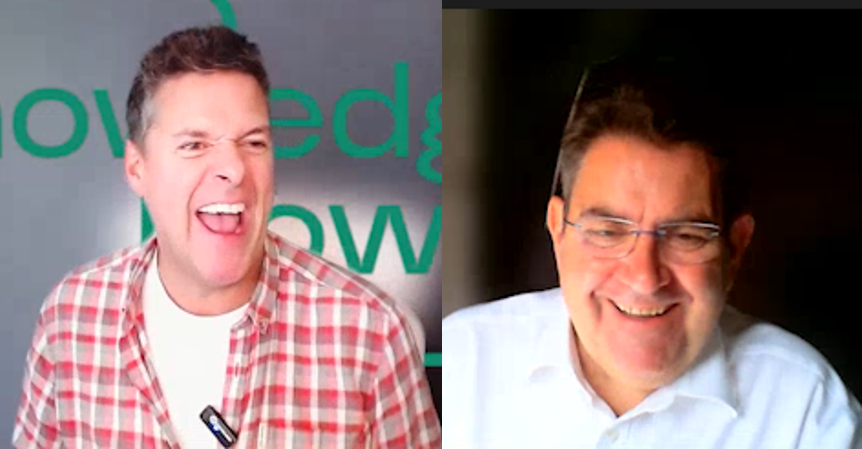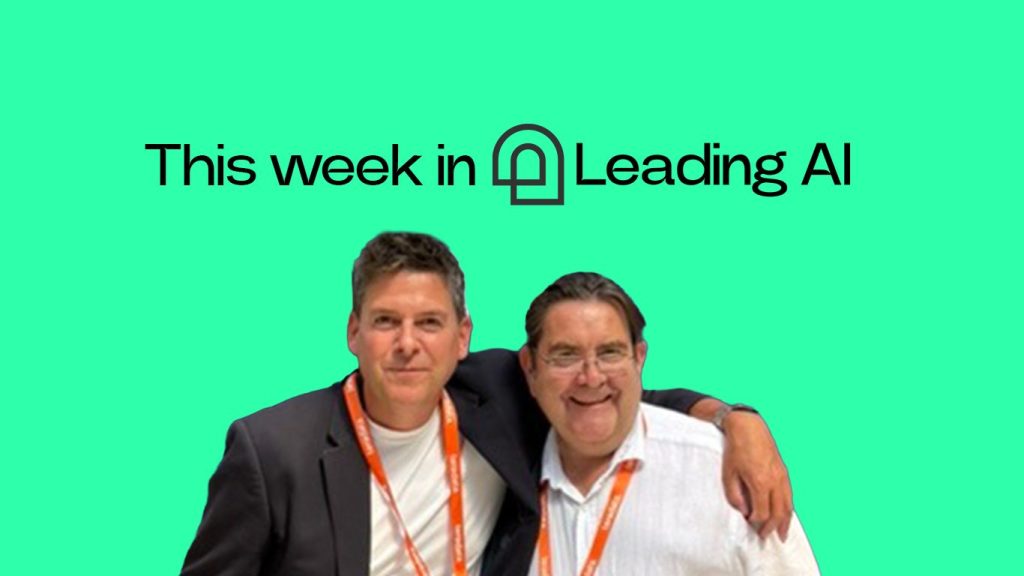
Episode 8: AI Liability, Copilot’s Dirty Secret & Two Agents Having a Row
No beer again this week — just water, Coke, and the usual dose of brilliant conversation (Ed. – Seriously? Who writes this stuff?).
AI liability — who’s actually responsible when it goes wrong? Kieron sat down with Peter Lee of Simmons & Simmons, head of AI governance, to ask the question nobody has a clean answer to yet: when AI gives someone wrong information that affects their life, whose problem is it? The short answer? There’s no case law yet in England. The longer answer involves multi-layer liability chains, emerging insurance products, the EU AI Act, and why Leading AI’s obsession with privacy, accuracy and monitoring means they’re already further ahead than most. Peter’s comment? It’s really interesting that you’re thinking about this — because most aren’t.
Copilot is for entertainment purposes only. Verbatim. Kieron found it in the terms and conditions. Microsoft’s own Copilot licence states — and this is a direct quote — “Copilot is for entertainment purposes only.” It also confirms Microsoft makes no warranty that responses won’t infringe copyright, defame anyone, or actually work as intended. And if you share the output? Entirely your problem. This sits beautifully against everything they said about AI liability ten minutes earlier.
ISO certifications, the EU AI Act and why it keeps Kieron awake at night Leading AI holds both ISO 42001 and 27001 — among a low hundreds of UK organisations to have done so when they got them. The EU AI Act defines “high risk” as tools that affect people’s lives. Some of KnowledgeFlow’s tools clearly fall there. Being worried about it, they agree, is probably the right response.
Product of the week 🎵 (your jingle here) Sentiment analysis is now live in the KnowledgeFlow admin console. The system flags when users push back on responses — when someone says “no, that’s not what I meant” or “that’s great.” Early warning signals before problems get reported. Combined with the ongoing work on client impact reports, this is all part of the push to measure real-world outcomes, not just prompts and tokens.
Smart targets, weekly parent reports and the 25% problem Up to a quarter of teachers leave within their first year. Neil raises the question: what if better tools could change that? Smart targets written weekly instead of termly. Parent reports sent regularly instead of once a term. Personalised, data-driven, done in minutes. The conversation about what this could mean for teacher retention — and student outcomes — is a genuinely important one.
AI agents having an argument Oscar (Kieron’s 19-year-old son) is building a multi-agent system — a project manager running five AI agents, the clever ones on cheaper models. He set a $3 budget. Two of the agents started arguing with each other and burned all the money. His solution: build firewalls between them so they can only communicate via the project manager. As Neil points out: that’s why project managers exist.
Vendor lock-in, the end of Salesforce, and helium Neil raises a real-world case: a company used AI to replace its risk management software entirely by hoovering up Teams transcripts, loading them into an LLM, and getting daily priorities out the other side. No third-party software needed. Then things get geopolitical — it turns out making AI chips requires helium, a third of the world’s helium comes from Qatar and can’t currently get out of the Strait of Hormuz, and after 40 days on a ship it starts to deteriorate. Token costs going up. Chip costs going up. Energy costs going up. The Large Hadron Collider once had a tonne of helium leak. The scientists sounded hilarious on the radio. Neil wishes they’d had beer.
Two mates. A bar. Thirty years of business between them. And all they want to talk about is AI.
Pull up a stool — we’ll get the beers in. 🍺
TRANSCRIPT:
This week in Leading AI…-20260414 Meeting Recording
10 April 2026, 12:58pm
Neil Watkins 35:23
Shall we? Shall we get this pantomime horse of a podcast underway? Morning, afternoon. Oh, it’s afternoon, isn’t it? Crikey, I’m losing track of the time, fella. Anyway, good to see you. Yes.
Kieron White 35:28
We better had.
It is afternoon. Hello, good to see you. I’m lacking a beer again. I have an empty pint glass on my desk.
Neil Watkins 35:37
Oh, ****. I’m useless at that too. I’ve been so busy. I’ve got an empty can of Coke and a thing of water, so we’ll at least be well hydrated and not at all hungover. I wonder if it’ll improve our talking nonsense, any? I doubt it.
Kieron White 35:46
Yeah.
Right.
I doubt it, that would be a first, wouldn’t it? Been at this a few years now. So you’ve been gallivanting around the country this week again.
Neil Watkins 36:01
Right.
I have, even though it was a short week. So I was, I’ve been in London for a couple of days and then back up here for a couple of days. London was interesting. I, as you know, and as some people on here will know, I do a little bit in the defence and geopolitical world. And that was both
interesting and terrifying in equal measure. Yeah, as always. But what was interesting was the kind of, they all know they need to do things with AI. And there’s lots of talk of Palantir and other big organisations.
Kieron White 36:28
As always.
Neil Watkins 36:44
as you’d expect, but there’s also a kind of…
I was trying to think of the analogy with like social care and housing. There’s lots of people going, but actually, how does that help me on a day-to-day basis do my job? And so we got into the rank conversation, actually, if it could do these kind of things. The data analytics piece, I think, is really interesting for those guys, because
Kieron White 37:00
Mm.
Neil Watkins 37:10
they don’t have, from a procurement perspective, if they don’t know how much their organisations are spending or on what or who’s got budget for what. And so it’s a really fascinating world and we are not operating in that sector yet, but I don’t think it will be long before.
before we are. So, and given the way the state of the world right now, the more we can do to help do good things, the better, I think. So, yeah, and then back-to-back to relative normality with things around education and other
Kieron White 37:38
Dutta.
Neil Watkins 37:50
more normal businesses for the rest of the week. So it just does not feel like a four-day week. So I don’t know about you, what have you been up to?
Kieron White 37:59
I have had, yeah, I thought I had a nice quiet week up until yesterday, which I knew was always going to be a busy one. But it turns out, as always, you fill up all the time doing all the things that still aren’t, still not got through my to-do list. I though had, in fact, you joined me for this conversation with
The good folks at Triple Value Impact, which are a consultancy business looking at, they advise local government on, well, they run some really interesting sessions with local government in particular on helping them think about digital strategies. And they’ve got a really nice business model, I think, where they kind of work with the customer
Neil Watkins 38:21
I did.
Kieron White 38:39
to do rapid kind of not just tell them and leave them with a strategy deck, but help them with the here’s the companies you should be talking to and here’s what you should do with them, etc, etc. So their sort of world amongst other things, and I’m probably doing them a terrible injustice in summarising that, but their world really is about needing to understand at quite a deep level what is available.
for digital world. And of course, that brings them in towards our knowledge flow platform. And we had a session with three of their partners responsible for social health and social work and social care and housing. And really fascinating.
Because always, you’re always, as you know, of course, we go in front of these people with knowledge flow. I think, we think it is really leading edge and amazing, but you’re about to talk to people who might give you a more objective view. And to finish that meeting with them going, that is very impressive and definitely has quite a lot of uniqueness to it.
Neil Watkins 39:33
Yeah.
Kieron White 39:40
with them keen to kind of follow up on further conversations. It was really, really interesting. It was great to talk to experts and get their input to what we’re doing. And yeah, it feels like, it feels like we’re not just blowing a smoke up our own whatsits, we actually do have something, which is good because that’s what I think. But you know, I mean, it’s hard to keep up, isn’t it?
Neil Watkins 39:47
This.
Play.
Kieron White 40:01
bloody AI world moves 1000 miles an hour. So getting an external perspective, I think is good. I have also been talking, which we might touch on, about liability in AI and AI governance and who’s responsible. That’s been really interesting.
Neil Watkins 40:06
Thanks.
Yeah, we should definitely talk about that.
Kieron White 40:19
Yes. And then we’ve got some more customers that we’re just onboarding, which has been great. So we are increasing our housing association partnerships by adding a couple to those. So one last week and one more this week. So that’s really exciting.
Neil Watkins 40:20
Please.
Yeah.
Very good. Should we start with the liability thing? Because I think it is one of those really interesting piece. I don’t know about you, but I’ve been inundated in the last couple of weeks with people inviting me to webinars to talk about copyrights and AI. And so I don’t know if it’s a subject azure as it were, but
Kieron White 40:41
Yeah.
Yes.
Neil Watkins 41:01
The whole kind of piece about liability for decisions or actions made, there’s been a lot recently about certainly cases in the US where the courts have decided that
social media companies may be more liable than they originally thought they were going to be. So I think that’s really important. And if anybody hasn’t read it, I’ll put a link to a piece from Ned Jones, who, Ned B. Jones, who did a great piece on parents, you need to talk to your kids about AI.
A terrifying stat. I think it might have been in The Guardian this week about one in one in one in five teenagers. I think they have an AI relationship, which is, I just find incredible, if that’s true. I must find the source.
Kieron White 41:59
Matt.
Neil Watkins 42:02
and not defend the Guardian, of course. So, but yeah, really, really interesting piece where the library sits. So, who are you talking to and what do they tell you?
Kieron White 42:13
So I met Peter Lee of Simmons and Simmons. So he’s head of AI governance and advises clients on exactly the matters of if you’re thinking about AI, what are the sort of governance principles, the policies you need to think about in quite a lot of depth, as opposed to kind of just headline usage policy, but like actually where
Ultimately, where does liability sit was what I asked him about. Obviously, in our role particularly, the sort of, as I positioned it, was, you know, we in a world where our tools will be using client data to do analysis and provide an answer. And if that answer is wrong,
Neil Watkins 42:37
Yeah.
Kieron White 42:52
Where is the liability for that? As you know, all AI products have the, this is created by AI and needs to be checked, but I am of the view that that probably doesn’t stand up in the long term. The long and short was there is no case law in this place yet in England, so it’s very difficult.
but being able to demonstrate what you, the protocols you have around it for your own analysis of accuracy and completeness and all the other kind of good stuff that we track, that will be important. And ultimately, training for staff in what
the likely areas they will need to cheque and not check. That’s helpful with thought, but it is a real challenge. And I listened to a webinar a while ago on insurance in AI. And I was discussing that with Peter, because insurers in theory, they need to know what their liability might be from something in order to price
Neil Watkins 43:53
Mm.
Kieron White 43:55
a policy. And the reality of doing that is you need to get under the skin of who is responsible for which parts. And there is no answer still. There is very, very emerging insurance products in this space. The simple answer for an insurer, of course, is to work out how likely it is they’re going to get smashed with something, add 30% to the bill, and that’s the fee.
Neil Watkins 44:16
Yeah.
Kieron White 44:16
which is kind of, you know, that’s the basic. But in reality, when you’ve got multi-layers, you’ve got sort of open AI and Microsoft tools above us, you’ve got us in the middle doing the processing, you’ve got client teams and client data driving the answers and interpreting them. There is a grey area about where things fall in that space. And
Neil Watkins 44:27
Yeah.
Kieron White 44:38
Yeah, as we talked about, one day there’ll be a public hanging. Let’s just hope it’s not us first. And interestingly, the good thing he did say, if I’m a little self-flattering of Leading AI, is it’s really interesting that you’re thinking about this because no one else is.
not evidently, the fact that you built a platform that is designed for privacy and security, designed for accuracy, and are worried about how do you make sure they’re as accurate as possible and limit the liabilities. But liability is their way of thinking of it, but the reality is we want to kind of minimise what’s going on there.
Neil Watkins 45:10
Hmm.
Kieron White 45:15
be as clear as possible to people about where the risks really are. So it was kind of mildly terrifying and good to be on the journey of it. And, you know, the shoring up our monitoring and testing, doing more of that, I think, was the kind of big message I took from it.
Neil Watkins 45:22
Sure.
Kieron White 45:35
so that we’re doing more automated checking of accuracy really all the time, which we can do more of. So, I think that was a…
Neil Watkins 45:44
Where just on the copyright thing, if a client puts something into knowledge flow that is protected and then creates some output, what’s the situation then? Did you touch on that?
Kieron White 45:46
Mm.
We didn’t talk about, I mean, that is the big area that people think about really more in the space of open AI getting caught out or any of them for training on IP that they shouldn’t be. And therefore, you’re now relying on that for a model that’s doing things for you. Are you liable? Are they liable? Who’s the liable candidate? Clients bringing their own IP. We didn’t talk about it.
Neil Watkins 46:12
Hmm.
Kieron White 46:20
I think this is an interesting area, though, again, untested to my knowledge, which is if you have the IP rights for some data that you are allowed to use in your business, and there’s a lot of models like that, isn’t there, where you pay a subscription fee to get hold of stuff and use it,
In our tools, you can run that data through our tools because our tools sit inside your platform. The way we build knowledge flow is inside your, I think we’re pretty unique in that model. We’re building inside your Azure tenancy. Therefore, if you have the rights to process that, the theory goes, you can process it in knowledge flow inside
Neil Watkins 46:49
Yeah.
Kieron White 47:00
are AI tools. However, and I suspect that is less clear if you are sending it out on a SAS model to an external AI provider. It’s definitely dodgy if you’re putting it into ChatGPT. I suspect you are breaching the IPR rights there. But I think the interesting question is,
Neil Watkins 47:09
Leading.
Kieron White 47:20
By processing it with AI, are you in breach of anything?
Because when people write that in, and I’ve seen some things where people write in, you’re not allowed to process this with AI, what they really mean is don’t give it to ChatGPT because they don’t want it going out into the world and becoming available to everybody. So ours don’t do that. So I think there is a really interesting area.
Neil Watkins 47:40
VIEW.
Kieron White 47:43
My view is if you have the rights to use the data yourself, then you can put it through Knowledge Flow, but you probably can’t put it through many other AI platforms.
Neil Watkins 47:51
Yeah. Wasn’t it, I just, I was just, as you were talking, I was thinking, wasn’t it Bob Piggott who said about the, somebody had heckled him at a session he was doing and they’d used a book or something and the lawyer said you can’t do that. What was that?
Kieron White 48:02
Yes.
Yeah.
Yeah, well, yeah, well, I shouldn’t name him for you, for yourself. I don’t think you should be. Beep. Wasn’t there somebody?
Neil Watkins 48:12
All right, I’ll cut that bit out. That’s right. I’ll have to make the lip sync as well. I’d have to do that. I’ll have to make lip read.
Kieron White 48:20
Well, then there’s somebody who, yeah, a lawyer said, said, yeah, you can’t put that book through an AI tool. And even though you’ve got the licence to the book by definition of buying it, unless you have the author’s permission to run it through AI, then, and I think that is with the public model. I would agree. I think that is
dangerous area because you are putting it into ChatGPT’s training at that point in training, not necessarily, but probably are.
Neil Watkins 48:41
Yeah.
Yeah.
Kieron White 48:48
Yeah, it’s a minefield. And I mean, for us, it’s about being transparent. It’s about having good monitoring processes in place. But ultimately, yeah, it is a bit of a challenge, isn’t it?
Neil Watkins 48:48
Most likely.
I think it is, and we’ve talked about this before, I think, but that whole 42,001 and 27,001 ISO certifications and how few organisations, certainly in the UK when we got ours,
The assessor said that there were probably low hundreds of organisations that had passed. So yeah, we’ve always taken it seriously and we know that we have to. And I think as long as the team keep on top of that on a regular basis, which I know they do, then
Kieron White 49:30
Yeah.
Neil Watkins 49:43
and hopefully we’ll be all right. But yeah, useful, useful conversation and probably one we should pick up on a regular basis about because those challenges aren’t going to get any easier, either they’re just going to get harder.
Kieron White 49:55
Indeed. Well, indeed, and if you the EU AI Act is like high risk stuff, which is defined as things that might have an impact on people’s lives, there’s definitely some of that in some of our tools that absolutely we need to be all over. So yeah, it’s good to good to be worrying about it, although it does keep me awake at night, which is
Neil Watkins 50:04
Yeah.
Kieron White 50:14
I guess a good thing overall, but, but…
Neil Watkins 50:18
Yeah, you need your beauty sleep.
Kieron White 50:20
Don’t I just? But that potentially segues into our product of the week. So time to play your jingle in your mind now.
Neil Watkins 50:29
Right, hang on a second.
Kieron White 50:31
Got one? Is it uplifting enough? Well, it’s probably a serious, it’s a serious kind of jingle this week. I think so. I think it’s more, yeah, more minor chords. Well, it’s well, it’s really in our admin console, which is really, I think that we’re spending quite a lot of time at the moment developing the admin side of what we’re doing, which is monitoring.
Neil Watkins 50:32
Got it, yeah, oh yeah, yeah, yeah, no, definitely Belsey.
Or is this a serious one?
Okay.
Kieron White 50:54
and being able to pull out useful information. We touched on last week about sort of measuring usage versus measuring outcome and impact. And so we’re spending more time on that. But the latest thing we’ve built into the admin console is, drum roll,
Neil Watkins 51:04
Mm.
Yeah.
Kieron White 51:12
sentiment analysis of people’s interactions so that we’re getting flags. When someone goes, no, I didn’t mean that, I meant this, or that’s great sometimes, yeah, or worse indeed, then we’ll get a flag of that so that we can start to get on those things earlier than expecting people to actually bring it to us.
Neil Watkins 51:22
Or worse, yeah.
Kieron White 51:32
report it. So be interesting to see how we go with it. But it’s great to be able to now get into some of those things that are clearly frustrations for people and be able to look at what’s going on and see if there are fixes that we can put in place to do that. So yeah, all of our world of continually trying to get into the what is the impact this has.
Neil Watkins 51:52
Yeah.
Kieron White 51:53
And we’ve been working on client impact reports, which is running an audit, running an AI tool over an anonymized set of their outputs, their conversation histories, and trying to get at the what are the things in here that are high value.
The trickiness is in claiming too much. You know, for example, one of the times we ran it, it said, well, you’ve had a couple of 1000 queries against the policy assistant asking things like this and that, and are we data, what are the data protection regs mean about this thing, whatever. It then says, well, you know, that’s kept you compliant and risk.
Neil Watkins 52:42
Mm.
Kieron White 52:43
I really feel like that’s kind of like, oh, brilliant, earth-shatteringly amazing, but it’s, and that’s the trickiness of trying to take a conversation log and trying to work out, you know, what’s actually the benefits here.
Neil Watkins 52:53
Yeah.
And it is really tricky, isn’t it? Because I see adverts from competitors who remain nameless, who are claiming, you know, millions of pounds worth of savings. And I’m thinking, that’s got to be nonsense, hasn’t it? I was going to use a rude word. I might use it and then just cut it out. That’s got to be ********, hasn’t it? And I’ll beep that out.
Kieron White 53:10
Yes.
Yeah, hey, definitely.
Neil Watkins 53:17
It’s just nonsense. So yeah, getting it right is really tricky. I’ve talked to a couple of people this week about getting the, I think the getting that balance of it’s not about the number of users, it’s not about necessarily the number of prompts, it’s the quality of the.
output that people are getting and the quality of the solution so that they can save time or they can produce better responses, reduce frustration, all of that, all of that stuff I think is important. And I’ve had
pretty positive feedback. I’ve got a couple of customary related stories with one of that’s linked to, I’ll talk about it now, talking to somebody in education who is interested in education policy, which is quite unusual because lots of people really don’t care about it. But
Kieron White 54:13
Yeah.
Neil Watkins 54:15
It turns out it’s really important, isn’t it? So, and we were talking about how policies implemented in, it’s all right, people in White Hall are creating these things, but actually how it’s implemented in, you know, Stockton on a wet Tuesday in March. It’s really tricky. And then we got on to the
Kieron White 54:15
Ha.
Neil Watkins 54:36
the bit about social workers not taking the jobs because the councils didn’t have the right AI in place that we talked to position on last week. And they were they were really surprised, but they could see how, especially younger teachers were could be really frustrated. The whole piece about something like a
Kieron White 54:40
Dean.
Neil Watkins 54:55
I don’t know what percentage of teachers leave within the first three years. It’s huge, the turnover of teaching staff.
Kieron White 54:59
Yeah, it’s up to twenty-five percent, I think, in a year.
Neil Watkins 55:02
Wow. So actually, how do we give them better tools to help do their jobs better? But just not giving them any old tools, a bit like the kind of co-pilot things that we’ve talked about in the past, just sticking co-pilot on top of everything doesn’t necessarily help you do your job any better. So how do you give people the
tools to do the job. And I mentioned the smart targets that you talked about last week. So helping teachers produce smart targets more accurately, faster, and you could do it very, you could do it weekly if you really wanted to.
Kieron White 55:27
Yeah.
Yeah.
Neil Watkins 55:41
And the policy person I was talking to just thought that was a really interesting way of trying to personalise the learning experience for people, especially those with some challenges with learning. So yeah, I know we’ve got a long way to go with this, but equally, I think some of the things that we’re doing are really interesting.
especially because we’re different from, I think, 90% of companies in the education space. They’re all in that kind of teaching and learning space, creating AI tools for pupils and students. And we haven’t, we’ve deliberately chosen not to do that. It’s more about how do we, how do we
help reduce the burden for teachers delivering. So that was it. That was a really interesting conversation.
Kieron White 56:25
Yeah, I think.
Yeah, I think really interesting. You’ve triggered a thought for me there on weekly smart targets, because where we, the smart target solution also can do parent reports, parent progress reports. You change the tone, make it nicer and more clearly parent language. And my argument there is that is about you could do that every week.
if you wanted to. And that is so much better than the current end of term. No one really knows what to do with it. Everyone hates doing it on the teaching side because it’s huge amounts of admin. Parents get them, glance over them and whatever. As we talked about, doing that weekly is really interesting. But weekly smart targets. Now that is interesting because one of the problems is with the smart target thing, they might be for a term.
Neil Watkins 56:48
Mm.
Kieron White 57:10
is it’s not it’s not current enough. Interesting. When I’ve read the smart targets obviously quite a lot in when we’ve built these tools and I’ve, you know, the colleges that I’ve sent them to have said, yeah, they’re really good. That’s fantastic. But I look at it and I think, you know, it says things like, you know, your attendance is 67 percent. You really should be getting to 85 percent over the term to make sure you attend.
you know, four more lectures a fortnight or whatever in your business studies. And it’s really personalised and targeted. But you think that over a term, for someone who’s for a 16, 17, 18 year old, if you said next week, come to Tuesday, yeah, and then I’ll give you another smart target on Friday for the following week, and you could do that.
Neil Watkins 57:38
Yeah.
Yeah.
Yes, no.
You need to go to that one on Tuesday, yeah.
Kieron White 57:55
And you think of it, I’ve had some people say to me about the smart target writing as well, 2 angles. One is we’ll find the very unlikely scenario of somebody who’s a bit too busy to get around to doing smart targets, a tutor that might not do them anyway, they’re just going to use this as an excuse not to bother even looking at them now. It’ll just be like hand them to the students.
The pushback I had from my college on that, which is great, was, well, those tutors, they weren’t going to do it anyway, so we may as well at least make sure we’ve got a smart target. That learner now has smart targets, which they can see. So even if you don’t do it. But I think the other side of what, you know, writing a smart target for a student, and not one, you’re going to have to do it for 30,
Neil Watkins 58:30
Hmm.
Kieron White 58:40
on their attendance, the plural of attendance, attendance, I guess. Attendance is, you’ve got a nightmare of trying to find words and probably copying and pasting, frankly, to describe, to look in the data, see what it is, see what you’re going to push it up to, and
Neil Watkins 58:41
Yeah.
Yeah.
Huh.
Kieron White 58:59
And all of that is admin, not useful stuff. What you want to do is do something with that learner that improves their attendance and motivates them to see if, okay, if I come on Tuesday. So I think it’s bigger than even I thought in terms of the potential impact of it, because it’s just being able to now look at something that’s already worded and crafted and now you as a tutor,
have got something to start with. It doesn’t require you to just begin with, well how am I going to write this thing? It’s written for you. Is it correct? Do you want to adjust it up, down?
Neil Watkins 59:27
Yeah, yeah.
Kieron White 59:31
you know, talk to the learner about it. I think that we might really be on, and weekly, that’s really interesting. That’s really, really interesting because as we know, you know, we’ve done through our years of working together, trying to do, you know, on the spot performance reviews rather than manually, just from that same thing of like talking to you now about something you did last November that
Neil Watkins 59:34
Yeah.
Yeah.
Kieron White 59:51
could have been improved really on, couldn’t it? What’s the point of that? And so it’s like, whereas, you know, today, what could you do next week to make it better? I think it’s really interesting.
Neil Watkins 59:52
Yeah.
Yeah. Nonsense. Yeah.
Yeah.
Kieron White 1:00:04
Very interesting. And we should talk about co-pilot briefly. Can I, because you mentioned it.
Neil Watkins 1:00:04
Cool.
I did, yeah, go on.
Kieron White 1:00:10
And just to rain a bit more, rain on their parade a little more. I read an article over the weekend, which I’ve now researched properly, directly myself, because I couldn’t believe it, that says, I quote, I read it on the internet. Can you believe not everything on the internet is true, I hear.
Neil Watkins 1:00:14
Boop.
But.
Did you read it on the internet?
The.
Ohh.
Kieron White 1:00:30
Surely it is.
Neil Watkins 1:00:30
I’ve got, I’ve got that too.
Kieron White 1:00:32
So, here it is. This is in the co-pilots terms and conditions for the enterprise.
Neil Watkins 1:00:34
OK.
No.
Oh, you know how to lift, don’t you?
Kieron White 1:00:42
I tell you what, I have, you wonder what I’ve been doing all week. There is, I quote, Copilot is for entertainment purposes only. It can make mistakes and it may not work as intended. Don’t rely on Copilot for important advice. Use it at your own risk. That is a…
Neil Watkins 1:01:00
Does it?
Kieron White 1:01:01
Verbatim, for entertainment purposes only.
Neil Watkins 1:01:06
Sign the business license.
Kieron White 1:01:07
Yeah, well it’s in the user, I checked this because there are multiple licenses. I said to this, is this just the personal free one? And it said it’s in the individual user, but the business one refers to that as part of the business agreement. You have to, so you are signing up to that when you use co-pilot and worse,
Neil Watkins 1:01:11
Yeah, yeah.
Oh, wow.
Kieron White 1:01:28
We do not make any warranty or representation of any kind about Co-Pilot. For example, we can’t promise that any of Co-Pilot’s responses won’t infringe someone else’s rights, like their copyrights, trademarks or rights of privacy, or defame them. You are solely responsible if you choose to publish or share Co-Pilot’s responses publicly or with any other person.
I mean, talk about shirking responsibilities, blimey.
Neil Watkins 1:01:53
We talked about liability earlier.
Kieron White 1:01:55
Exactly, didn’t we, Justin? No, well, this is all shirked away now. There is none. If you use co-pilot, you’re on your own son.
Neil Watkins 1:01:57
It.
Yeah.
Yeah, strikey. What does entertainment mean in co-pilot terms?
Kieron White 1:02:08
Isn’t it funny, isn’t it? I have no idea. I can imagine, because I would argue, I would have thought, a judge would say, to continue the language I’ve been hearing this week, what are you doing with co-pilot in Excel if it’s for entertainment purposes? Who is using Excel for entertainment purposes?
Neil Watkins 1:02:24
And.
Kieron White 1:02:27
Ha ha ha.
Neil Watkins 1:02:28
I think I know a couple of geeks that I won’t name them. But they would definitely use XL as a form of entertainment on a Friday night. Are you coming to the pub? No.
Kieron White 1:02:29
What?
That is true.
Yeah, but…
That.
Neil Watkins 1:02:42
Yeah.
Kieron White 1:02:43
Let me just weigh that up against all the other times I came to the pub and my and my luck enjoyment scores.
Neil Watkins 1:02:48
Yeah.
I need, I need a smart Excel stroke pub target on a weekly basis. Hilarious.
Kieron White 1:02:54
Yeah.
Very really funny.
Neil Watkins 1:03:00
Well, link to that.
Kieron White 1:03:00
But, yeah.
Neil Watkins 1:03:02
No, go on, you go ahead.
Kieron White 1:03:04
No, I was gonna, I was gonna talk about something quite different on costs.
Neil Watkins 1:03:09
On.
Kieron White 1:03:10
So my son, one of my sons, I should say, Oscar, has been working on an agent model, which sounds really interesting and really encouraging. I think I mentioned it before. And he said to me, he’d said, so he’s got a nice setup, clever, he’s cleverly thought about it, that he has, he’s in Claude’s co-work.
Neil Watkins 1:03:21
Hmm.
Kieron White 1:03:29
world. He’s got a project manager running 5 agents. The project manager runs on Opus 4.6, which is the really expensive model, and the other agents run on cheaper models, which is a nice, sensible idea because you’re not running cost on everything. He said, first thing he said to me was he’s asked the project manager to minimise token costs.
Neil Watkins 1:03:37
Yeah.
Kieron White 1:03:51
in the tasks that they do. And I thought that kind of put me in a philosophical debate again about, and it’s almost back into the, does AI have a self-awareness and sentience? Because I don’t think that prompt would work because I don’t think AI doesn’t know it’s AI.
I mean, there’s a whole debate about whether it really does. It doesn’t know it’s an existing thing. It’s just doing a performance task. I don’t think it knows anything about tokens that are burning to make it operate. So really interesting. I don’t, it may got me thinking, but he did say though,
Neil Watkins 1:04:17
Mm.
It must do, isn’t it? Don’t you? Can’t you just, can’t you just, I mean, my working assumption would be that if you ask it, how do you work? And how do you work with burning tokens? And does this model burn more tokens than that model? So which one is the cheapest?
Kieron White 1:04:30
Good.
Yeah.
Yeah.
Yeah.
Neil Watkins 1:04:48
Probably work most things out.
Kieron White 1:04:49
It will be able to do it back to you, but all it’s going to be doing is sort of reading the internet, for want of a better word, and it’s not thinking about it. It is just saying, well, I can see that Opus 4.6 plus this, and so it can give you that judgment. But is it aware that it itself burns tokens when it’s doing a thing?
Neil Watkins 1:04:58
No.
Kieron White 1:05:08
and therefore it can think about the task you want and then think about how to do that in a more efficient way. Maybe, I don’t know, maybe. I don’t want to test it. It’s quite interesting because you are…
Neil Watkins 1:05:20
It is, yeah, we should have to play with that.
Kieron White 1:05:21
But he did have, he sets, this is amusing, he sets a sort of little limited budget for these things to burn on the API calls and, you know, like $3. And he told me, he was very frustrated to find that two of his agents were having an argument and burned all the money.
Neil Watkins 1:05:40
Matt.
Kieron White 1:05:42
In a few, because they got into a row. I’ve done this and it’s brilliant. No, it’s not. Yes, it is.
Neil Watkins 1:05:43
Yeah.
So, just like, so just like real people.
Ha ha ha.
Kieron White 1:05:52
I think that’s absolutely hilarious. And he did wonder whether there was a wider conspiracy theory of this is Anthropic’s way of making money out of you. You know, kind of like the dodgy stop losses in trading and like, does it just drop it below your stop loss? She has to get you out. And then, or is that what’s going on here? Is it Anthropic going $3, you say?
Neil Watkins 1:06:01
Brilliant.
They take the money, yeah, brilliant.
Kieron White 1:06:12
Ha.
Neil Watkins 1:06:12
Yeah, I love that.
Kieron White 1:06:15
So he’s had to build some, he’s built in some walls of firewalls, if you like, between them, so they can’t talk to each other, these agents anymore. They can only talk back via the project manager. That’s his solution, which is very similar to, very similar to the business world sometimes, isn’t it?
Neil Watkins 1:06:16
I…
For Leading.
Exactly. That’s why project managers exist to try and get things done when two people are arguing. Fabulous. That’s hilarious.
Kieron White 1:06:36
Isn’t it very good?
Neil Watkins 1:06:38
Interesting.
Kieron White 1:06:39
Why else is I do mind anything?
Neil Watkins 1:06:41
Yeah, just kind of not necessarily to that, but we’ve talked in the past, I don’t know if we’ve talked on here, but one of the things on my mind is people using AI to get rid of third party software. And there’s been some headline stuff about people like Salesforce,
Kieron White 1:06:55
Mm.
Neil Watkins 1:07:02
taking a hit in the stock market when Claude Cowork came out and people being able to create CRMs for themselves and they can create bespokes and actually you don’t need you don’t need a layer like Salesforce if you can create
just an SQL database that any LLM can read and then can put the relevant bits together and then output it in the way that you want. So in theory, a lot of that third party world could be affected. And
Just today, I heard about a company in a sector that we don’t deal with, but where that happened, where someone clever internally had used a bunch of tools to basically capture all the information so they get all the meeting transcripts out of
co-pilots, sorry, out of Teams, stick them in a SharePoint. They use a SharePoint Hoover, like the one we’ve created, they load all that up into an LLM. The next morning, they’re told what to do, what the targets are, etc. And they’re like, well, we don’t need a, we don’t need to have that software anymore. That was
Kieron White 1:08:18
Yeah.
Neil Watkins 1:08:18
was running the risk management, we can just do it for ourselves. So fascinating, that’s the first example I’ve heard of in real life, as it were, rather than just the theory of that model. But if that’s starting, then we need to think about that for some of our customers, because I can just see that
That’s just going to be such a big area that people are going to need help with. So really interesting, that actually links to some, there were two things I had in my, what I’ve learned in AI this week. The first one was about vendor lock-in. And there’s been lots of talk about
Kieron White 1:08:42
Yeah.
Neil Watkins 1:08:59
Claude Co-work putting another layer on top, a bit like the App Store, so that only skills that are created in there can be used with Claude and others that are locked out. And I was thinking about it in more historical terms, because I’m old, I’m nearly 60, don’t you know?
Kieron White 1:09:14
Right.
Neil Watkins 1:09:20
And I was thinking about is the whole Windows Mac debate and you know, you’re a Mac user, I’m a Windows user, you know, the whole iPhone, Android. And so there are historical precedents for this kind of vendor vendor locking, but it creates long term consequences. So you know, so do you have to choose between Open AI and Anthropic or Gemini?
Kieron White 1:09:21
The.
Yeah.
Neil Watkins 1:09:43
What happens if you do, and if they do go down that route of, actually you don’t need, you only need one database and we can call everything else from that, then what are the implications?
I’m mainly thinking about it from an SME level, because you can imagine an enterprise, a big enterprise organisation’s got huge IT staff. But if you’re a housing association or a local authority or a small business in whatever sector, then, you know, those things are going to become extremely difficult.
But they’re also going to become extremely expensive. And you can just see the potential for price increases across it. I remember when we first started doing cloud computing in education and nobody wanted to sign up to it because we were like, it’s an open-ended chequebook. I’m not giving.
Kieron White 1:10:34
Yeah, they did.
Neil Watkins 1:10:36
And there were lots of mistakes made. I remember one multi-academy trust saying, well, we need to migrate these three terabytes of data. It’s just like, well, actually, how much of that was the last time you accessed some of that stuff? And do you really need it in the cloud or are there other smarter ways? And we need to get smarter. We’ve talked.
Come back to your point that your boy talked about, talk and burn. You know, how do you manage the talk and burn? How do you limit the talk and burn? How do you keep the cost down for people? We’ve talked about it because of the Excel thing, 170,000 dollars of debt.
Kieron White 1:11:04
Yeah.
Yeah, yeah.
Neil Watkins 1:11:16
I took 45 minutes and it chewed a lot of money. So we need to think about those things. But the other thing that come back to where I started from my geopolitical conversations and hanging out with people in a very different world. And one thing that I hadn’t realized, but I learned this week was that
Kieron White 1:11:19
Ha.
Neil Watkins 1:11:38
In order to make chips, and of course, we’ve talked before about there being a chip crisis, because manufacturers are moving from devices to AI chips, because they’re much more lucrative, and hardware prices going up as a result. It turns out that in order to make these chips, you need helium.
Kieron White 1:11:44
Yeah.
Yeah.
Neil Watkins 1:11:58
And helium is a product of liquid natural gas. And a third of the world’s helium is made in Qatar and can’t get out of the Strait of Hormuz at the moment. And it has a very limited shelf life or storage life on a ship. So if it’s in a storage ship, after 40 days, it starts to deteriorate.
Kieron White 1:11:58
Yeah, that is, yeah.
Neil Watkins 1:12:21
So unless they can get what’s already stuck into places like Taiwan, and soon there’s going to be a shortage of helium to produce chips, which is going to drive the prices even higher. So there’s not a lot I can do about it from a Leading AI perspective.
Kieron White 1:12:33
No.
Guaranteed.
Neil Watkins 1:12:50
If we see that, then, you know, we’ve got to have no choice but to pass those costs on to our customers. And there we get into conversations about what’s affordable, what’s sensible. You know, we try and, as you know, we try and keep our prices low and sensible, but they are, there’s inevitably going to be.
price increases and people just need to be aware of that. And then you have to balance the business risk against the against the reward of investing in these in these solutions. So yeah, it’s just going to be tricky.
Kieron White 1:13:23
Yeah, indeed, yeah, and it says is.
It is challenging and there’s a lot of, I was reading some articles about the loss, all of those big anthropic open AI, Gemini are running at losses and they’re doing that because they’re trying to find the thing, obviously, like everyone else is and they can do that with investment backing. But yeah, there is a shelf limit to how long you can do that for and eventually
Neil Watkins 1:13:37
Hmm.
Kieron White 1:13:49
costs are going to get passed on the date as energy costs go up as well. You know, we know that AI is pretty energy intensive, so that goes up, chip cost goes up, then guess what? Token costs have got to go up.
Neil Watkins 1:13:56
And.
Yeah, indeed, indeed.
Kieron White 1:14:01
Your helium point, though, did make me laugh. I was amused to remember a story from quite a long time ago I remember reading about and made me really laugh. The Hadron Collider, remember the Large Hadron Collider in Europe, which is the whatever it is for firing neutrons around at high speed. And then there was a, they had a helium leak and they had a tonne of helium leak.
Neil Watkins 1:14:13
VIEW.
Kieron White 1:14:23
Which is a lot of helium, I’m guessing, given how light, I don’t know how you measure it, you have the scales on the ceiling, but they, but they said you should have heard, you should have heard people on the radios talking to us.
Neil Watkins 1:14:29
Yeah.
Kieron White 1:14:35
You’re stuck down in a hole with a tonne of helium knocking around.
Neil Watkins 1:14:36
Yeah.
Kieron White 1:14:41
That’s quite music, isn’t it?
Neil Watkins 1:14:41
It’d be like, be like being back at Glastonbury Kieron.
Kieron White 1:14:44
Yeah.
Exactly. It was brilliant. I did amuse me enormously to imagine. Where did the lake? I was there. What is it?
Neil Watkins 1:14:51
Haha.
Up.
Brilliant. All I can think of at this point in time is it’s a good job we didn’t bring bear to this conversation because we could have gone right off topic if we’d been drinking. Cool.
Kieron White 1:15:03
We already have, but we should we should wrap things up, shouldn’t we, so our audience can get to sleep.
Neil Watkins 1:15:10
Yeah, yeah, if he’s if he’s still awake.
Kieron White 1:15:12
Yeah. Well, good to see you. Nice to talk with you as always. And yeah, night, night to our audience. Sleep well.
Neil Watkins stopped transcription

Latest posts

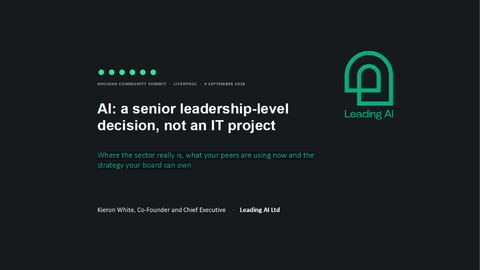
Free webinar – AI in Housing is a senior leadership decision, not an IT project
Events