I had a conversation this week that I keep coming back to*.
I was talking to another recovering civil servant, who now runs a literacy charity, along with another tech bod (someone from a much, much bigger company – the blue one). Catching each other up, I explained that I do, well, this now. Naturally, we started talking about AI and what it means for reading.
She asked us a good question: there’s a lot of noise about the benefits of AI, but — knowing what you know — could you run a session on what you can only get from an actual, physical book?
Hell, yes.
My new tech friend then immediately recounted the first time he read The Hobbit from beginning to end, as a kid. He could still remember the feeling of finishing it and we agreed it probably wouldn’t have been the same on an e-reader, and certainly not as a summary.
That’s the thing I’ve been thinking about, because it sits slightly awkwardly alongside the way many of us — me included — now normalise working with generative AI.
Reading is a physical experience
It turns out there’s quite a lot of research showing that reading on paper leads to better comprehension and recall than reading on screens, particularly when the text is longer or more complex. This extremely helpful meta-analysis found a small but consistent advantage for paper, especially when there’s time pressure. People tend to think they’re reading just as well on screens, but the evidence suggests otherwise. When you read on paper, it’s more likely to stick.
When we read a physical book, we don’t just process the words; we build a sense of where things sit. You remember that a passage was early on, or halfway through, or near the bottom of a page. That kind of spatial mapping is much harder to recreate when you’re scrolling, and it helps you learn.
Maryanne Wolf’s work on “deep reading” goes further. She describes a slower, more reflective process where you’re not just taking in information but making connections, using your imagination, and interpreting meaning. It’s the kind of reading that shapes how you think, not just what you know — and she’s written about how digital environments (science talk for “screens”) can create an “illusion of speed over understanding”, where we move quickly through text without really engaging with it.
I know all this because I did some really rapid research with Perplexity, summarised the tricky bits, then asked ChatGPT some questions to check I’d understood it correctly before typing this on a screen. None of this is me telling you screens are bad or that AI is the undoing of society; it just means they encourage a different kind of reading.
And we can all accept the ongoing irony: no one printed this article to read it.
When friction is useful
This relates to something I wrote a while ago about AI and “content”: in a world where words are now cheap, the value shifts away from producing text and towards judgement, interpretation and taste.
Reading feels like a parallel case. AI is extremely good at removing friction. It can get you to the key ideas of a long read in seconds — you can have the TL;DR version of literally any text. It helps you – or maybe it encourages you – to bypass the slower, trickier passages.
Reading a novel properly — holding the thread of it over time, staying with it when it becomes demanding or uncomfortable — exercises a kind of attention that is otherwise quite easy to avoid. The experience is not just a delivery mechanism for information; it is part of what makes the information meaningful. It changes you.
We recognise this in other areas without thinking too hard about it. You don’t get the same benefits from watching someone else exercise, or from reading a recipe instead of cooking, however much you enjoy both. Reading sits somewhere in that space: friction is not always a problem to solve. Sometimes it’s the point.
Not every book deserves your time
Before I start to sound too evangelical, I should tell you how I really feel about taking time to read certain books.
At university — back in the era of queuing for the computer room — I spent a fair amount of time resentfully working my way through books like Ulysses, Tom Jones, The Life and Opinions of Tristram Shandy, Gentleman, and Moll Flanders. They are all unarguably important texts and I was studying literature, so that’s a fair cop. These are books that broke conventions and created new ones, and you can see their influence running through everything that followed.
That said, I would never advise anyone to read them cover to cover (unless maybe for an exam, a personal obsession, bragging rights, or perhaps a desire to argue this point with me). Tristram Shandy is a particularly slow read; it opens with the protagonist’s conception. Parts of it are mildly amusing, but Lawrence Sterne is no Chris Rock.
Lots of people will disagree — often the people who spent weeks of their lives reading those books and want you to empathise with their journey by suffering it yourself. But this is where summaries — and now AI — can really help. A good overview, combined with a few carefully chosen extracts, can give you the context and the key ideas more efficiently. It can also free up time for discussion, interpretation and reflection, which are arguably where the real learning happens.
I’m not saying the full reading experience is unimportant, but it isn’t always the best use of time, and being selective about where you invest that effort is a reasonable response to the sheer number of books available. You can’t read everything that’s deemed worthy and still find time to eat, sleep and make a living. Cut yourself some slack.
AI as a reading companion: information versus experience
AI doesn’t have to be a threat to reading; it can be a companion to it. It can help you decide what to read next based on what you’ve enjoyed. It can help you approach a difficult text with a bit more confidence. It can answer questions that might otherwise interrupt your flow or remain unresolved.
Used well, it supports the reading experience without replacing it. The risk is not in using it, but in allowing it to become a substitute for reading actual books when it matters.
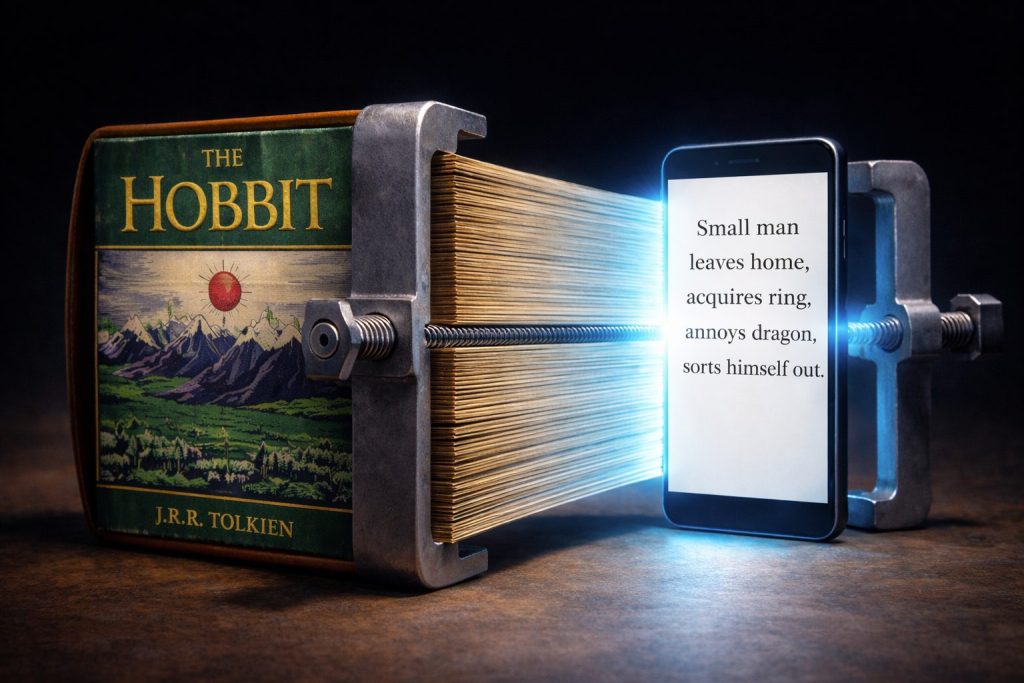
You can summarise the plot of The Hobbit very effectively. You can explain what happens, who the characters are, and what the themes might be. But that summary is not the same as the experience of reading it, and it doesn’t produce the same effects.
“Small man leaves home, acquires ring, annoys dragon, sorts himself out.”
See what I mean?**
For the love of your bookcase
During lockdown, when we all became amateur broadcasters on video calls, people made very deliberate choices about what could be seen behind them. Almost no one went with a massive telly. The flex was always a bookcase, ideally over-laden. Books signal something: curiosity, judgement, a bit of intellectual life. The telly signals: sofa.
Part of the appeal is how books feel. The weight of a book in your hand, the texture of the paper, the sound of turning a page rather than tapping a screen. You notice the cover in a way you don’t quite notice a thumbnail — the font, the design, the way certain books become instantly recognisable. Some of them you remember almost as much for how they looked and felt as for what they said. They make a great gift, especially if there’s an inscription. My favourite bosses have all given me books with a little note in.
Books accumulate over time. They get damaged, borrowed, returned (or not), rediscovered years later when you weren’t looking for them. They hold traces of when you read them — where you were, what else was going on, who recommended them. Sometimes there’s sand from a foreign beach caught between the pages, and a stain from the pina colada you drank on that lounger in Mexico. Your bookcase is a slightly uneven record of your life, and it’s one you can pass on. Your licence to a digital version doesn’t quite work like that.
And then there’s bookshops… but this article is already too long so I’ll stop there.
Digital text is efficient, but it doesn’t attach itself to your memory in quite the same way. It’s there when you need it, and then it disappears again.
What we choose to do slowly
If you’re worried you’ll forget any of this, you could always treat yourself to Reader, Come Home by Maryanne Wolf and test the theory over a cup of tea, but the takeaway is this: AI is exceptionally good at compressing information. Reading, particularly reading a physical book, gives you several extra cherries on top.
And as more of our world becomes optimised for speed, it’s probably worth being a bit more deliberate about the things we still choose to do slowly — even when we don’t have to.
* I’ve reached that stage where almost any conversation makes me think: ooh, there’s a blog in this. So here we are.
** I asked the AI to make the Hobbit summary more relatable for professionals. It suggested: “Group project goes badly; quiet one ends up doing most of the work.”