I read something in The Neuron this week that deeply appealed to me – albeit in a quietly satisfying way. Like a really good cup of tea. The argument was basically this: maybe the future of AI isn’t about bigger, louder, more astonishing systems; maybe it’s about making AI boring.
This is a call to action I can really get behind. Once you move on from the initial awe of what a large language model or image generator can do these days, the really useful stuff becomes unremarkable — in the best possible sense. The kind of technology that works quietly in the background and doesn’t require a standing ovation every time it completes a task. In other words: not the creepy humanoid robots, please and thank you.
The idea landed because it mirrors something I’ve said (possibly too often): my favourite AI isn’t the ‘shock and awe’ stuff (although we do still get plenty of delighted gasps in the audience when we demonstrate our assistants). It’s precisely because it’s boring stuff — so you can get to the good stuff. The things that summarise documents, analyse data to spot patterns, draft first versions, or save me half an hour without making a fuss about it.
Which got me thinking. If the most valuable AI is the boring kind, why does that idea make some people twitchy? And is AI even a “category” of technology anymore — or is it just becoming part of everything else?
Why the boring stuff usually wins
Most of the technology we rely on every day is invisible. Spam filters, fraud detection, scheduling systems, search ranking… none of it is exciting, until it stops working and we realise we don’t have the first clue how to fix it. As far as I’m concerned, electricity is much the same (although my school did a decent job on the basics of how power is generated — a stage of education we haven’t really reached with tech and AI). In practice, electricity comes out of the walls, I plug stuff into it, and I’m kept safe by getting a certified expert in when it lets me down.
That’s not a design failure; it’s the point. And AI should be — and increasingly is — the same.
When AI works well, it doesn’t feel like AI. It feels like a sensible feature that removes friction from whatever job you’re doing. And for most organisations, that’s the prize. Not novelty or theatre, just things working as they should.
This is especially true in places where the stakes are high — public services, regulated industries, professional decision-making. In those settings, “exciting” is often a polite way of saying “slightly worrying and possibly high risk”.
But doesn’t ‘behind the scenes’ sound a bit creepy?
Here’s where it gets interesting (for me, at any rate). People are generally fine with invisible systems right up until they remember those systems are making decisions, shaping outcomes, or nudging behaviour.
A lot of anxiety about AI isn’t really about intelligence; it’s still about trust. It’s about not knowing what a system is doing, or why — the sense that something important is happening just out of view, without a clear line of accountability.
And let’s be honest: years of breathless headlines aren’t helping.
So when we talk about AI “working quietly in the background”, we need to be clear what we mean. Quiet doesn’t mean secret. Invisible doesn’t mean unaccountable. And boring definitely shouldn’t mean “nobody thought this through”.
Transparency without the paperwork
There’s a persistent idea that building trust in AI means showing people everything: the code, the data, the wiring diagram. This is where regulation often ends up, particularly in the EU. In reality, that’s like handing someone the schematics for a jet engine when they’ve asked whether the plane is safe.
What most people actually want is simpler:
- what is this thing for?
- what does it rely on?
- where are the limits?
- and who’s responsible if it goes wrong?
That kind of clarity is much more compatible with boring AI. Calm systems and clear boundaries. No mystery required.
So… is AI even still a thing in its own right?
I was recently in a reference group using a taxonomy to categorise technology companies, and we got momentarily stuck on an awkward question: where does AI actually sit?
The more you think about it, the less sense it makes to treat AI as a standalone category. It’s not a product type so much as a capability — something that turns up inside lots of other tools.
We don’t talk about “electricity-powered organisations”. We just assume the lights come on. AI is heading the same way.
Which might be why the boring framing matters. Once AI is everywhere, the real questions aren’t about the tech at all. They’re about design choices, governance, usefulness, and whether the solution actually helps someone do their job better.
What this looks like in real life
For organisations trying to move beyond pilots and proofs of concept, this usually comes down to some fairly unglamorous questions.
Useful (a better word for “boring but important”) AI tends to:
- fit into real workflows
- respect data and context
- have clear boundaries
- support professional judgement
- and get on with the job without constant supervision
That’s the stuff that sticks.
A final note on Grok (because: of course)
I’d love to end by saying this is about moving past the era of loud, attention-seeking AI — and in most professional environments, that’s probably fairly true. But then Grok controversy pops up again, and I realise it bears repeating that this is one to watch, in and outside your day job.
If you read our last blog, you’ll know why I think this matters. The issue isn’t that Grok exists, or that it has a deliberately provocative tone (although if you want me to write a full essay on the ethics of their choices, that can be arranged). The issue is that we keep replaying the same pattern: an AI system framed as edgy or “truth-telling”, followed by screenshots, ‘hot takes’ (spare me), and a fresh wave of anxiety about what it said this time.
Depending on the day, that usually comes with another quote from Elon Musk about free speech, disruption, or why everyone else is overreacting.
It’s all a bit exhausting — and that’s if you’re lucky. If you’re unlucky, it does lasting damage to your life, your friends’ lives, or your kid’s life. And it’s a useful reminder of why the boring future of AI still needs defending from the instinctive “switch it all off!” reaction it can invoke.
Because while these systems grab attention, they also reinforce the idea that AI is chaotic, unaccountable, and designed to provoke rather than support. And that’s the opposite of what most organisations actually want.
What people tend to need is much less dramatic:
- tools that work quietly in the background
- sensible guardrails
- clear accountability
- support for human judgement, not a running commentary on it
In other words, assistants built to do jobs (like ours), not generate headlines.
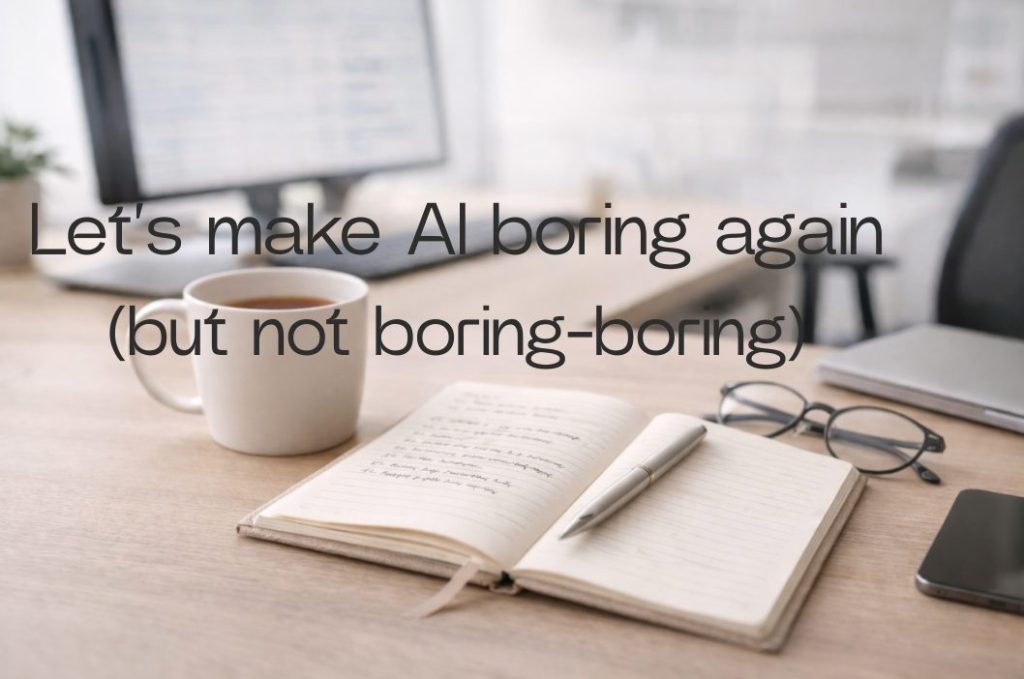
So yes, let’s make AI boring again. Not because it’s uninteresting — but because boring is usually what happens when something is doing its job properly.
If you’d like to see how ‘boring AI’ are transforming our client’s organisations then head over to our website where you can see our education quality assistants analyse data to draft self-evaluation reports, housing assistants that provide instant answers on tenancy rules and procedures, and our AI BidWriter that uses your case studies to draft tender responses.