I may finally have found a use for advanced robotics that doesn’t either (a) creep me out or (b) make me suspect some very clever people have too much time on their hands.
Incredibly – for me – the use I’ve found is not in a “transforming public services” kind of area. It won’t even boost productivity. And, honestly, it probably goes against everything I’ve said here about conserving energy. But we are where we are.
This is a much more specific and frankly more compelling way to finally get behind a robot army: I would quite like access to a robot that can beat my husband at table tennis, and I think this might actually be achievable.
This is not because I am especially competitive, just petty. And I’m not trying to make him feel bad, it’s just that he is one of those deeply annoying people who is good at lots of things in an impressive quiet, unshowy way. Table tennis. Chess. Snooker. Poker. Anything involving timing, angles, or strategy. Also anything sporty and physical, which seems very unfair. And he doesn’t go on about it; he doesn’t need to. The results speak for themselves, and that’s quite fun when I see other people try and take him on.
But when we play any kind of game or sport, I know he does that thing that people who are much better than you do: he adjusts. Pulls his shots. Makes it just about competitive enough to be enjoyable, while remaining completely in control.
Which is kind, but also completely unbearable. The only thing more unbearable is when he actually puts some effort in and I lose really, really badly.
Enter the robot
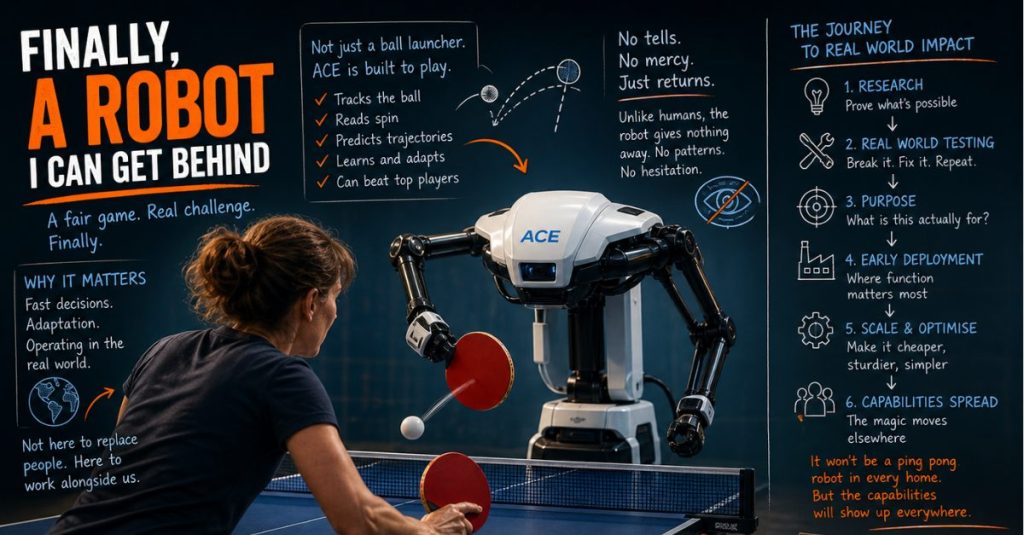
This is why I was so interested to read about Sony Ace ping pong robot, a table tennis–playing robot developed by Sony. This isn’t one of those novelty robots that lobs balls at you in a predictable rhythm. This one actually plays.
It tracks the ball, reads spin, predicts trajectories, and returns shots in real time. It learns. It adapts. It can, in some cases, beat very good human players. Which raises an important and slightly overlooked question:
Could it beat my husband?
Why it could work
This is, admittedly, not the question the researchers had in mind.
They are interested in things like perception, reaction time, and how AI systems operate in fast-moving physical environments. Table tennis turns out to be a perfect test case because everything happens quickly, unpredictably, and with very little margin for error.
You have to see the ball, understand what it’s doing, decide what to do about it, and execute — all in fractions of a second.
Which, when you put it like that, is not a million miles away from quite a lot of real-world jobs.
I’ve spent a fair bit of time being sceptical about robots. Not in a dystopian “they’re taking over” way – although the ick is a big part of my standard response to each AI robot unveiling. Our criticism here has been more practical: a lot of robotics has felt either over-engineered for the real world, or underwhelming when you actually see it in action.
But Ace is different. Because no one faffed around trying to make it look like a person, and this isn’t a robot doing a pre-programmed task in a controlled environment. It’s a system making decisions in real time, in response to something genuinely unpredictable.
And that’s where it starts to get interesting.
The bit that’s really clever (and slightly uncomfortable)
One of the things people have noticed when playing against systems like this is that they don’t give away their intent in the way humans do. There are no ‘tells’. When you play a game against a person — even a very good one — you’re constantly picking up cues. Body position, grip, the look on their face. You get a sense, consciously or not, of what might be coming next. I know my husband is going easy on me because he’s far too relaxed and looks slightly sorry for me.
The robot doesn’t do that to its opponent. There’s no hesitation and no readable pattern in the way we’re used to. It just… returns the ball. And that’s very clever, obviously. It’s part of what makes it very effective.
But it’s also a useful reminder that when we build systems that act in the real world, we’re not just replicating human capability; we’re changing the nature of interaction. In a game of table tennis, that’s mildly disconcerting but mainly just a fun new challenge. In other contexts, it will start to matter a bit more, which is why it might be great for training the next Ma Long*, but you might not want one as your nurse.
A system that doesn’t signal intent can be efficient. It can also be harder to anticipate, challenge, or trust. You might not want it popping up at your bedside.
Or maybe you do. Everyone has different… preferences.
Practical benefits
If you work in any kind of public service, you’ll recognise this immediately. I think it’s true across the private sector too, and especially once you’re in a leadership position. Most of our work isn’t all that neat or predictable. It’s messy. It involves incomplete information, time pressure, and constant adjustment.
We tend to talk about AI in terms of chatbots — useful, yes, but largely confined to text and knowledge work. What this points to is something else: systems that can act in the world, not just advise. Not replacing people, probably, but operating alongside them in environments where timing, judgement and adaptation matter.
How this sort of thing actually makes its way into the real world
The other thing I’ve been thinking about is how something like the Sony Ace ping pong robot gets from a group of very clever people at Sony to anything resembling normal life.
It doesn’t happen in a straight line. It starts with a small team proving a point to show you what might be possible. The version you see at this stage is usually quite delicate: lots of specialist kit, controlled conditions, and surrounded by a handful of people who know exactly how to make it behave.
Then comes the awkward middle phase, which no one really makes YouTube videos about. That’s the part where you try to get it to work again. And again. And in increasingly less perfect conditions. Things break. It turns out one part is doing far more work than anyone realised — but only when you try to manage without it. You simplify it, and it gets worse before it gets better.
At some point, if it survives all that, someone (usually someone who has to work out whether to invest in it) asks: what is this actually for?
That’s when it starts to change, and the tech moves toward a market that probably isn’t a typical family home. It’ll be somewhere more likely to tolerate a slightly clunky, expensive version because it does something genuinely useful. A factory line. A warehouse. An education setting. Somewhere function matters more than elegance.
Only after that does it begin to look like something that could scale to a mass market. More engineers start pulling it apart to make it cheaper, sturdier, easier to run. Supply chains get worked out and corners get smoothed off. The magic is still there, but it’s then made a bit more ordinary on purpose.
And then, quite a long time later, like the carbon fibre first designed to make F1 cars lighter, parts of it start to show up elsewhere. We probably won’t all get a table tennis robot, but we’ll get better perception in a camera, or more reliable movement in a machine, faster decision-making in systems that need to respond in real time. The original thing disappears, but the capabilities spread.
If you pick a familiar example — voice assistants like Siri and Alexa, for instance — that journey from “interesting research” to “something you shout at in the kitchen” took the best part of a decade, depending on where you start counting. Robotics tends to take longer, because the real world is less forgiving than software.
So no, I’m probably not ordering one of these any time soon. But it’s a safe bet it will show up in pieces.
What’s really at stake
Also, and I don’t want to lose sight of this, it really might finally give me a fair game of table tennis to enjoy. Because if a robot can return a full-speed, spin-heavy shot with 20 milliseconds to spare — without signalling what it’s about to do — it might be the only opponent who refuses to take it easy on me or anyone else.
And that, frankly, is all I’ve ever wanted.
We may not need a robot in every workplace just yet. But one on the patio, waiting to play ping pong with my husband – and annihilate him – feels like a very sensible place to start.
*Known as The Dragon and generally recognised as the greatest ping pong player of all time. See for yourself: https://youtu.be/36zx34BlQF8?si=L-i9ZZuk6mj851JR