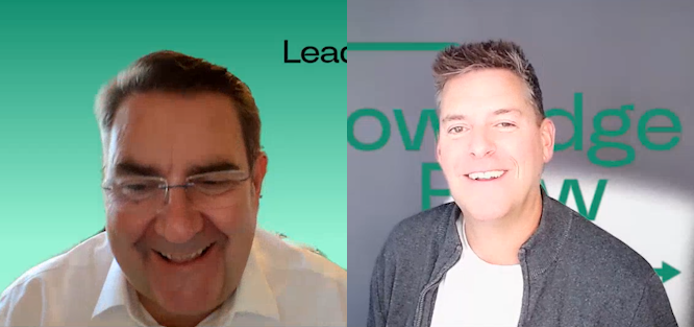
Week 33, and the sun is out at both ends of the call.
Neil asked AI how Disney would handle AI adoption. It said Copilot is a ticket to the car park and KnowledgeFlow is a ticket to the theme park. That line is ours now. Kieron takes the Rory Sutherland idea even further: give people a castle to walk towards instead of a map of every land. That leads to a frank chat about demos that feel like drinking from a fire hose.
Also this week:
- Product of the week: a ticket-based AI complaints handler, built on KnowledgeFlow overnight between our CTO Donald and Kieron
- AI costs: Epoch AI says the cost of a given level of AI performance is falling about 13x a year. Neil still can’t work out what he’s buying when he tops up his tokens
- Council leases: 100-year leases, subleases and landlords that no longer exist. The real prize isn’t saving time. It’s collecting rent nobody has been chasing
- Walmart rules out AI dynamic pricing on shelves: Neil fears what it would do to prices in the beer aisle
- Is university worth it? Anthony Seldon’s warning that we’re educating for an AI-less world. IFS figures show graduates are only about £90–110k better off over a lifetime once tax and loans are paid. And Kieron’s card-deck idea for building courses employers actually want
- The race for AGI: is the regulation talk a smokescreen for replacing payroll?
- Who gets blamed when an AI agent does something bad? You, the model, or the company in between? We nearly become lawyers
Two mates. A bar. Thirty years of business between them. And all they want to moan on about is AI.
Pull up a stool — we’ll get the beers in. 🍺
TRANSCRIPT
Are you ready? Are you? Jolly good.
Kieron White
Let’s go. I am ready. I am ready and willing. Whether I’m able or not is a whole new thing, but I am willing.
Neil Watkins
A different thing. All right, let’s kick the hooves off this pantomime horse and get this podcast underway for week 33, Kieron, week 33, here we are. It’s a sunny old day. I don’t know if it is where you are, but
Kieron White
Well…
It’s sunny, yeah, it’s sunny here as well.
Neil Watkins
That.
Excellent, excellent. Well, I hope you’re of a sunny disposition and you have lots of interesting things to talk to our audience about. Have you?
Kieron White
Oh, I’ve got heaps. I’ve got heaps of really interesting stuff. Is it worth going to university? I want to talk about that in the light of an AI paper. So I will definitely talk about that. What’s the kind of economic value? And I’ve got some stuff on AI costs carrying on the conversation we started last week about that. I think that’s really interesting, obviously close to our heart.
Neil Watkins
Oh, crikey.
Always.
Alright, good.
Mhm.
Kieron White
And probably the most interesting, so listen till end, who gets blamed when AI agents do something bad? So it’s a more complicated picture than you might sound from that simple statement. So those are my headlines.
Neil Watkins
Who?
Yeah, yeah.
Jolly good. Well, I wanted to talk about the race for AGI and the implications of that. I had something on AI in retail, which really struck me this week. I wanted to talk a little bit about one of our customers that we talked to and some of the challenges that they’re facing.
And then back to last week’s question about the Disneyfication of AI adoption and if Disney were doing it, how would they do it? And I desperately get, I think I have yet. I went rummaging through the grandkids dressing up box looking for Mickey Mouse ears, but I couldn’t find any. So
Kieron White
Disnification, if that is your new term, you’ve created a new verb, I think.
Haha.
Okay.
Neil Watkins
I’ll have to try harder for next week. But there you go. Where should we start this week, Kieron? Where should we start? You said you had something.
Kieron White
Let’s go with Disney. That’s a wonderful area. I think it’s really interesting. And this was on the back of last week. We were talking about Rory Sutherland and his, if you ask Disney to sort out the trains, how would they approach it compared to our current approach, which is get engineers to make them a bit faster and longer or whatever.
Neil Watkins
OK, alright.
Yep.
Yeah.
Kieron White
That’s where it came from, didn’t it? And then you got yourself all carried away in a Disney-ificationizing of things. Go on, what have you been up to?
Neil Watkins
Big thing.
Kieron White
Yeah.
Yeah.
Neil Watkins
clothing and just put in, what would it mean if, how would Disney approach AI adoption? And it basically said it would create a theme park and it would be much more interesting and all of the individual people would
Kieron White
Yeah, I have Thomson.
Neil Watkins
be characters and they’d find a way to make it engaging. They’d do interesting that those things like it would managing it would manage the queuing better. It would it would make the queuing much more fun and but I also put in from a Leading AI perspective, how do we make
How do we make the designification of the knowledge flow and the adoption of that work? And it basically said, well, one of your biggest challenges is co-pilot, but co-pilot is like a ticket to the car park where knowledge flow is the ticket to the theme park, which I loved. It was brilliant. Yeah.
Kieron White
Yeah.
That was good. We should, yeah, we want to, we should publish that. I liked, and I read your, I read the response. I liked the part about Disney, all the Disney parks have like the giant castle as the big draw, the magic moment, and you don’t have to have signposts to say come this way.
Neil Watkins
Castle at the end.
Yeah.
Kieron White
because people will go to that and then on the way they might find the other lands, but you don’t need to talk about all the other lands that are available at the beginning. I think that really struck a chord with me because I’m very conscious in our, when we demo knowledge flow where we’ve got, I think in colleges now, we’ve probably got 20 different assistants that do various things that are necessary.
Neil Watkins
Yeah.
Yeah.
Kieron White
problematic in the world of FE. But I’m conscious when we try and demo even half of those, there’s just so much information to take in. It’s hard. So having that castle that draws you in and you kind of find the other things on the way, I thought that was really, that was really interesting.
Neil Watkins
Yeah.
We’ve had a bit of that though, haven’t we? Because when people get a knowledge flow, there’s all a list of all the potential assistants down the side and some of them are greyed out until they switch them on or ask for them to be switched on. And there is, we’ve definitely had, oh what’s that bid writer thing or what’s this thing? So we’ve definitely had a bit of that, but yeah, maybe we need to put some candy floss on it or make it a bit.
Kieron White
Yeah.
Neil Watkins
Put some sparkles on. Yeah, that’s right. Yeah. Something to make it more. So it’s a theme I’ll come back to. I’ll definitely, I’ll definitely think about Disney fighting the pantomime horse.
Kieron White
Dancing Princess, perhaps, and some fireworks.
I love it. And I think it’s that just coming at something from a completely different mindset is the really interesting part, isn’t it? And how when I read that response, basically everything about the Disney and the Imagineers and their methodology is all about the experience first, everything else later, whereas technology tends to be the technology 1st and the experience later.
Neil Watkins
Yeah.
Yeah.
Kieron White
And that, I think that’s really helpful to think about.
Neil Watkins
That’s really interesting from a number of different perspectives that I was thinking about. So we did a pitch to a customer this week. And the person giving the pitch and giving them this feedback, they’ll be listening later. They know who they are.
they kind of rattled through all of the features, like, oh, look at this, oh, shiny, shiny. And then the feedback I got from the customers was that it was like drinking from a fire hose. It was just like too much stuff. And actually the whole kind of maybe that kind of leading down Main Street and discovering different bits as you as
Kieron White
There you go.
Neil Watkins
as you go. So maybe that individual needs to think about designifying their presentation skills.
Kieron White
Indeed. It’s a challenge for all of us and I am just as guilty. It’s very tough. But I do think, I think the Disney thing of, which is I’ve been trying to do a bit more anyway, is trying to do it as a day in the life of a complaints handler, day in the life of a social worker or whatever, you know, this is the first thing and then, you know, these are the tools that help them.
Neil Watkins
Yeah.
Kieron White
Probably the way through that for us, but…
Neil Watkins
I tell you what we haven’t done for ages is product of the week. Thank you.
Kieron White
Oh, I’ve got one. Oh, I have one today. I’ve got it on my list. Yeah, well, you did now because you were at stand up this morning. So this is another wonderful moment. We have been talking about complaints for a long time, complaining about complaints for a long time. And we’ve got several tools that do different parts of complaint handling.
Neil Watkins
I knew you would, I knew you would.
That’s right.
Kieron White
for housing and for colleges, for education. And what we kind of have stumbled into is what we really needed a ticket based AI complaints handler. And that is what we, I said, we, Donald, our CTO, has created. And he and I last night were firing messages backwards and forwards to each other until
Neil Watkins
Yeah.
Kieron White
quite late, late for me at least. And yeah, this morning we have a really pretty reasonable minimum viable version built on Knowledge Flow, which is the great thing. I mean, the wonderful thing about Knowledge Flow as a platform is that it’s got all of the safeguarding and governance and guardrails involved already there. So anything you build on it.
Neil Watkins
Mhm.
Kieron White
is kind of you don’t have to start from scratch. You’re really building functionality and weaving together bits. So it’s amazing. I really think we’re on to something. I pitched it today to a housing association and I think they were very impressed, I think, by how it can change their world. So yeah, really, really interesting. I’m delighted with it. So exciting. That’s the product of the week. So
Neil Watkins
Yeah.
Excellent.
Kieron White
You can play out your jingle, your outro jingle now.
Neil Watkins
I’m playing it in my head. I’m playing it in my head. Done. Right. Where should we go next then? That’s product of the week. What should we do next?
Kieron White
Yeah, very good.
I got a couple of bits, just kind of random news articles which caught my attention, which are worth thinking about. I read in the FT, there’s, and it’s really just a headline that you need to get your head around for this, is investment decisions are, so large company investment decisions are increasingly taking into account
Neil Watkins
Mhm.
Kieron White
lower AI regulation in terms of where you where you invest. So and I guess that’s probably driven largely by the EU and the AI Act for the EU, which I mean, you’ve seen Apple’s behaviour in there already. They’re just not releasing features into the EU for some of their areas or at least releasing them later. So sort of shutting out markets. But this is about companies saying, well, we’re not coming to your country if you’re going to have strict AI regs.
Neil Watkins
Yeah.
Kieron White
which is a really interesting kind of counter to last week’s conversation about, are we all going to get, are we all going to, is humanity going to end because of the lack of regulation? So who knows? And then I’ve got one more picture.
Neil Watkins
Yeah, indeed.
Well, money drives though, doesn’t it? And I think we touched on this before, but that whole, you remember that the conversation about the guy from the minister from Singapore who runs the AI on his Raspberry Pi? Actually, you might not need to invest all that money in data centres. Actually, if you’re an investor and you’ve sunk hundreds of millions of dollars into data centres, then
Kieron White
Yeah, yeah.
Neil Watkins
See, that could be quite tricky. But yeah, money, follow the money, as my old friend used to say, follow the money and then you’ll get to the bottom of it.
Kieron White
No.
Yeah.
Well, and on that, then the other article is on AI cost. This is an article I read in, I cannot remember, unfortunately. Epoch AI is quoted here as having done some research. AI costs are falling faster than any other tech ever. Apparently the AI performance costs
dropped 47% per quarter. That outpaces batteries, compute and DNA sequencing, who knew? And the last part of that is that their report is that the cost of achieving a given level of AI performance has fallen roughly 13x, 13 times per year since 2023.
Neil Watkins
Wow.
Kieron White
So that is back into that costs are going the opposite as to how there was a line of thought saying costs are going to increase. It seems you can get much better performance for much lower cost and it seems to be heading that way for a while.
Neil Watkins
Well, yeah, it’s interesting how fast, I mean, we talked before about how fast new models are released and how the token costs seem to be coming down for the models as they go. And then you’ve got other people talking about using low price models in Agentix. So you put an overarching
project manager agent on top and distribute tasks to the relevant model, which is, you know, I think very sensible. The whole kind of pricing thing is just such a difficult area for lots of people. There’s no idea. It’s like I had this challenge with Claude last week where he just basically said, you’ve run out of tokens. Do you want to buy some more? I was like, how many am I buying? Oh, I just
Kieron White
Hmm.
Neil Watkins
press this button here? No, no, no, I want to understand what I’m actually, and it just was really, it just wasn’t very clear. And I, you know, I might not be the sharpest knife in the drawer, but I’m also not a complete numpty. So I kind of was thinking, they’re just skimming money off people left, right and centre. So yeah, it really, I think the whole pricing thing is really tough.
Kieron White
Yeah, yeah.
Neil Watkins
We come back to it all the time, don’t we? We talked about recently about our challenge with pricing for prompts and not for tokens. And we need to be really careful of that. And cranky, there’s a few things to bring immediate mind. One example I want to talk about was the customer that we spoke to this week.
Kieron White
Yeah, sorry.
Yeah.
Neil Watkins
really interesting use case. It’s a council. It’s got obviously a lot of property. It’s got a lot of leases of those properties. Some of those leases are 100 plus years. There’s lots of subleases, there’s lots of clauses, there’s lots of organisations that have been disbanded. So how do you track what’s live, what’s relevant?
Kieron White
Yeah.
Neil Watkins
days of reading is just incredibly powerful. And when they talked about the number of people they had just doing like simple data entry and the costs of temps doing that, you know, I don’t want to do people out of their jobs, but I see it’s got to be a mind-numbing job. And actually, there’s got to be a better way and just being able to say, here’s
Kieron White
Yeah.
And.
Neil Watkins
is all the information you need and write that back into the database has just got to be an absolute time server. So yeah, it’ll be interesting to see how that goes. It’ll be interesting to see what happens when the IT manager goes, oh, we’ve got co-pilot, which pretty much always happens, but now we know what to say.
Kieron White
Hey.
Neil Watkins
Yeah, copilot’s a ticket to the car park, mate. What you really need is.
Kieron White
Yeah, that’s right.
Well, yes, you designed. And I think in that use case, and it was interesting in the conversation that we really only talked about it at the end, is the what’s the business case? What’s the return on investment? And obviously there’s time saving, which is one thing, but for me, it will be the most boring thing. The interesting opportunities to stop losing income. So, you know, how many times have you not collected the rent, not had a rent review for years, in breach of
Neil Watkins
Yeah.
Kieron White
pieces, whatever they might be, all of those things that just very, very difficult for a human to keep in their head.
Neil Watkins
And something where public services are under so much pressure, councils are under so much pressure, there’s been a whole lot of talk about reorganisation and our council is going to be reorganised and what does that mean and what does it mean for funding, etc. Just taking care of the basics, which is your income, just, you know, you wouldn’t do it as an individual, would you?
Kieron White
Yeah.
Neil Watkins
So you keep on top of that stuff. But it’s difficult, I get it. But actually, that’s a great use case of where AI can really make a difference.
Kieron White
Yeah.
Yeah, I’m excited. I’m hoping that we will get to work with them. We’ve sent a proposal, as you know, and we’re about to run a little pilot and see what’s possible, see what their data actually says.
Neil Watkins
Bye, Hunting.
Yeah, yeah.
Oops. Yeah, well, date is.
Kieron White
That’s always the challenging part, yeah. I should do that actually for the, that just reminds me, we should take that same approach for the housing association if they want to go next step, is run a pilot version. Because I’m very conscious, as we’ve talked about before in our sales strategy, it’s kind of wonderful, mind-blowing demo and all kinds of
Neil Watkins
Yeah.
Kieron White
amazing thoughts about what you could do and then big, well not big bill, but significant enough to have to stop and think invoice in order to proceed. And I think if we can smooth that path a bit to showing people we can actually do for real rather than just what we might talk about. So yeah, we build that in. It’s good, good conversation.
Neil Watkins
Well, that’s it’s like it’s like giving it’s like giving out a few sweeties on Main Street to to get them to one down here. Right, speaking of sweeties, let me tell you let me tell you something I saw this week which really kind of freaked me out a bit. You know, we’ve all had a dynamic pricing, whether that’s Oasis tickets or…
Kieron White
There you are, there you are, yeah, giving out taste of.
Yeah.
Neil Watkins
on Amazon and the prices change, I get it. But I saw a thing this week where Walmart said it would not implement dynamic AI driven pricing on supermarket shelves. And I was like, supermarket shelves? Can you imagine just kind of walking down the aisle and the person in front of you, either they’re buying
I don’t know, some bananas, and then all of a sudden, because it’s me, the bloody price goes up. We say, hang on a second, why is that?
Kieron White
Look, it’d be like a fruit machine with spinning wheels, and then whenever you get there, dun, dun, dun, there’s your price.
Neil Watkins
Ha ha ha!
Can you imagine what’s going to happen when I get to the beer aisle? That was what was really worrying. He’s like, oh, ka-ching. It’s like.
Kieron White
You’re in so much trouble. Inflation’s coming your way. Mind you, they might try and tempt you in with some different offerings, you know.
Neil Watkins
Oh, they sent me in with a little offer and then kind of like, here we go, Mr. Watkins. Thank you very much.
Kieron White
That’s interesting. I don’t think they do any dynamic pricing even on like home delivery supermarkets. I think that is all fixed as well. But so many, I mean, flights is the one that’s most well known for, if you search for flights, it’s tracking cookies or probably IP addresses these days. And next time you search the same route, it’s all gone up a bit.
Neil Watkins
Yeah.
Yeah.
Yeah.
Kieron White
You find it funny if you come at it from a competitive an IP address and you might see the same prices again.
Neil Watkins
Yeah, yeah.
Yeah, but if you’re walking down the supermarket aisle and things are changing as you’re walking past, like, wow, it’s a run.
Kieron White
You have to be quick, quick, fill your basket before it goes up.
I heard about there was a restaurant in London which was in the city near where the traders were having lunch. A brilliant idea. It had a menu with dynamic pricing. This was years ago and it would shift depending on what was being ordered, what was popular. And so you could, you know, if you hung around a bit and waited and weren’t that bothered, you could get a real decent cheap meal. It worked great for everybody. It’s real fun.
Neil Watkins
All right.
Yeah, yeah, yeah, yeah.
Kieron White
The traders loved it, and they, and for the restaurant, you know, you get to sell your steak and chips or whatever the popular one is for increased pricing every time someone orders it, so…
Neil Watkins
Yeah, very good.
Kieron White
Yeah, nice, nice, isn’t it?
Can I talk to you about education?
Neil Watkins
That.
Oh yeah, Kushkin. Yeah, I’m very keen on education. As you well know, as a lifelong learner, I am very keen on education. Go ahead.
Kieron White
Indeed. And as a father of someone who’s just started year three, my eldest son of university, that’s the last year here, and another son who will be applying just about now for next year to start, this is really telling. So what got me into this was looking at, so Anthony Selden has
Neil Watkins
Uh-huh.
Kieron White
released a paper, really kind of lambasting, is that the right word, at schools and on AI strategy and really coming at it from a, their quote is, we’re trying to educate for an AI-less world that no longer exists. And he’s kind of, in his usual way, he’s pretty furious about the fact that no one’s really addressing this in any serious way. It’s very much kind of wait and see.
Neil Watkins
Interesting, really interesting.
Kieron White
And what he, his recommendation is that we need a rapid response unit on AI inside the Department for Education. And as he puts it, to reverse the desperate position that AI in education is currently in. So crazy. But then that led me on to the university.
Neil Watkins
Wow.
Kieron White
question, which is because the university as currently delivered most of the programmes in kind of, I guess, vocational, no, not vocational, in the kind of professional areas, something in psychology, business, anything that’s kind of classroom taught is just very difficult to understand.
Neil Watkins
Leading.
Kieron White
Yeah, calculators meant that we didn’t really need to bother with long division anymore. And certainly AI means there’s a whole bunch of stuff that is going to be available on a plate to us. So anyway, so I went into what is the value of university? Because I’m conscious my data is quite old and a few people have asked me this. What is
In terms of financial return, the value, and I found two really interesting reports, but the Institute for Fiscal Studies, which is about as trusted as you get in the UK, I guess, found that over a lifetime, women who went to university, this was in the 2002 GCSE cohort, so
you know, just to set the scene. So they’re now aged 39 to 40. So a reasonable place to kind of start providing judgments. They will earn the estimate of 290,000 more on average in today’s prices than those who did not attend uni. That’s per lifetime.
Neil Watkins
Thanks.
Kieron White
Men, it’s 390,000, right? So that’s the starting point, but it gets one step worse. Because in my mind, that is not enough to justify what is at least 50,000 pounds of spend. And 30% of people it says aren’t going to ever achieve, will be at a lot, there will be loss making by the end of it because they won’t have
Neil Watkins
At least.
Kieron White
got to the position to earn that much money. So, right, but get this, after income tax, national insurance and student loan repayments, so we’re now talking about actual money in your bank account you can spend, over a lifetime, females 90,000 more, men 109,000 more for going to uni or not.
Neil Watkins
Yes.
Wow.
Kieron White
It is shocking, really, isn’t it? And that’s obviously based on lots of average and median positions. So it’s not, you know, you have to find your place through that as well. But I was like, geez, that’s tiny, isn’t it? 100 grand more over your lifetime to spend than someone who didn’t go. You just better be going because you want to go, not because of the…
Neil Watkins
So.
Yeah.
Kieron White
Money.
Neil Watkins
Yeah, that’s crazy. I remember when I was a young man, I remember a quote, I think it was from Andrew Carnegie or somebody else, he said, if you think education’s expensive, try ignorance. And but the but the cost of the cost of intelligence as the AI
Kieron White
Right.
Neil Watkins
bods would say it has just is just plummeting. You can literally can find out about any subjects you so choose by typing it in and there you’ve got it and you’ve got all the links to wherever you want to go and you can deep dive as much as you want. So it’s really interesting, isn’t it? And I think the, you know, the
Kieron White
Thank you.
Neil Watkins
The social contract around education is really tough. I mean, I know I talked to you about your boy and, you know, the challenges where, you know, he’s got, I don’t know, two days of teaching time a week. It’s nuts, isn’t it? So,
Kieron White
Yeah, it’s that. Yeah. Monday, Monday and one hour on Tuesday. This is year three timetable at the moment. But 9 1/2 grand.
Neil Watkins
Yeah.
That’s crazy, absolutely crazy.
Yeah, and you know, we work with universities to help put better courses together, which, you know, I think that is that is the way forward is a much more personalized. Actually, here’s all the things that I want to do. I’m all reminded of my daughter has a massive amount of debt. If it’s not, if it’s not six figures, it’ll be close to six figures now.
and with all the interest and everything else. And we were talking about it. And I’m reminded of the Steve Jobs thing where he dropped out of university after the first year. He didn’t dare tell his parents because they’d skipped and scrove to pay for him to go. And he went to all sorts of different classes like calligraphy and
Kieron White
Mm.
Andy.
Haha.
Neil Watkins
and what have you, and then he learnt about design. And actually, I think if you could, you know, if your boy could just pick a whole load of different courses and just drop in and drop out, I think that would be a much, much better model. But you know, what do I know?
Kieron White
It’s thing.
Yeah, mix and match.
We did it.
Well, it’s interestingly, working on programme validation with universities, a bit like a qualification approval in sort of I guess schools based stuff. It’s a huge long process and it kind of everything has to be kind of provided to then decide whether or not it’s worthy of a degree and therefore what grade of degree it’s worthy of.
Neil Watkins
Yeah.
Kieron White
which is takes away annoyingly from the ability to mix and match. I mean, it’s not beyond the wit of man to work that out. I’m reminded of a piece of work we did years ago with a college with businesses, and we were creating a business school and I was working with them. I facilitated a breakfast meeting with businesses and what I introduced to it, and I will take the credit for this because it was entirely.
I said, what we’re going to do is produce effectively like a playing card deck style of the modules that make up each of your programmes. So they had their, I don’t know what their pharmaceutical skills, that was one of the things they taught, they had their business skills, they’ve got whatever, business studies and all these things.
And I then handed out decks of these cards to small groups of employers and said, I want you to put together your perfect training programme. So assuming you were taking on an apprentice or whoever that you’re coming in. And you know, none of them looked anything like the ones the uni or the college were offering. They were all mix and match.
And they were like, that’s fine. And the best thing was we then got them to kind of write their name on and hand them in. So you had a kind of perfect thing to kind of follow up with and create what would be for them, their ideal thing. And it’s a bit of project management, a bit of customer service, a little bit of the kind of actual functional skills of doing the job, you know, the technical skills, all put together in a beautiful
Neil Watkins
Yeah.
Kieron White
Program, so maybe that’s the future.
Neil Watkins
Well, when when they’re in when the entire HE system is re-energized and reconfigured, they might call it the Kieron White Education System. Yeah, yeah.
Kieron White
I can’t help them. Jeez. Well, let’s hope not. Maybe they can name a sports hall after me. Actually, that wouldn’t be very ticket keeping either pub. Name the student union after me.
Neil Watkins
Let’s say a bar, the student union bar, not even just the student, just the bar bit.
Kieron White
Yeah, that would do, yeah, just actually just a pump, just a pump.
Neil Watkins
Yeah, yeah, perfect.
Kieron White
Have you got anything else? If not, I’ve got a really interesting, come back to that, who gets blamed.
Neil Watkins
No, we’ll save that for the rest, because actually, actually, this might be a little segue into it. I wanted to talk for weeks, I’ve been dribbling on about the whole, I’ve been moaning on, twining on of how the whole kind of all the tech bros are saying we need to regulate.
Kieron White
Yeah.
But.
Neil Watkins
and then they released their latest versions. So I was gobsmacked this morning to see that Open AI had stopped the release of 6.1 because it didn’t meet their standards as they describe it. So that’s really interesting to me that that’s the first kind of demonstration of actually putting in
Kieron White
Yeah.
Yeah, indeed.
Neil Watkins
putting your actions where your mouth is. And then linked to that is in typical Trumpian fashion, he wants to rename AI to super intelligence or change it to something else, which, how amusing. Good luck with that, Donald. I’m not quite sure how that’s going to work.
Kieron White
Yeah.
I saw that, yeah.
Neil Watkins
But kind of linked to that was a really interesting answer. I think it might, I think it was in the FT, which talked about the race for AGI. And actually, all of this talk about regulation or self-regulation is literally just
Kieron White
Mm.
Neil Watkins
cover, it’s a distraction. And they’re using the race with China as a bigger distraction. They said the race with China is so important that we can’t stop because they will beat us. Actually, what it really is, is a race for AGI, automated general intelligence, I think
Kieron White
Mm.
Neil Watkins
Artificial intelligence, and then…
Kieron White
Yeah, no, it’s official, yeah.
Neil Watkins
And that, in the minds of the labs, is where you actually get to replace workers. And that’s instead of money going into payroll, it then comes into the AI companies, which is part of the reason why they’re investing all of these billions of dollars in data centres. It’s why they’re driving the risk. The first one
to get to AGI is going to be the one that starts replacing workers en masse. And I just thought it was a really interesting, quite a thoughtful piece, which described all of this, all of this distraction and noise for the China, the regulation, the guardrail stuff.
Kieron White
Okay.
Neil Watkins
It’s just noise because this is the, it’s a distraction technique because what they’re really after is the AGI trillions of dollars that instead of paying people, they’ll pay, the companies will pay.
Kieron White
Interesting. The jobs apocalypse is coming, according to the FTA, it seems.
Neil Watkins
More.
Well, yeah, and then in the economist, it says the jobs apocalypse hasn’t hasn’t arrived and there’s more jobs now because of the VEI. So 22 completely different takes, I’m saying.
Kieron White
Yeah, so that.
There’s no macro evidence. There’s no macro evidence. I was reading an article about the any job that jobs in general are falling. They are increasing as usual. No.
Neil Watkins
Yeah. And I think I can explain why it’s the AI back to AI adoption. You know, we’ve got companies, we’ve got organisations where people aren’t adopting it. We’ve got people where, you know, managers are saying, we want to, AI is going to transform our business and then going, oh, we’re a bit too busy to do any of that stuff. So we’ll just
Kieron White
Yeah, yeah.
Neil Watkins
or we’ll do things the way that we’ve always done and we’ll just stick some hair on the top. So I think there’s no, there is no evidence because it’s not happening as yet because we’ve just got so many people who are on the periphery, you know, they’ll use it in their sense, laughing because we did a training, somebody in the organisation did a training.
exercise for a person this week. And that person works in the world of PR and media. And they were trained on how to use knowledge flow. And here’s a set of documents. And I’ve created a button and I pressed the button and it pulls out all the areas where you need to critique and you need to go and question.
Kieron White
But.
All right.
Neil Watkins
And she said, why would I want to do that? Because that’s my job. My job is to read the papers and come up with those questions. I was like, oh, oops. So that was.
Kieron White
Yeah, well…
It’s interesting, isn’t it? Because I mean, that’s no solution to it, is it? I’m not going to do it when you can, when AI can do 10 of them in the time you could do one and it will probably be more accurate and pick everything up.
Neil Watkins
And even even more pertinent, perhaps, is the fact that…
people that they are working with will just go, I’m going to type it in and get it instantly. I don’t have to wait for you to read those 10 documents of, you know, those 1000 pages.
Kieron White
Yeah.
Yeah, exactly. You don’t need to be reviewed. Yeah, exactly. And that’s one of the…
Neil Watkins
Yeah, yeah, and it might only get 80%, but that’s good enough.
Kieron White
And that’s one of the steps, one of those bits is, you know, why put that human in there doing that when you could give it direct to the end user and just say, here you go, you can do it yourself. You don’t need us to do it for you anymore. Yeah, all of that’s kind of interesting world, isn’t it? But that brings me nicely into then the final point, at least on my list, is
Neil Watkins
Indeed.
Kieron White
that who gets blamed when the agents do something bad. So this was a report I read about this sort of future, the language they use was to describe an agent ecology. I mean, I’ve heard a few quotes, I think Elon Musk was the most recent with 900 million billion, 900 billion agents expected by whenever date you dream it up.
sort of made-up numbers, isn’t it? But in a world where organisations have agents running within them, and then we have individual agents doing stuff for us, and I saw ChatGPT have released their version of that. And so you’ve got all these agents dealing with agents, taking the admin off, you know, very, very compelling in my mind to have an agent that I
Neil Watkins
Next Thursday.
Mmh.
Kieron White
can forward all my e-mail and admin crap to and let it just deal with it for me. But who gets blamed when it goes wrong? So the quote was potentially billions of agents researching, negotiating, buying things, writing software and dealing with other agents on our behalf. So the question is,
Does your agent actually represent you or the company that built it? And it is a minefield.
Neil Watkins
Yeah.
Kieron White
And it’s, I mean, I joined an insurance webinar which I talked about before on insurance in AI and that I think is a similar question as to where’s the liability if you’re, you know, something does go wrong and this is right into that is if it’s if it as an individual, you have an agent that’s done something that’s gone wrong.
Neil Watkins
You did, you did.
Kieron White
Is that your fault? Is it the LLM’s fault? Is it the agent layer if that was a different company?
Neil Watkins
Wharam.
Kieron White
OK.
Neil Watkins
We’re going to be lawyers by the end of this, Kieron.
Kieron White
Well, we don’t need lawyers, but turns out Claude, apart from Claude’s guardrail, I did read a thing a while ago, I think I’ve talked about it, that those regulated industries are probably going to end up being here for the longest, because you still, it’s going to be a while before anyone will accept that an AI can, it doesn’t need approval by a legally trained professional.
And that I think will be an interesting, you know, that’s going to drag on for a very long time, whether it’s good or bad, I don’t know. But because Claude.
Neil Watkins
But that picks up on the whole should or can AI be legal entities problem that we’ve talked about before, which is really
Kieron White
Yeah, exactly.
Exactly. And as they get towards AGI, you know, when they are cleverer than any human being, and they’re close to that now, but when at AGI level, when it can, you know, cheque itself 17 times in half a second and triangulate against every research article there of what, you know, the accuracy goes up really. At what point do you say this has a liability of its own?
Neil Watkins
Challenging in.
Kieron White
A legal, a legal position, it can sign contracts, or…
Neil Watkins
Wharam.
Kieron White
Yeah, there you go. So that’s a good pontification to be left with. And interestingly, that’s where I like what Knowledge Flow is doing currently because we are constraining our tools to do the thing they need with the agency that they need to do it and not too much more or none more, ideally, so that it can’t go off and start doing silly things. It can’t access all your documents and
Neil Watkins
No.
Kieron White
Send them off somewhere, and so as…
Neil Watkins
Have you been drinking the marketing juice again?
Kieron White
Anyone would be thinking I was looking at our website.
Neil Watkins
Yeah.
Brilliant. On that note, I will leave you there, boy. It was great to talk to you. I will see you sometime next week.
Kieron White
Very good. Well, have a good few days off. Enjoy yourself and yeah, look forward to seeing you with you back.
Neil Watkins
I will, I will.
All right, cheers. Thanks, Kieron. Bye bye. Bye.
Kieron White
Alright, see you later. Bye bye, bye.