One of my earliest real-life encounters with ‘proper’ simultaneous translation was at a student United Nations conference in the iconic UN Assembly Hall in Geneva.
Imagine, if you will, several hundred teenagers attempting diplomacy. We represented different countries, negotiated resolutions, delivered speeches and pretended the fate of humanity depended on amending some joint declaration.
At least we did for the first few hours. It descended into chaos pretty quickly for those of us sat at the back representing the smaller countries. Me and my friend John tried to declare war on the people at the next desk, just to pass the time.
Like the real UN, we also had multilingual translators sitting in the gallery, talking into our headphones. Except it was the student UN, so we had student translators. They were mostly brilliant, but they were also young trainees, and live translation is hard. A joke would land in one language and arrive pretty battered in another. An earnest speech would lose all its momentum while everyone waited for the meaning to catch up. Impressive, but laggy and occasionally, often, stilted.
At the time, that was normal. Translation took time and we didn’t have doom-scrolling then, so our attention spans allowed us more patience than they do today.
The Belgian problem
A few years later, in a bar in northern France, I was reminded that translation can fail in much more fundamental ways. A group of local lads had decided (correctly) that my friend was very attractive. More unusually, their opening gambit was to compliment her legs.
It’s a high-risk chat-up line at the best of times, but the real challenge was that she became convinced they were trying to tell her she was Belgian and kept responding to their compliments by insisting she was British.
What followed was several increasingly bizarre minutes in which they kept pointing at her belles jambes while she kept saying no, she was from London. I was laughing too hard to be useful for several minutes. When I eventually stepped in, everyone was embarrassed enough to retreat from the conversation. Which was, I’m fairly certain, for the best.
But the adult version of me knows that not all translation fails are as harmless.
It matters when it’s about access
Sometimes someone is trying to explain that they have nowhere to sleep tonight. Sometimes a parent is trying to understand why social services are involved with their family. Sometimes a patient is trying to give informed consent to treatment. Sometimes a victim of crime is trying to explain what happened to them. In those situations, translation isn’t a nice bonus your amused friend is providing as a half-arsed dating support service; it’s the difference between somebody getting help and somebody walking away confused, frightened or unsupported.
To stop language becoming a barrier, organisations spend huge amounts translating information into multiple languages. Across government and public services, millions of pounds are spent every year on translation and interpretation services. Much of that work is essential, but it can also be slow, expensive and difficult to scale.
Which is why I think the latest developments in AI translation matter rather more than they first appear to, and why this may be one of the most obvious and least celebrated use cases for generative AI.
Something has changed
Most of us have used machine translation for years. We’ve translated menus on holiday, copied text into Google Translate or used it to work out roughly what an email or website says. The difference today is speed.
Google’s latest Gemini-powered translation tools can translate conversations, meetings and audio streams in near real time, attempting not just to translate the words themselves but also the tone, emphasis and rhythm of the speaker. Translation is moving from something that happens afterwards to something that happens during the conversation itself.
That might sound like a subtle distinction. It isn’t. A translated document is useful. A translated conversation changes who can participate.
For public services in particular, that could be really significant. It becomes easier to engage with vulnerable families, easier to collaborate internationally and easier to involve people who might previously have struggled because of language barriers. For businesses, it opens up new markets and new partnerships.
The question isn’t whether the technology is impressive: it clearly is. The question is what we should trust it to do, and where we still need people in the loop.
What’s your risk threshold?
Too many discussions about translation end up as a debate about whether AI is better than humans or vice versa. That’s a bit like asking whether email is better than a phone call. Sometimes one is obviously the right answer. Sometimes either will do. The trick is understanding the difference.
The more useful question is: good enough for what? Translating a webinar so I can follow a presentation in Japanese is one thing. Translating a child protection plan is quite another.
One requires me to understand the broad meaning of what is being said, and the impact of errors is small to non-existent. The other requires a level of precision that could affect somebody’s safety, rights or future, and someone has to be accountable.
Organisations need to stop treating translation as a tech and resource question and start treating it as a risk and access question.
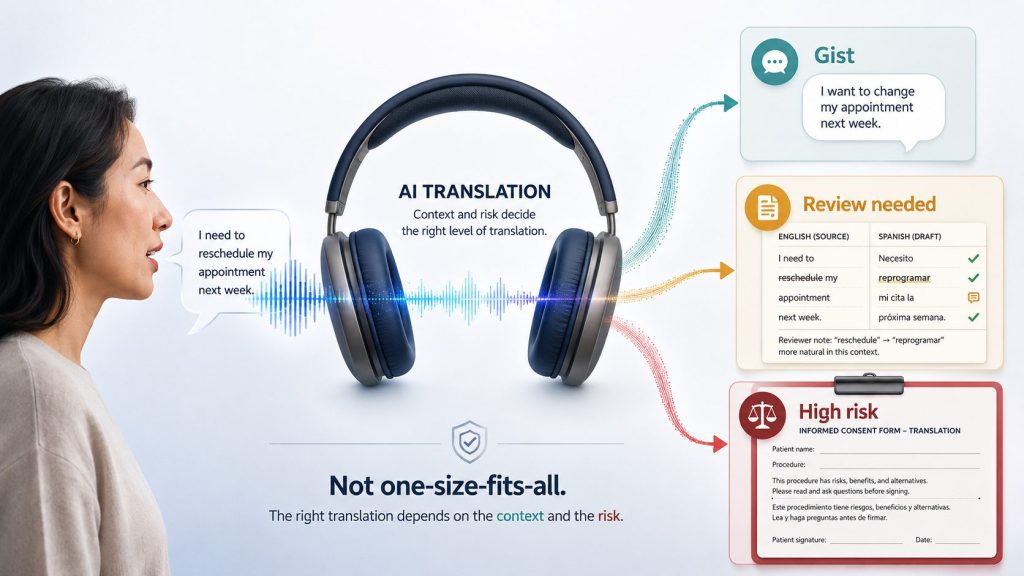
At one end of the spectrum are situations where understanding the gist is more than enough. Internal emails, research reports, conference presentations, background reading and informal conversations all sit comfortably in this category. If an AI tool allows somebody to participate in a discussion they would otherwise have been excluded from, that’s progress. It helps level the playing field.
The middle ground is more interesting. Service information, website content, appointment letters, public health campaigns and guidance documents all need to be accurate, but they don’t necessarily require every word to carry legal weight. This feels like the sweet spot for AI-assisted translation now that the quality has improved so dramatically. The technology can do much of the heavy lifting while a bilingual reviewer checks the output, corrects errors and improves phrasing where needed.
The goal isn’t to remove humans from the process. It’s to use their expertise where it adds the most value.
Then there are the high-risk situations: court documents, consent forms, contracts, safeguarding assessments and formal legal correspondence. These are not situations where “probably right” is good enough. In those cases, professional translators and interpreters remain essential. AI may help with terminology, preparation work or first drafts, but human expertise and accountability need to remain firmly in the loop.
Not because we’re better than the tech, but because we know our limits
Nobody ever expected a human interpreter to be perfect. We understood that they might miss a joke, struggle with an unfamiliar technical term or choose a slightly different phrase from another interpreter. We accepted those limitations because the alternative was often no translation at all.
Human translators get tired, and they have to train before they become expert. They work under pressure. Different translators will make different choices. Bias can creep in.
AI, meanwhile, tends to fail in a different way. It is often fluent, confident and persuasive right up until the moment it is proved wrong. That’s what makes it both powerful and potentially dangerous.
A poor human translation often sounds poor. A poor AI translation can sound excellent. The challenge is that polished language creates an illusion of accuracy.
That is why the real issue isn’t technology. It’s your governance.
If you’re responsible for communications, policy or service delivery, a useful question is this: do you actually know which documents in your organisation can be translated by AI, which need human review and which should remain firmly human-led? Have you revisited those choices since the AI landscape changed?
My guess is that most organisations don’t have a clear answer yet.
The organisations that get this right won’t necessarily be the ones with the most advanced tools. They’ll be the ones that understand their own content, make best use of the resources they have, know where the risks sit and have sensible review processes in place.
I suspect we are approaching a point where real-time translation becomes so commonplace that we stop noticing it. My friend will be able to hear flattering remarks about her legs directly from handsome Frenchmen, without needing me to translate between fits of laughter.
Future generations will find it strange that international meetings once required teams of interpreters, or that residents sometimes waited hours to access services because nobody available spoke their language – or because nobody was entirely sure what language was being spoken.
We may lose a few entertaining misunderstandings along the way, but I reckon we’ll find some new ones. And if the trade-off is that more people can understand their rights, access support and participate fully in important conversations, that feels like a price worth paying.