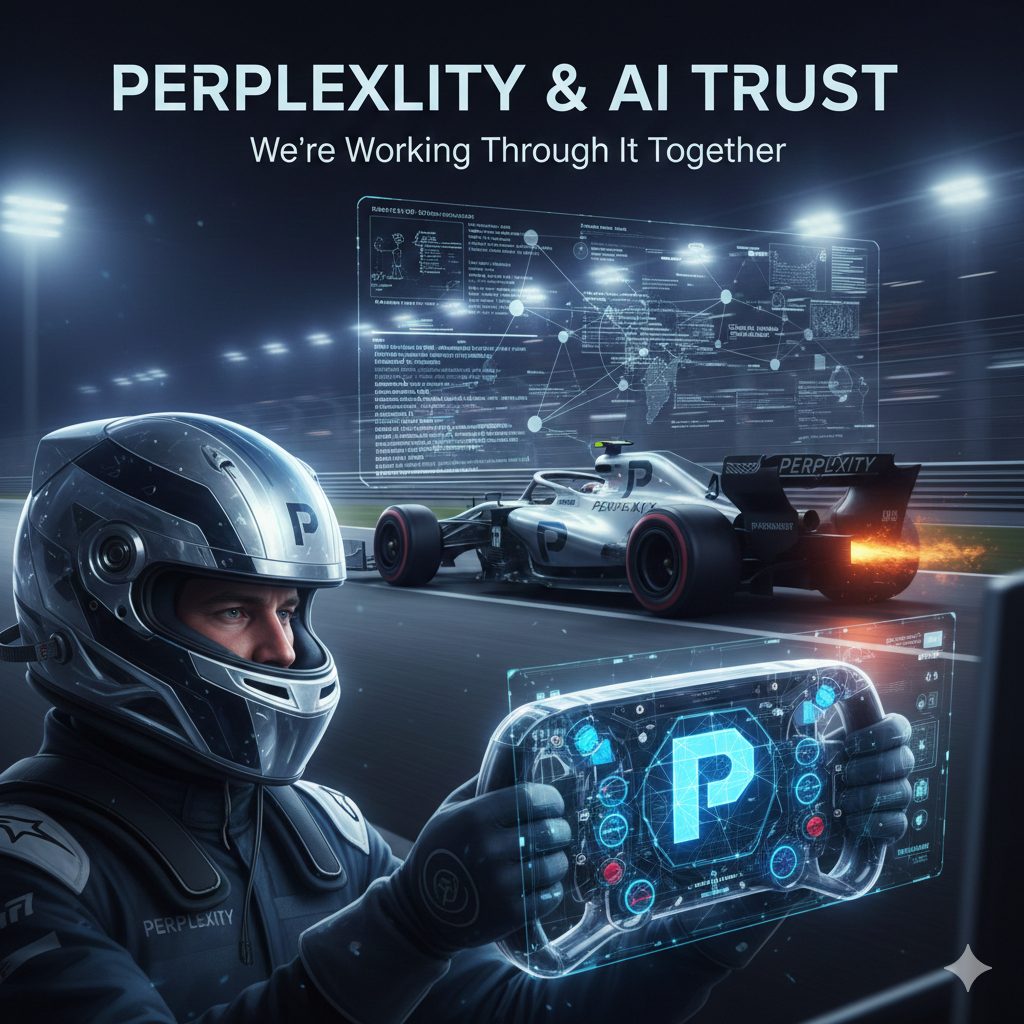
I knew Perplexity had gone mainstream when it appeared not once but twice in places I didn’t expect to find it: first on Lewis Hamilton’s helmet, then in Lee Jung-jae’s new K-drama. I know my niche interests aren’t for everyone, but let’s bear in mind that Lewis has over 40 million followers on Instagram alone and holds every record in F1 that means anything: finishes, wins, podiums… legend. Meanwhile, Lee Jung-jae starred in Netflix’s most-watched drama of all time, Squid Game. In global terms these are endorsements that signal serious investment and a pretty determined “global leader” brand strategy.
I’m one of those annoying people who mentions Perplexity every time someone tells me they’re still wading through sponsored Google links to find information, or when a colleague complains about a ChatGPT hallucination. I’m a fan, but I still have to explain to people what it is and why they need to ditch Google for it. Full disclosure: I love Perplexity nearly as much as I like cartoonishly violent Asian dramas and fast cars. I admire the product because it actually helps me find information online; and I admire the ambition. And I’ll freely admit I felt an unreasonably large amount of joy seeing the logo tear round a circuit at 200mph.
But being a fan doesn’t mean ignoring the issues.
Perplexity, like other free online generative AI tools, has faced questions about how it crawls content, how it attributes sources, and how transparent its summaries really are. These debates matter; they cut right to the core of search: trust.
Search isn’t just a tool we use. And ever since Google made our lives easier, it’s no longer a job we outsource to expert researchers — we do huge amounts of our own research and, increasingly, we’re using generative AI to do it. It’s the foundation we build decisions on. Whether you’re a policy adviser checking legislation, a founder exploring a new market, a social worker looking for guidance, or a product manager comparing vendors, the information you see shapes the choices you make. But — crucially — if the provenance is unclear or incomplete, the risk lands on you, not the model.
If you need a reminder of how quickly a chain of small misjudgements can turn into full-blown chaos, the Hamilton helmet connection throws up an excellent example. Imola is where the Perplexity logo first appeared, and that day Ferrari served up a series of “moments” that felt very on brand: a split-tyre gamble, awkwardly timed pit stops, and a late-race radio message that left Leclerc visibly fuming (in so far as a well brought up Monagasque can ever fume). It was a masterclass in how confident-sounding instructions can unravel when the underlying reasoning isn’t solid. There’s evidence-based strategy, and then there’s vibes-based strategy. Ferrari are, if they are anything, about the vibes.
Search tools can fall into the same trap: they look ever more slick and certain, but if the logic or sourcing underneath wobbles, everything on top does too. Admire the innovation, enjoy the spectacle — but, as Ferrari kindly demonstrated, don’t hand over the steering wheel without knowing who’s actually calling the pit stops and what that decision was founded on.
The truth is, people are already defaulting to tools that weren’t designed for search at all. I see a lot of people jump into ChatGPT and ask it factual questions, forgetting that LLMs blend knowledge, inference, and (occasionally) pure invention — often without citing a single reliable source. Sometimes they make up the source too. Others stick with Google and get an AI summary whether they asked for one or not, mixed with ads, SEO noise, and the occasional competitor conveniently placed above the brand they actually searched for.
So we end up with a strange dynamic: a world hungry for information, using tools that hide how they know what they know.
This is why, even with the occasional wobble, I still think Perplexity is the strongest universal search option right now. It’s not perfect — and it shouldn’t pretend to be — but it’s trying to solve search for the user rather than the advertiser, and it forces your attention to the sources so it’s hard to forget who’s in the driver’s seat. It cites more openly than Google, hallucinates less than a standard chatbot, and generally respects the idea that users deserve to see the underlying sources. In a landscape where transparency seems optional, that alone puts it ahead.
But — and this is the grown-up bit — affection isn’t the same as accountability (although, for clarity, I have zero financial interest in telling you to choose Perplexity over anything else). If we’re going to use AI search tools, whether in government, a company, a charity or a start-up, we should understand how they work, what their limitations are, and where responsibility sits. We need internal norms about checking sources, keeping track of where information came from, and not outsourcing judgement to something with a neat interface and an extremely confident tone of voice.
In Formula 1, veteran drivers know when to press, when to back off, and — crucially — when to question a call from the pit wall. Organisations using AI need that same kind of experience. A mature driver doesn’t blindly follow every instruction; they bring judgement, instinct, and a readiness to override the system when something feels off. Without that human steering, even the smartest tool becomes a liability.*
So yes, I’ll keep smiling when Perplexity shows up in another F1 broadcast or make a K-drama cameo. But I’ll also keep asking the awkward questions — because good tools get better when their users demand it.
…which, in fairness, all of our users do. It’s why we choose RAG. But you knew that.
*And if you’re following the F1 references, that is definitely a dig at McLaren’s recent decision-making in Qatar — where both young drivers followed the call to the letter and handed Max Verstappen an opportunity he wasn’t expecting. It did make me wonder whether a more experienced driver might have pushed back harder and forced a different decision.

Latest posts


Free webinar – AI in Housing is a senior leadership decision, not an IT project
Events