There’s something wonderfully reliable about the aftermath of an election: everyone immediately explains how the result proves the thing they already thought.
America’s midterms are, depending on your reading material and whichever corner of social media you tend to inhabit, the beginning of the end for Trump, a verdict on the war in Iran, a rebellion against billionaire influence, or confirmation that Americans get very cross when petrol stops being cheap as chips.
Meanwhile, between Trump’s electoral rejection, Musk’s expensive disappointment, the investigation involving Nvidia’s Jensen Huang and Russell Brand’s sentencing, it’s been quite a week for contemplating the limits of powerful men. These are very different circumstances — criminal convictions, an unresolved investigation and electoral fallout — but I may have raised an eyebrow at the apparent discovery that personal confidence is not, in fact, an exemption from accountability.
Back to the election, though. What does it actually tell us about AI? And should those of us using it over here be worried?
You can buy the adverts
Campaign spending certainly didn’t guarantee the outcome of the US midterms. AdImpact’s election-eve figures put political advertising spending at nearly $11.9 billion across the cycle. Musk himself committed at least $445 million to supporting Republicans, according to AP’s reporting. That is an extraordinary amount of money to spend on an evening you didn’t enjoy.
For perspective, UK political parties spent £19.7 million on advertising at the 2024 general election. America has roughly four times as many registered voters, but we’re talking hundreds of times the advertising spend — albeit across a whole cycle of different contests. Another scale entirely.
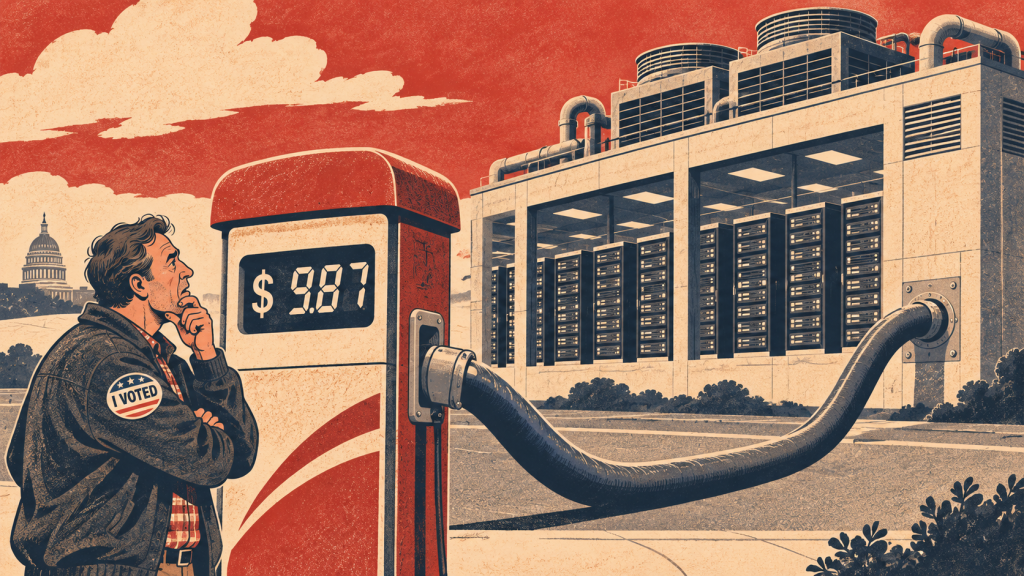
But people arrive at the polling station with actual experiences that even a very expensive advertising campaign can struggle to explain away. ABC News’ voter polling offers a useful quick account: three-quarters thought the economy was doing badly. Around six in ten were very concerned about each of fuel, food and healthcare costs. Petrol mattered, but it had company. And “Iran” and “the cost of living” overlap when the war has helped push up fuel prices.*
None of this gives us a precise recipe for why every voter voted the way they did. It does suggest some caution about declaring that America collectively woke up with a settled position on artificial intelligence.
So why did AI stocks take a battering?
Good question. It’s because elections change expectations about what companies will be allowed to build, how quickly they can build it, and how much money they might make.
The AI boom depends on physical things: chips, data centres, electricity, water and somewhere to put them. Incoming politicians who want tighter controls on development can make investors more nervous about the speed of expansion. Reuters reported a roughly 5.5% Nasdaq fall on 5 November, with concerns about restrictions adding to existing doubts about financing and returns on AI investment.
If your investment case assumes everything will grow very quickly, “possibly a bit more slowly” can knock a lot off your valuation. Share prices reflect expectations about future earnings, so they can change long before a politician has changed a single rule.
There’s a political lesson here too: being promised a share in a glorious technological future may be less persuasive when you think you have to find the money for the electricity bill first.
Has anything actually changed?
The election has changed who will hold power in Congress from January. Trump remains president. That creates more scope for scrutiny and obstacles to his agenda, rather than installing an entirely new administration. Exactly what follows for AI investment will depend on decisions about planning, infrastructure, energy and regulation. A campaign promise, a new law and a delayed building project are different stages of something happening.
Markets are still working out what they think, too. The Nasdaq rose 2.7% on Monday, while several big brokerages argued that the sell-off was overdone. Those are judgements, rather than an all-clear from the future. If you were imagining something more scientific behind the daily movements, remember that markets also involve people trying to anticipate what other people are about to do. Plenty of room for drama.
One lesson is: a technology can be useful while some of the businesses surrounding it are valued on heroic assumptions. A good technology doesn’t guarantee a good investment.
So, should we worry over here?
For most organisations in Britain and Europe, there’s no immediate reason to change their AI plans because American technology shares had a rough week.
An assistant that helps colleagues find the right policy, or reduces time spent writing up notes, should still be judged by whether it does that job accurately, safely and at a worthwhile cost. Its usefulness doesn’t rise and fall with Nvidia’s share price.
That said, there are possible consequences worth watching. A substantial infrastructure slowdown could eventually affect capacity, prices or the pace of new services. Financial pressure might matter if your supplier depends on constantly raising money. Neither follows automatically from a week’s market movements.
When buying, look past the logo, too. Who supplies the model underneath, and what happens if they change the price or withdraw it? Can you move your documents, prompts and working processes elsewhere without starting again? Two different apps may depend on the same provider, while a UK address doesn’t tell you the whole story about where your information goes. You don’t need to predict which AI company will win. You do want to avoid making your organisation’s future depend on having guessed correctly. Ask. A good supplier will tell you the answers.
In practice, this brings us back to our comfort zone and the questions we should already be asking. Is this tool saving time once checking is included? Is it dependable? Can we get our information out and move if we need to? Does the cost make sense? Are we meeting the rules that apply here?
You don’t need to become a US political analyst to answer any of those questions.
So, do we need to worry, or are we cool? I reckon we can probably carry on with the useful work, while keeping an eye on the big suppliers. The case for using AI should be able to survive both Silicon Valley getting carried away and Wall Street having a wobble.
*If you wondered, Americans are still paying less than half the UK price per litre at the pump. But voters tend to compare today’s bill with their own previous bill. Their petrol… sorry, gas… prices are up about 30% since Trump was re-elected in 2024; ours have risen slightly more slowly. Since his first election in 2016, theirs are up about 78%, before adjusting for inflation — which you don’t tend to do while looking at the enormous numbers on the board beside the road. You can see how that would be… quite annoying.