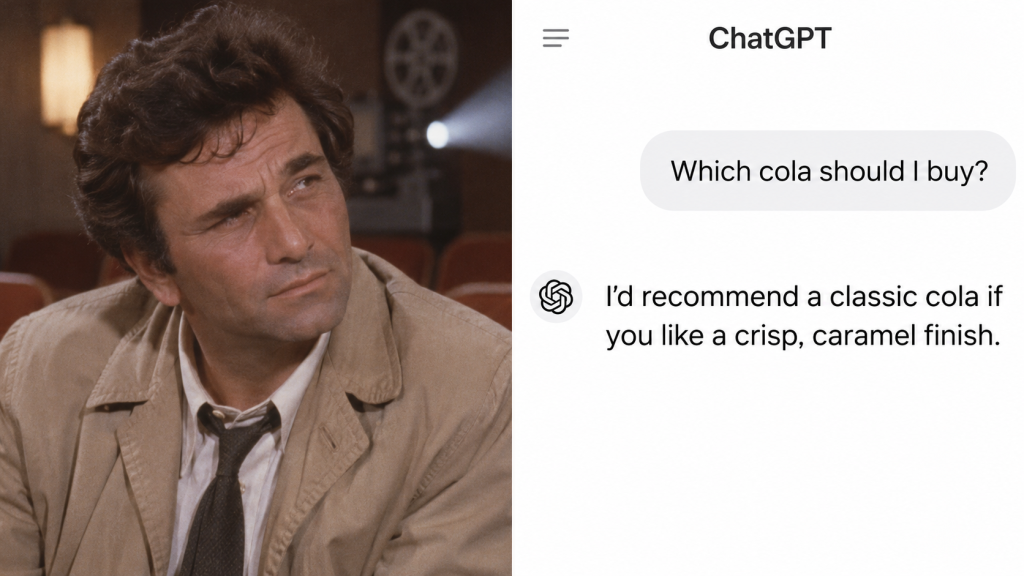
I remember an episode of Columbo in which an advertising expert uses subliminal images of a nice cold drink to lure his intended victim into a trap. The idea is that images flashed up during a film are too brief for you to consciously notice, but your brain registers them anyway. Suddenly, you’re thirsty.
Later, wily old Columbo — the greatest fictional detective of all time* — uses the same trick to lure the killer into giving himself away. A somewhat extreme approach to audience conversion.
The episode, Double Exposure, first aired in 1973, but Columbo repeats were practically a public service in the 80s, when I was growing up with just three television channels. Then, excitingly, four.
The famous real-world experiment behind subliminal advertising was discredited years earlier, but the question it left behind is still a good one: what happens when we don’t recognise that someone is trying to sell us something? And now there is a new twist. The advertising may not be aimed directly at us, but at the AI assistant reading on our behalf. The machine can see the advert – it may even know it is an advert. Do we?
First, why this matters
The underlying change is not just that people are using new search tools: increasingly, you can get an answer without visiting the organisation that supplied the information. Click throughs are in decline, and we don’t have to make a conscious decision to “use AI” for that to happen. SparkToro’s June 2026 analysis of Similarweb data found that almost seven in ten UK Google searches ended without a click.
For someone checking a simple fact, an answer without a visit can be useful. For the organisation behind that information, it depends on what was meant to happen next. A business might lose a potential customer. A charity might successfully answer someone’s simple question — or they might miss the opportunity to explain an exception, offer much-needed professional support or help someone understand what applies to their circumstances.
The leadership question is not just “How do we get the click back?” It is “What can safely be answered at a distance, and when does someone need to come to us?”
It’s not enough to say GEO
If you work with a marketing team, you have probably encountered GEO: generative engine optimisation. Traditional search engine optimisation, SEO, helps your content get found through search engines. GEO focuses on whether your organisation is found, mentioned or cited within AI-generated answers. You may also hear AEO, or answer engine optimisation. The labels overlap; Google describes optimising for its generative search features as still being SEO. The useful distinction is between competing for a place in a list of links and becoming part of the answer someone reads instead.
There is sensible work that helps here: publishing accurate, accessible information, making your expertise clear and making basic facts easy to find and interpret. Google’s guidance emphasises those fundamentals rather than a special collection of AI tricks. But becoming a source, buying an advert beside an answer and paying to place material in its sources are different things. Those distinctions matter more than remembering the latest acronym.
Three routes into the answer
- Becoming a source
So your organisation publishes information that an AI system retrieves and uses: research, guidance, product details or an explanation of who you help. This is broadly the territory GEO describes: the aim is visibility within the answer, although visibility does not guarantee a recommendation, enquiry or sale.
For a council, charity or public body, accurate representation may matter more than promotion. Does the assistant explain your service correctly? Does it understand eligibility, geographical coverage and what someone should do next?
- Advertising within an AI service
This is where the platforms sell advertising within the user’s experience. OpenAI announced plans to test advertising in January 2026. Its stated approach separates clearly labelled adverts from ChatGPT’s answers; its guidance says advertisers cannot shape, rank or alter those responses. Paying to appear alongside the advice is not, according to that policy, paying to change it. The practical question is how that separation works and can be checked.
OpenAI are also testing “Sponsored Agents”: click an advert and you can enter a separate, labelled conversation with an AI representative of that business. The sales pitch can now answer your questions.
- Advertising to the assistant itself
This is the less familiar development that caught my attention last week. TIME has been working with advertising technology company Mobian to place sponsored material in machine-readable versions of its pages. Mobian describes its “Agent Ads” as labelled blocks of brand information served to registered AI agents.
Think of it as a version of a webpage designed for software rather than human readers. Alongside the article is information a brand has paid to put there. The immediate audience is the assistant gathering information – the eventual audience may be you. This doesn’t mean the assistant will use the message or lose the disclosure, but commercial influence can enter before the answer reaches your screen.
For a council or charity, this adds to an existing concern: what survives the journey from your information to someone else’s answer? A summary might describe a service correctly but forget to say who qualifies, or turn general guidance into something that sounds like individual advice. Paid material adds another question: has the distinction between evidence and promotion survived too?
Follow the money — and the label
The commercial logic is understandable. Publishers like TIME earn money from adverts seen by website visitors. If an assistant reads an article and answers on their behalf, that visit may never happen. Selling advertising in the material assistants read offers another way to earn money from the information they use.
Imagine you ask an assistant to recommend a supplier and it reads a paid promotional message on a publisher’s website and includes that supplier in its shortlist — without telling you the information came from an advert. The commercial claim has travelled, but the advertising label has not.
The claim doesn’t need to be false for that to matter. “A respected publication independently recommends this” is different from “an advertiser paid to put this message on that publication’s website”. If another assistant then reuses the shortlist, the original advertising connection could become even harder to spot. And three assistants repeating the same claim would not make it three independent sources.
Haven’t we already got rules for this?
Most countries have rules, yes. Advertising should be identifiable as advertising, including when AI is involved. In the UK, the ASA says its existing rules apply regardless of how advertising is generated, edited or targeted. The new operational challenge is making disclosure survive the journey. A label attached to source material is not automatically a disclosure that is visible in the final summary.
What survives the summary?
You do not need to become an advertising technologist, or unpack each claim with Columbo-like diligence. But “Are we doing GEO?” is not enough.
Start with a few questions your customers, residents or service users tend to ask. Get someone to try them in the AI services people generally use. Next, compare the answers with your published information. Is the answer correct? What has been left out? Does it preserve important conditions and direct someone to individual help when needed? Check the sources too, although a link to your website is not proof that the answer represents it faithfully.
Keep the prompts, platforms, dates and examples, so you can repeat the exercise and see what changes. If an agency is selling improved AI visibility, ask what it is actually doing and how it measures success. Being mentioned is of limited use if the assistant confidently describes a service you don’t offer.
For charities and public services, fewer website visits are not automatically a failure. An accurate answer might help someone without adding another step. But if a missing qualification stops them seeking support, the summary has failed them, however reassuring it sounds. The question remains: what can safely be answered at a distance, and when does someone need to come to us?
…and just one more thing: when your AI says “I recommend”, who’s really doing the recommending?
* Because: Peter Falk, obviously. And guest stars like Johnny Cash and Leonard Nimoy. But also, Columbo could be rumpled without being tormented. He loved his wife, had a dog and solved murders without carrying a dark secret or an inability to sustain human relationships. Somewhere along the way, television decided this wasn’t flawed enough. Buy the cookbook – it includes Johnny Cash’s Chili recipe for goodness sake.