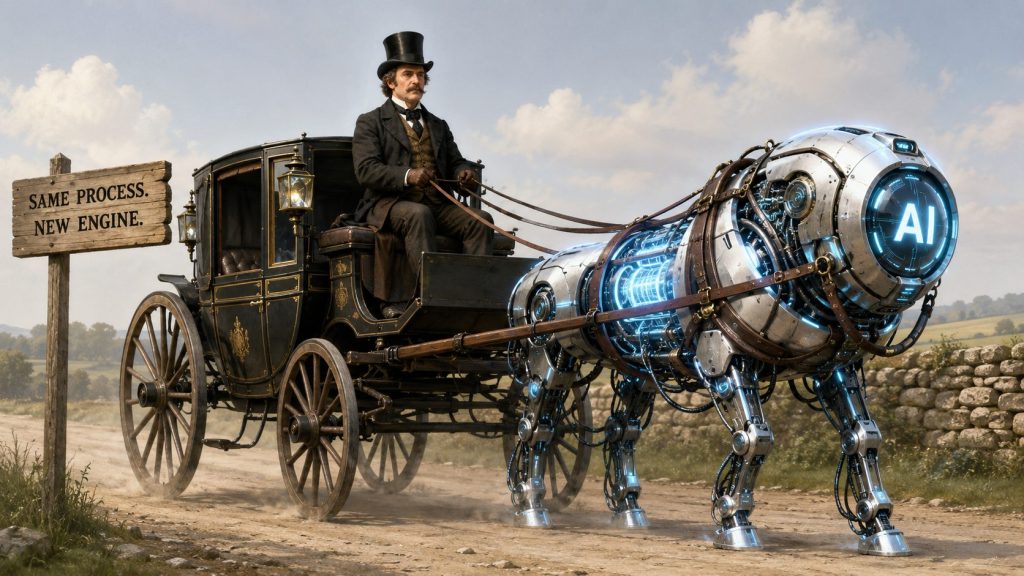
One of my favourite silly things about the earliest cars is that they looked almost exactly like horse-drawn carriages. So much so that they were, rather obviously, called horseless carriages, which tells you a great deal about how humans respond to new technology. We don’t usually stop and ask, “If we were solving this problem from scratch, what would we build?” We tend to keep almost everything the same and… replace the horse with a slightly smaller mechanical horse.
In some cases, we didn’t even manage that. Early cars still required you to climb out, walk round to the front and crank the engine by hand before climbing back in to drive away. A revolutionary new technology with a remarkably familiar workflow.
I think about that quite a lot when people ask me about AI. Not the horse per se, but whether we could do with taking one extra step back from the problem to make sure we’re getting to the right solution and not just polishing the old one.
When organisations ask where they should use AI, the issues are usually familiar:
“We’ve got a report that takes three days to write.”
“We spend hours taking minutes.”
“Our approval process is really slow.”
“These forms are so very, very painful.”
All true — especially in the public sector. And there are genuine automation quick wins here, but they can sometimes feel like someone proudly announcing they’ve invented a self-cranking horseless carriage. Progress? Yes. The best we can imagine? Probably not.
Meddling disguised as redesign
My favourite examples don’t involve AI at all; they involve printers. Stop me if you know this one but it’s when a paper form becomes a PDF, the PDF gets emailed, someone prints it, signs it, scans it, emails it back, and someone else uploads it into a system that was supposedly introduced to eliminate paperwork. Parts of the NHS still largely run on this process.
Congratulations. We’ve digitised almost none of the process.
This isn’t just anecdotal. Reviews of public sector transformation programmes (for example by the National Audit Office and others) consistently find that digitising existing processes without redesign delivers limited productivity gains. In some cases, it simply makes inefficient processes run faster — and therefore at greater scale. We just do more of the inefficient thing.
AI risks becoming the latest version of this story: the report still exists, the meeting still happens, the form still asks seventeen questions, and the approval still requires four signatures. We’ve just found a slightly faster way of completing each step.
Subtraction neglect is real
There’s a helpful piece of research that explains why this keeps happening. I haven’t mentioned it here for at least a year, so it’s time for a reminder: In a 2021 study published in Nature, Gabrielle Adams and colleagues gave participants simple design problems — improving a Lego structure, stabilising a roof, redesigning a grid. Participants overwhelmingly chose additive solutions: more bricks, more supports, more features. Subtractive solutions were consistently overlooked, even when they were obvious and better. The researchers called this “subtraction neglect”: a systematic bias towards adding rather than removing.
Once you see it, it’s everywhere in organisations. It’s another approval step to make sure you don’t repeat that rare mistake that you didn’t actually need help to notice and fix the one time it happened before. It’s another spreadsheet because the old one wasn’t quite doing what you need, so you’re running a new one in parallel because the old one is still needed by someone else. Both live on, each with its own version of the truth. Sometimes it’s another mandatory training because one determined rulebreaker got through the perfectly serviceable existing safety net. Maybe it’s another KPI while you’re still collecting all the old ones no one looks at.
Each one probably had a good reason to exist. But almost nobody is rewarded for removing them. If anything, we tend to reward the opposite.
Why AI is an opportunity (if we use it well)
This is why I think AI has accidentally handed us something more valuable than automation. It gives us permission to ask a different question. Not: “How can AI help us do this faster?” But: “Why do we do this at all?”
The biggest productivity gains in complex systems rarely come from speeding things up a bit; they come from removing steps entirely. There’s a consistent finding across service design and operational research: reducing unnecessary demand, duplication, and handoffs delivers more impact than optimising individual tasks.
And that’s where redesign starts to get interesting: it’s when the meeting becomes an email or disappears entirely. There’s good evidence that this isn’t just a nice idea – experiments with meeting‑free days have found that cutting meetings altogether can significantly increase productivity and reduce stress, largely because people stop attending meetings that never needed to happen in the first place. Or when we see what happens when we remove an approval no one can remember the reason for introducing and find out… we’re fine.
A simple way to redesign (not just automate)
If some of this feels familiar and you’re wondering how it turns into something practical, here’s a simple approach: Take one process — something irritating but common — and map it end to end based on how it works in practice. Then work through four questions:
- What is the actual outcome?
Not the outputs and products (the report, or form, or meeting), but the purpose. What decision, assurance, or action is this meant to enable? - Which steps genuinely add value?
Value means one of three things: improves the decision, reduces risk in a meaningful way, or improves the user experience. Everything else is a candidate for removal. - What would this look like if we started today?
Ignore current structures, roles, and systems. If you were designing for a digital-first, data-rich environment, what would you build? You might need to swap out the workshop participants for people unencumbered by organisational baggage in order to answer that one. - What would you remove if you had to halve the time?
This is the most useful constraint: it forces subtraction. You can’t optimise your way to 50%; you have to eliminate something.
Using AI to ask better questions
AI is genuinely useful here — but not just as a production tool. It’s very good at challenging assumptions if you prompt it properly. Describe your workflow in detail (and remember it’ll be pretty forgiving about your tone so you can rant away and really make this an exercise in catharsis, if you need), then ask:
- What assumptions are we making?
- Where are the bottlenecks, and why do they exist?
- Which steps could be removed entirely?
- How would this work for someone new, under pressure, or using a phone?
You won’t get a perfect redesign from an AI, but you will get better questions, and often that’s the missing ingredient. Because at the moment, we’re spending a lot of time teaching AI to fit into our existing workflows, and we might get more value by letting it challenge whether those workflows should exist at all. Give it a seat at the table.
Pick one irritating process this month, map it, and let AI help you ask what you can remove.

Latest posts

Free webinar – AI in Housing is a senior leadership decision, not an IT project
Events