Week 15. Kieron is back from six days on the beige boat of joy — a 1980s river cruiser that he describes as “full on retro”. Neil describes Kieron as the “Magnum P.I. on the Thames”. If you’re lucky enough to be under 50, look it up. Kieron said his six-year-old son’s favourite thing about the whole trip was watching YouTube on the iPad. The joy of parenting in 2026.
“Neil, you’re the biggest problem in the company” 😬
Both Kieron and Neil independently asked Claude to give them brutal, honest feedback on their business — and told it not to worry about their feelings. Neil went first. Claude told him he was the biggest blocker in the company. Then Kieron ran the same exercise. Same result. They’re now wondering if Claude just tells everyone they’re the biggest problem — which, frankly, might be the kindest way to land a difficult truth. The more useful output: stop comparing yourselves to Copilot, focus on the context layer, security, compliance and control — that’s where the real value is. And get a non-exec director. Claude was quite insistent about that last one.
Scaling — what would we do if we launched today? 🚀
Kieron’s river-based reflection led to a genuinely important strategic question: what would Leading AI do differently if they were starting from scratch today? Not abandoning anyone — that’s not who they are — but drawing a line in the sand and asking what a cleaner, simpler, better-priced version of the business looks like. The pricing team session from last week fed into this, with Claude doing a brilliant job of synthesising everyone’s thoughts and — as Neil noted — flattering Kieron just enough to make his ideas feel more persuasive than they perhaps were. Behavioural science at work.
Three customer stories 📋
Neil had a busy week of conversations. A private sector organisation selling personalised services to global clients wants to partner with Leading AI to scale their communications — consistent messaging across multiple regions, multiple languages, explainability and accuracy baked in. A NOC/SOC security company (Network Operations Centre and Security Operations Centre, for those who didn’t know — Neil didn’t) wants to use KnowledgeFlow to get the right information to the right people in real time during incidents. And a large organisation doing lots of public sector bidding got in touch off the back of the 100/100 bid story — they want to explore BidWriter. Meeting on Monday.
BidWriter impresses a fellow boater 🛶
Kieron set up BidWriter for an organisation at speed last week — they got their documents in the day before the tender deadline, used it straight out of the box on a big bid, and the feedback from the team was excellent. Kieron bumped into the CEO on the river over the weekend. The CEO was delighted with the result. Neil noted that the CEO still hasn’t signed the contract. His suggestion: contracts should only be signed, in person, on the beige boat of joy from now on.
Claude Opus 4.8 is out 🤖
Kieron flags the new Opus 4.8 launch. Key improvement: it’s reportedly better at knowing when it doesn’t know something — which is genuinely hard to achieve. An AI that doesn’t know what it doesn’t know is a hallucination machine. An AI that flags uncertainty is a trust machine. The question is how Anthropic is achieving it, because the model itself doesn’t know what context it’s missing. Meanwhile, Microsoft has apparently cut their internal Claude licences because it’s too expensive. You can’t run Opus at scale on a thin margin. Sonnet is the sensible choice for KnowledgeFlow — and even then, token costs are a real consideration.
Model switching — the Hoover analogy 🌀
Why would you turn the suction down on a Hoover? Kieron doesn’t understand that setting. Neil does — you wouldn’t you’re your Granny’s teapot flying up the tube. The analogy maps perfectly to model switching: customers say they want it, but what they really want is the best model for the job without having to think about it. The answer is automated intelligent switching — a governing agent that picks the right model for the task. Leading AI monitors models constantly. Most customers don’t — and AI marketing on LinkedIn isn’t exactly an unbiased source of guidance.
Neil is heading to Scotland. He says his friend there is lovely, but after two beers he can’t understand a word he says. He just nods sagely and reverses his position if the man looks grumpy. To be fair, Neil does that with pretty much everyone when he’s had a drink. 🤣
Two mates. A bar. Thirty years of business between them. And all they want to talk about is AI.
Pull up a stool — we’ll get the beers in. 🍺
TRANSCRIPT:
This week in Leading AI… Episode 15 – 2 June 2026
Neil Watkins
Are you ready?
Are you? Right. Well, let’s get this pantomime horse of a podcast underway for week 15, which has been an interesting week for me, but I’m not so sure for you, because you’ve been pottering up and down the Thames on the beige boat of joy. What was your week off?
Kieron White
Week 15.
I have pottering. Pottering is the right word for it. I had a really lovely time. It was super hot. It’s been a very, very hot week in the UK and that has its benefits and downsides on a boat. Interestingly, sleeping is much better because you’re on water and the boat doesn’t really retain heat because it’s only fibreglass.
Neil Watkins
Shame.
Yeah.
Kieron White
So that’s good to get cool very quickly, but in the daytime you get all the opposite of all of that. It’s bloody boiling. So it was lots of fun. Thank you very much. And the amusing thing about river boating is so the boats in Windsor and we got to Reading on day three, I think it was, past Reading on day three. That is approximately an hour
From where we live on a train.
or three days on a boat. I mean, you could have done it in a day, but it would have been a pretty unpleasant day of boating all day. It’s about probably 8 hours of boating.
Neil Watkins
But.
Hey, you.
at your massive 2 knots an hour, whatever you’re doing. It was so deep you can get out and push.
Kieron White
Yeah, exactly. It was, but it was, it was a fun week.
You can, most of the time. You can, yeah, and hilariously. And we were with my 6 year old boy who was having a brilliant time on the paddle board, speeding the ducks, paddling around in little beaches as we found them and generally having a lovely, wholesome time. And I said to him, what was your favourite thing?
about spending six days it was on the boat and he said, hmm, watching YouTube on the iPad.
Just like, oh, great. The joy of parenting in 2026.
Neil Watkins
Oh, dear.
Exactly. Kids today. Kids today. So did you do any reflecting while you were supping beer, chugging along on the old Thames?
Kieron White
Exactly.
Ha ha.
I did, I did. I mean, we had last week and we talked about this, a big team session on pricing. And really interestingly, that has turned into a strategic conversation about what is it that we sort of do, we should do,
We do all kinds of amazing, amazing things. KnowledgeFlow is the best AI platform out there for enterprises. But no, not at all. But we’re not very good at sharing that at scale, which is interesting. I anyway, the getting to the where we go with all this, the Claude conversations that we had last week.
Neil Watkins
and you’re not biassed at all.
Kieron White
getting it to help bring a third perspective to our team view, to some data, and then getting Claude on it was really interesting. And so I’ve been doing a bit more of that. I think the headlines that I’ve been most excited about is the idea of remembering that we’ve learned for
Now, three years, what works, what doesn’t work, what’s really effective, potentially what’s coming next? Who knows? That’s the stuff we always kind of hope we’re right. I think we should acknowledge that all of that is amazing learning and doesn’t necessarily define the future. And that there maybe is a time for a line in the sand, sort of like,
What would we do if we were relaunching today? How would we price? What would we offer? What would we not do anymore? I think we’re at that kind of stage. Not that we’re going to abandon anybody because I just, there’s not at all. I could, frankly, couldn’t work for a business where you just sort of ditched a client. So no, we’re not doing that anymore. Off you go. Good luck.
Neil Watkins
Mm.
Hmm.
Yeah, thanks very much.
Yeah.
Kieron White
But I think there is a kind of everyone for the future.
we can benefit from all that learning.
Neil Watkins
Yeah, I did a little bit of playing with Claude as well. And I put some stuff in and one of my prompts was along the lines of, tell me what I need to do next. Don’t worry about hurting my feelings. And boy, it did not worry about hurting my feelings.
Neil, you’re the biggest problem in the company. Oh, brilliant. So yeah, that’s right. I’m the biggest, I’m the biggest blocker apparently. So yeah, apologies everybody in the company, but yeah, it’s me. So, so that was that was really interesting and it’s a good job I can have a laugh about it.
Kieron White
The thing I’ve always suspected is true. Ohh, God, it’s me.
Yeah.
Well…
And not just you, it turns out, because I run the same thing again on through me, and it turns out I am the equal biggest problem. Maybe it just says that to everybody. If you tell it, don’t be shy, you know, don’t worry about my feelings, maybe it just immediately, who knows?
Neil Watkins
Yeah.
What?
I think so, yeah.
Yeah, yeah, you’re rubbish. Let me get, let me tell you why. So that was fantastic.
Kieron White
Yeah, exactly, yeah.
Yeah.
Neil Watkins
But it was interesting. And some of the things that came up were really useful, actually, and actually really challenging. There was one interesting bit, though. It said, you really need to get a non-exec director. I don’t know the context. You shouldn’t be coming to me for this kind of advice, which I thought was interesting, given stuff that I’ve said about
relationships and things in the past with AI and people building relationships. So I wasn’t planning on building a relationship, especially with an AI that says I’m the biggest blocker in the company. And it couldn’t even get it couldn’t even get that right, because it apparently turns out you’re off after a problem, not just me. So there are a couple of really interesting things. One is
Kieron White
Yeah.
Put you right off.
Yeah.
Yeah.
Yeah.
Yeah.
Neil Watkins
about the scaling piece, you know, how do we take what we’ve got and make it bigger and better? And I’ve got 3 customer stories for this week, which we’ll come on to, but part of that scaling piece is really interesting. The other bit was around
Copilot comparison. And it broadly said, you need to pack that in because Copilot isn’t your biggest competitor. And actually, the challenge is that Copilot is, oh, sorry, in our solution, AI is the really cheap part. It’s actually the control, the security, the access, the integration.
Kieron White
Mm-hmm.
Neil Watkins
the compliance, all of that is the expensive part and that’s the bit that we actually should be, we should be mergering on that. But I think it missed one piece which we picked up from Gartner last week, week before, whenever it was we were in Gartner, which is the context layer. And I think
If we added the context layer into that piece, it becomes increasingly powerful because, you know, organisations struggle without that context layer to get context layer to get good value out of the AI. And indeed, I think
One of the things it said to me was, come back to the non-exact point, he said, I don’t understand your context. You need a person who understands your numbers, your people, your challenges, da, da, da, da. So context, I think here in his work, one of the things, one of the big things that we need to be focusing on. And as Gartner said, context is king and reflection. I think they have a point and we need to start building that into all of
All of our customers’ tools.
Kieron White
Yeah, no, wholeheartedly, we definitely do that. And I think we can do some of that because a lot of it is like always a context layer or semantic layer or what did I what did I write down? Yeah, that’s it. It was a semantic context ontology layer. And those are many ways of describing what really in practical terms is
Neil Watkins
Ontological.
Kieron White
the kind of how you talk about things around here, the acronyms you use, the systems you use, the way your data is. And, you know, it’s not none of it is particularly difficult things to gather and get. I think there is a problem with, as we talked about, I think last week, but you can’t just lob it all into every prompt as a system prompt.
Neil Watkins
Yeah.
Kieron White
So there is the whole knowledge graph side of how we introduce it at the appropriate times. But I think we can crack all of that stuff and really make knowledge flow way better for even people that are not very adept with AI, because that’s obvious in some of the prompts when we do our sort of insights research about how to improve
particular people’s knowledge flows, knowledge flow experiences is what you see is where people are really just sort of think the AI is some magic wand that knows everything. And when it doesn’t, they’re like, ha, see, told you it was rubbish. So at least trying to help with some of that stuff.
Neil Watkins
Yeah.
Kieron White
as well as educating, but I think building in context, it will know a whole bunch of the things they might be asking it. So I think that is interesting. I was with a customer today, though. You reminded me of this with the kind of the strength of KnowledgeFlow as a platform and having effectively an enterprise grade.
AI platform and co-pilot is sort of just the AI bit as opposed to all that brings the rest of it. He they were they were sharing with me their hopes for an AI to help with pricing. I’m trying to be a bit vague about it. I don’t want to kind of expose them.
for pricing jobs. And they had built a GPT, one of them, and showed me it on screen, the GPT, and it did a great job, I thought. And they said, OK, so this is what we’d like to emulate. And I said, well, before we start, why don’t you just use the GPT? Share that with your staff. There’s some licencing problems with that as who is it, where does it belong, who owns it, and all of that stuff that you’d need to get over. So
Neil Watkins
Mm-hmm.
Kieron White
It’s not entirely straightforward. Then you got the data privacy, which was their bigger concern. I was like, well, this is pricing jobs. I mean, that doesn’t, there’s nothing private in that, really. You know, just leave the names out. But they were like, oh, we can’t leave the names out. We can’t guarantee it. So good. But then he said, and this is the interesting part. He said,
Neil Watkins
Excuse me, Matt.
Yeah.
Kieron White
To summarise slightly, we really want to work with you because we know there’s a big journey ahead of us. And actually, I was interested to get this one working to show the organisation that AI can help and that you’re the guys to help us with it. Yeah, really interesting. That was following the scene. I was on stage doing a session and then I’ve had one
Neil Watkins
Nice.
Kieron White
meetings since then with them and presumably all of our other sort of marketing and other content that they’ve been aware of. So yeah, it was quite good to be like, yeah, because that is what you want to hear, isn’t it? That we’re the partners to help them transform with AI as opposed to just one thing. So yeah, there you go.
Neil Watkins
Brilliant!
Yeah.
Oh.
Super interesting. Yeah, very good. Well done. Congratulations. Well, on way you got it so far.
Kieron White
Well, I was merely the, I’m merely the mouthpiece.
Neil Watkins
Well, that’s so that’s so true in many, many areas of our life.
Kieron White
This is true. So you want to talk about customer stories. I talked about one.
Neil Watkins
Well, I guess linked to that, I spoke to an organisation that will remain nameless, because it’d be rooted to share, but they are effectively selling solutions into private sector organisations.
They have a very kind of personalised service. They don’t want to lose the personal touch, but they think that AI can help with so much of these things. And a bit like the conversation that you had with your customer, my customer was along the lines of, could we partner with you to do this? And I was like, yeah, of course, good.
you know, frankly, you know, we’re interested in the technology, and you’ve got the customers, so let’s bring the two things together. And one of the things that they were not concerned about, but interesting, was that whole communication at scale, because they’ve got some global customers.
who have operations in the UK, which they deal with, but they think there’s a wider market, especially for companies in the US, which is really interesting, given that’s the kind of home of AI tech or frontier models at the moment. But anyway, so
that whole kind of how do you scale it, how do you do it across multiple regions, multiple languages, but it’s that consistency of message and how do you help those global organisations with doing that in a way that helps people do their jobs. And we kind of got back to the whole
AI isn’t trying to replace these jobs, it’s really trying to help people do a better job. So that old chestnut came up again. But it was a really interesting piece. And the bit that they were sort of concerned about, and I think kind of rightly so, links to some of the things we’ve already talked about, is that trust element. And if you’re going to do this across
a large organisation across multiple countries, that whole kind of explainability, that whole kind of accuracy of response, that whole kind of observability, you know, where did it, how did it do its reasoning? Which sources did it cite? Is it pulling the right
local sources, is it pulling the right central office sources, all of that good stuff, which we’ve done quite a bit of in the public sector now, trying to move that to a private sector. I don’t know how much different it’s going to be or whether it is going to be at all, or it’s just a simple kind of, we just need to make sure we get the rag right and we need to train it and do all that stuff. So that
Communication at scale is a really interesting problem, but I think we can help with. The second, the second.
Kieron White
Hmm, interesting. And I suspect the difference between private and public sector.
Neil Watkins
Mhm.
Kieron White
will be that public sector, regulatory wise, have to have all their policies and regulatory standards and all of that stuff published and available. And that allows you quite easily to train an AI model from the scratch. And I suspect that we’ll find it’s much more sloppy in private sector, non-regulated industry, private sector customers. So that would be my
Neil Watkins
Yeah.
Yeah.
Kieron White
My guess, but let’s come back and sing.
Neil Watkins
Yeah, that’s interesting, because some of their customers are regulated and some aren’t. So, but even even in even with some of our public sector customers who will remain nameless, that whole kind of, and how does it keep the policies updated? Hang on a minute, isn’t that isn’t that your job?
Isn’t somebody have to do that already in your organisation? Well, yeah, but so yeah, so I think there’s a whole, there’s that whole kind of consistency, accuracy, keeping things up to date. That’s a universal problem for everybody. But as we know, there are ways to deal with that and keep stuff up to date if they choose to do it. Some of it we can automate, but
kind of not everything. The other thing that came up in there, which was stuff we’ve done before with lawyers and with health, is the whole kind of comparison of policies or comparison of contracts and that kind of, you know, you put your two things in and say, where are the conflicts or where are the overlaps and all of that stuff.
Kieron White
Yeah.
Yeah.
Neil Watkins
They think for certainly for HR, there’s going to be a lot of benefits in that area. So yeah, really exciting conversation. I was there for 2 1/2 hours. I could have stayed longer because it was a really interesting set of conversations.
but I had to go and see another potential partner, which was interesting. They work in the technology sector and I didn’t know what a knock was or a sock was, but I do now. So, and a sock isn’t something you put on your feet just to be absolutely.
Kieron White
So, since I know what a sock is.
Neil Watkins
Yeah, well, not like so a NOC is Network Operations Centre and SOC is Security Operations Centre. And the way I’m going to get this wrong. So, you know, if our audience is listening and he knows what a NOC on a SOC is, he’s going to he’s going to write in to complain that I’ve got it all wrong, which is fine. But basically, you’re monitoring.
Kieron White
Ha ha.
Okay.
We’d love the feedback.
Neil Watkins
Yes, thank you, audience. But the idea is for both things, you’re monitoring, you’re monitoring, then there’s a network problem or there’s a security incident and you kind of get on it. And actually, they were asking about how AI could help with that. And I think there are already tools that do the kind of the monitoring and the
Kieron White
Yeah.
Neil Watkins
But, but actually, they were taking it more to the…
people side again. So actually, you know, who needs to be alerted and how do you give them the answers to the right information? You know, if it was all the technical information was in a rag, could they just pull from the rag? There would be an audit trail of kind of who’s accessed what or who’s done what and all that. And I talked to Donald about it and he felt that that was
all super doable, not least because of the progress he’s made in getting the Agentic, the Agentic stuff working. So, that’s really quite exciting. But yeah, to be to kind of be playing in a very technical space like that is isn’t something that I’d expect us to do.
Kieron White
Mm.
Neil Watkins
whether it goes anywhere or not, we don’t know, it’s early days, but it was an interesting, it was an interesting conversation. So, and when I kind of quizzed them and said, why don’t you do this yourselves? They’re like, we’re a security company, we’re an AI company, we do the security, we want you to do the AI. So you do the AI.
Okay, Perrin. So let’s see where we get to on that.
Kieron White
Yeah, good. That’s at least good to hear. That’s a mature attitude to it, isn’t it? Rather than trying to grapple with all of that. You spend your life just doing AI grappling and fighting, you lost all your other business.
Neil Watkins
Yeah.
I think so, because…
Ben.
Well…
But we’ve seen that in other areas, especially places like colleges where the IT director goes, yeah, yeah, I can do that. I can knock that up in co-pilot. Well, can you? Go on then, and I bet you can’t. Do you remember there was a college that remained nameless who we went to an exhibition,
Kieron White
Yeah.
Neil Watkins
thing and you presented and they presented and they were like, oh yeah, we’re doing, we’re doing that. And then six months later, you actually, you predicted that they wouldn’t be able to solve the problem that had taken us a long time to fix. And you were right. And six months later, how did you get, oh, we didn’t, we didn’t solve that problem. Well, have you moved the thing on then? Oh, well, we haven’t really, sir.
Kieron White
Yes, I do.
Yeah.
Yeah.
Neil Watkins
And and eat.
Kieron White
No, and they’re moving away from their own stuff now, I hear. Yeah, they’re just, yeah, they’re just kind of like, it’s got too hard, I think. It is, and it does, I mean, yeah, definitely. Especially rag, and you start out thinking it’s a magic wand, and then a couple of months go past and people start sending you in errors, and you’re like, oh.
Neil Watkins
How are they interesting?
Yeah, but it does get home, yeah.
Kieron White
And that’s a huge amount of work to work out what’s wrong then. And then never mind all the model drift and the security updates you’ve got to keep adding in and those things. And that’s just to stand still. Never mind, then where do you go that next? How do you make RAG Agentic as it does the job for you and what other use cases can you bring to it?
Neil Watkins
Yeah.
Yeah.
Yeah.
Kieron White
So yeah, I’m, yeah, that’s an interesting reminder.
Neil Watkins
Yeah, and I was just thinking then, as you were talking about the, you know, the challenge we had with 5.4 last week, and listening on the team meeting this morning, you know, people saying that the responses, the responses are really good, but it gets lazy quickly. And how do you, you’ve got to, you’ve got to have a really robust system prompt at the back end in order to stop that and make it work. And if
Kieron White
Yeah.
Neil Watkins
Unless you’re doing this on a daily basis, you’re never going to, you’re never going to know. And hopefully that message is starting, starting to get across. The third customer conversation I wanted to talk about was basically a supplier to public sector. And
Kieron White
Right.
Neil Watkins
It’s to do with bid writer. So how 100 out of 100 bid win has clearly resonated. So I got an out of the blue message from an organisation that will remain nameless.
Kieron White
Wharam.
Neil Watkins
but they’re massive and they basically, they have a large number of people who are writing bids, so they’re not being very successful. So they would like to explore whether a bid writer could help them be more successful. So yeah, I’ve got that, I’ve got that presentation on Monday. So I’m looking forward to that. It should be, yeah, it should be.
Kieron White
Tremendous.
Will be good.
Neil Watkins
Should be really interesting.
Kieron White
Well, we span in a bid writer into last week. If you remember, there was a, we had the team working.
rapidly, let’s say, to get a bid writer set up for an organisation they slammed in their bids last Thursday. I met the CEO over the weekend, he’s a fellow voter, and we had a joint…
Neil Watkins
All right. OK.
Did you crash into him on the tent?
Okay.
Alex.
Kieron White
The feedback has been amazing from the teams like from and that’s when literally they got it. They got their documents into it the day before bid deadline day and the deadline and it was a big old bid, big huge thing and they managed to spin to use it successfully enough that they were impressed with it. Yeah, it’s really good straight out-of-the-box.
Neil Watkins
Yeah.
Brilliant, brilliant.
Excellent. Is it is that the guy that hasn’t signed the contract yet?
Kieron White
Yeah, probably I did. I should have said to him then. I’ll send him a message. So sensitive feedback was so positive.
Neil Watkins
You should have, you should have said you’re not, you can’t have a beer until you’ve signed the contract. You should, you should.
Kieron White
Yeah, that’s why I should have had it there. If I’d have known, could have taken it on the boat, sign here, whilst we’re chatting.
Neil Watkins
That would have been hilarious. You’re only going to do contract signings on your on your beige boat from now, but for those for those for the audience who doesn’t know, the beige boat of joy is fabulous. It’s a is it 1980s or is it 1970s?
Kieron White
Yeah, I think it’s 80s, early 80s.
Neil Watkins
Yeah, it’s very early 80s and it’s Bersian Brown and it’s definitely, it is definitely, I mean, it is full, full on retro.
Kieron White
Ohh.
Beautiful.
If it is, I need a 70s touch and to figure with it.
Neil Watkins
It’s like you’re like Magnum P.I. like you’re in Hawaii, cruising down the Thames, hilarious.
Kieron White
Yeah, exactly. Yeah.
A medallion.
Neil Watkins
Oh, well, okay, I could see you getting dressed up now. That would be bad. That would be bad.
Kieron White
Yeah, that might be bad. Yeah, that would be bad.
Neil Watkins
Cool.
Right, well, I have, I’m off to Scotland again shortly, so I don’t have anything else for our audience to listen to today. It’s a big old week next week, though. So have you got anything else on your list to talk about before we go?
Kieron White
Okay.
Yeah, just quickly to, we will, I see that Claude have launched Opus 4.8, that’s straight out now. So if you remember, we had a brief chat about 4.7, that was estimates of about IQ of about 140. So it’ll be interesting to see if 4.8 is that it goes up on there. Some of the early reading I’m having is it’s
Neil Watkins
Good.
Yeah.
Kieron White
It’s better at telling you when it is not sure, which is on the road to fixing hallucination, which would be really good. It will be, I’d be very interested. I’m going to try and read a bit more around how that’s being achieved, if anthropic is sharing that level of data, because it’s pretty tricky for AI to know when it’s not sure.
Neil Watkins
Mm.
Yeah.
Kieron White
Because it doesn’t know, it’s not sure. So, yeah, it’s, yeah, I’m interested because there is a probability score on some of the factual stuff that they all know, yeah, but if it’s just missing context, then it won’t know it’s missing it, so that’s kind of really interesting.
Neil Watkins
It is for an LLM, yeah.
Yeah.
Mm.
The.
Yeah, it doesn’t know what it doesn’t know.
Kieron White
Yeah, exactly. Like us all. And if only more people were aware of that, I think life would be a better place.
Neil Watkins
Interesting.
Do you think do you think 4.8 is going to be less brutal than 4.7? Neil, Kieron, you’re both **** and you know it.
Kieron White
I’d have to try. I’d have to try it. I’m not sure if I even used it this morning. Maybe I used it on this one. I’m not sure. I’m just trying to work out whether I did. I know, now I’m still on, still got 4.7 there. There you go.
Neil Watkins
Yeah, yeah. It is interesting, though, though the whole kind of another customer conversation that I didn’t talk about was people really interested in the model switching piece, you know, using the different models for different things. And they don’t, by and large, understand the
Kieron White
Yeah.
Neil Watkins
technical complexity involved in doing something like that. And the fact that you can’t actually securely access these things in the UK from a data sovereignty perspective. But they all got, as soon as you mentioned data sovereignty, they’ve all got to be in the UK. Well, in that case, you can’t do it in the way that you’ve just described, because
Kieron White
No, David.
Neil Watkins
you can’t actually access these models. So I know there’s been talk on the wires about some movement on that, but I’ve not seen anything yet. I don’t think, I don’t know if you have in your, but you’d have been too busy booking.
Kieron White
No, I won’t. Donald sent me a note saying rejection from Microsoft to get an early Claude Sonnet licence inside Azure. That was a rejection for whatever reason, even though we’re now whatever goal partner 5, level 5, whatever the hell we are in Microsoft.
Neil Watkins
Okay.
Kieron White
something to make you excitable. So yes, so with no progress just yet, I don’t think is what I was seeing.
Neil Watkins
Yeah.
Did you see that thing where Microsoft have just cut all of their clawed licences because it’s too expensive?
Kieron White
I did, I did, yeah. And it is, I mean, it is spendy. Claud is loads. You definitely couldn’t run on Opus or any, I wouldn’t put Opus anywhere near any of our models, because any of our knowledge flow tools. Sonnet’s all right, because you know, it’s one of the cheaper ones. I think, I mean, I come back to this every time, when people tell you they want model switching.
Neil Watkins
Mm.
Kieron White
The next question ought to be, all right, which model would you use for this task or that one? No one knows. They just want the best one, they think. And actually, you don’t necessarily need it. But I mean, I always go to the latest, Opus, whatever, for everything, even though I could switch to Sonnet and use less tokens. But I kind of want the best possible response I can get every time.
Neil Watkins
Yeah.
Kieron White
Why would I say actually I only want a half-ass response to this one? It’s like a Hoover. It’s like the Hoover where you can turn the suction down. I’ve never understood why is it that I just do half of it today. I reckon I’ll have another go tomorrow. I’ve never understood why you’d have that setting. And I’m a bit concerned that model switching might be similar.
Neil Watkins
Yeah.
But that’s why people won.
Yeah, why? Yeah, why?
Hello.
What happens if you’re hoovering something a bit more fragile, like antiques or something? You don’t want full on suction as your granny’s teapot’s going right up the tube clattering as it’s all broken there. So
Kieron White
Yeah.
Yeah.
Your granny’s breachers.
Neil Watkins
Right, that’s going to be the title of the podcast, your granny’s breaches. Yeah, yeah, fantastic. But I think there is a, there is a, there is a, I get, I get why people, the reason you just articulated, I want the best possible model to do the best possible job. I just don’t know which it is because there’s so many of them and I want, I want, I want to, we talked about,
Kieron White
Ohh.
Oh, good. Oh, good.
Yeah.
Neil Watkins
A governing agent sitting above before, and last week I think we talked about it, and yeah.
Kieron White
Exactly.
I think it has to have that. I don’t think there’s any point in letting people choose. Obviously people will want to have that freedom and choice and you should allow it, but I think it needs to be automated switching.
Neil Watkins
Yeah.
Exactly. And not least, because the guys are monitoring the different models as they come out and checking them for what works and what doesn’t. And actually, you know, unless you’re going to do that yourself, how could you possibly know other than reading the AI marketing on LinkedIn, which tells you that it’s the latest and greatest thing.
Kieron White
Yeah, exactly.
Neil Watkins
Guess what? Whoever puts that out is biassed and they might, but they might not be telling you the entire truth. Kim, can you believe that? That would be awful.
Kieron White
What? Surely not marketers. Marketers not telling you both sides of the story.
Neil Watkins
Yeah, and on that bombshell.
Kieron White
Ha.
Yeah.
Nice one. Well, enjoy yourself in Scotland. I hope it’s a pleasant time.
Neil Watkins
I will.
I will, I’ll say this because I know he won’t be listening, but the chap I’m going to say, he’s lovely. But after he’s had two beers, I can’t send a bloody word he says. So I just nod surgely and then when he looks grumpy, I go, I mean, no, I mean.
Kieron White
Ha ha ha!
Neil Watkins
Yeah.
Kieron White
Fabulous. Nice one. All right.
Neil Watkins
So yeah, good. All right, fella. You had a good weekend, and I’ll catch you next week.
Kieron White
Thank you very much, and you take care, mate. Bye-bye.
Neil Watkins
Cheers. Bye bye. Bye.
Neil Watkins stopped transcription

Latest posts

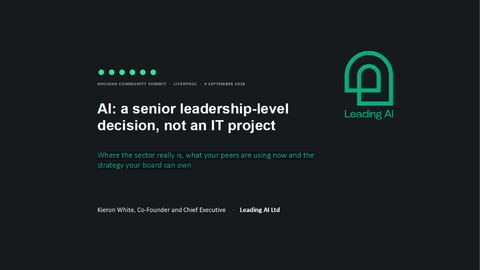
Free webinar – AI in Housing is a senior leadership decision, not an IT project
Events