
Someone asked me which AI tool their business should adopt.
That’s not unusual because, right now Claude seems to have the edge over ChatGPT and Gemini.
My answer surprised them: “Before you decide what to buy, decide what you’d do if you wanted to stop using it.”
They looked at me like I’d missed the point. They wanted to move fast. Get ahead of competitors. Start capturing the productivity gains everyone’s talking about.
I get it. For many, the pressure to act is real. But there’s a question most SME leaders aren’t asking, and the window to ask it, before it’s too late, is closing faster than most people realise.
The play nobody’s talking about
The big AI platforms (OpenAI, Google, Anthropic, Meta and others) are not simply competing to sell you useful software.
They’re competing to become the layer that sits on top of your entire business.
Your emails. Your documents. Your customer history. Your internal processes. Your institutional knowledge. The stuff that took years to build and lives in the heads of your best people.
They want all of it organised, structured, and embedded inside their ecosystem. Because once that happens, you’re not just a software customer. You’re dependent.
This isn’t cynicism. It’s just good business strategy… from their perspective. The more your data lives inside their world, the more their tools understand your business, and the more painful it becomes to consider leaving.
We’ve seen this before
It’s the same playbook that telecoms used in the 1990s; lock customers in through infrastructure, make switching feel like starting from scratch.
It’s the same move CRM vendors made in the 2000s. Businesses that went all-in on one platform found their customer data, their workflows, and their sales processes had quietly become inseparable from a single supplier. Switching wasn’t then just an IT project. It became a very expensive business disruption.
Microsoft is the most important example to understand right now
Most UK businesses are already deep inside the Microsoft ecosystem with Teams, Outlook, SharePoint, OneDrive. That’s not a criticism. For many organisations it’s the right call, and those tools work well together. I use them myself every day.
But here’s what’s changed. Microsoft is now layering Copilot directly into every one of those tools. And because your emails, documents, meetings, and files already live in Microsoft’s world, Copilot starts with a significant advantage: it already knows your business.
That can be genuinely useful. But it’s also precisely what makes the dependency deeper. The more Copilot learns from your data, the more your workflows are built around its outputs, and the more your teams come to rely on it, the harder it becomes to imagine using anything else. Not because the alternatives are worse, but because the switching cost quietly becomes enormous.
Microsoft has been here before. Businesses that standardised on Office in the 2000s found themselves effectively committed to the entire stack for decades, not through any single decision, but through accumulated dependency.
AI is that same dynamic, but much faster. It’s compressing years of lock-in into months.
The difference this time is scale and speed
AI isn’t just touching one department or one process. It’s being woven into how businesses think, decide, and operate, all at once. And when your company’s knowledge isn’t just stored somewhere but has been used to train a model or structure a workflow that only runs inside one vendor’s ecosystem, you’re not just dealing with switching costs. You could be dealing with the potential loss of your competitive edge.
What the smart operators are doing differently
The business leaders I most respect right now aren’t just asking “what can AI do for us?” They’re asking a second question alongside it: “what are we signing up for long term?”
In practice, that means pausing before committing. Not to slow down, but to go in with eyes open. A few questions worth putting on the table before any significant AI investment:
- Does our data stay portable if we leave? Can we take it with us, in a usable format, or does it belong to the platform?
- Are we building workflows that only work inside one vendor’s world? If the answer is yes, that’s a strategic dependency, not just a tech choice.
- What would it actually cost us to move in three years? Not just financially, but operationally. Model that scenario before you’re in it.
None of this means holding back. The productivity gains from AI are real, and the businesses that sit on the sidelines will fall behind. The point isn’t caution for its own sake.
It’s that the businesses with the most flexibility, and the most leverage in future negotiations, will be the ones who treated AI infrastructure decisions the same way they’d treat any major supplier relationship. With a clear understanding of what they’re getting into, and a plan for the day it stops working for them.
The question worth asking this week
Most leadership teams are having the “which AI tool?” conversation. Fewer are having the “what’s our AI strategy for the next three to five years?” conversation.
The two aren’t the same thing. And conflating them is how you end up, a few years from now, realising you’ve handed the keys to your company’s knowledge to someone else.
What does your AI strategy look like beyond the next twelve months? I’d genuinely like to know. Please get in touch and let’s talk it through.

Latest posts


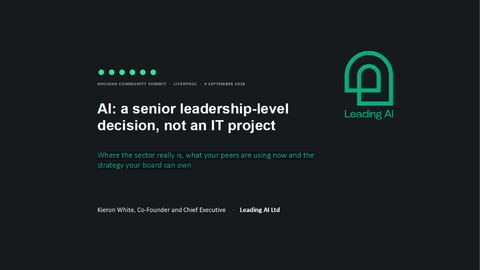
Free webinar – AI in Housing is a senior leadership decision, not an IT project
Events