
If the business world were a cocktail party, the arrival of AI would be that mysterious guest everyone’s talking about. Equal parts excitement, anxiety, and a dash of FOMO. And, as ever, lots of organisations have rushed to “deploy” AI with all the subtlety of a child let loose in a sweet shop. But let’s be clear: treating AI as just another software upgrade is like buying a grand piano and using it as a side table. You’re missing the music.
Beyond the Software Mindset
It’s tempting, isn’t it, to treat AI like a new version of Excel. You set your adoption targets, measure usage, and wait for the productivity fairy to sprinkle her magic dust. But AI’s true potential is not in making the old sausage machine run faster. It’s in reimagining what sausage even means. The organisations that thrive won’t be those who simply optimise existing workflows, but those who ask, “What if we threw out the recipe entirely?” AI is an invitation to rethink the very nature of value and collaboration, not just to polish the brass on the Titanic.
The Productivity Mirage
Headlines boasting “30% productivity gains!” are the corporate equivalent of diet pill adverts. The instinctive response is to cut costs, shrink teams, and pocket the difference. But the real opportunity is not in doing the same things with fewer people. It’s in doing things you never imagined possible, empowered by radically new capabilities. The teams that truly “get” AI aren’t just automating. They’re tackling problems that used to be considered impossible, achieving 2–3x productivity by expanding their ambition, not just their efficiency. It’s not about arithmetic, it’s about creativity. If your AI implementation is only making the old things go faster, you’re still thinking inside the box. The real magic happens when you throw the box away.
The Culture of Concealment
Now, here’s a very human twist. Employees, unsure how their AI-driven productivity will be received, often keep their innovations to themselves. Some fear their jobs are at risk. Others suspect their extra output will benefit the company, but not themselves. The result? Leaders are flying blind, relying on second-hand stories and PowerPoint decks found on LinkedIn. To counter this, you need to create rituals and mechanisms that reward experimentation and make it safe to share both successes and failures. If you want to unlock AI’s real value, make it feel less like a performance review and more like a science fair.
Leadership as the Catalyst
Unlocking AI’s value requires more than dashboards and directives. It demands vision from the top. Senior leaders must do more than mandate adoption; they must model daily AI use, share their own failures, and champion experimentation. The best transformations are those where leaders articulate a compelling vision for how AI will reshape the organisation’s identity, not just its operations. Launch short-cycle pilots, prove value in 90 days, and scale what works. Remember: “Perfect is the enemy of progress”.
Embracing the Unknown, But With Guardrails
The greatest risk is not in taking bold steps, but in clinging to familiar routines and missing the chance to reinvent. Responsible AI means proportionate governance. Build in human oversight, prioritise transparency, and avoid automating high-risk decisions without robust controls. Invest in accessible training, foster cross-functional collaboration, and ensure AI benefits are distributed equitably. In other words: don’t let the robots run the asylum, but don’t let the accountants run the imagination, either.
Measuring What Matters
Traditional ROI metrics are about as useful as a chocolate teapot when it comes to AI. Broaden your measurement framework. Include outcomes like time savings, service quality, employee satisfaction, reduced errors, and knowledge gains. Capture intangible benefits like improved decision quality, reduced stress, enhanced creativity. After all, what gets measured gets managed, but what gets imagined gets transformed.
Conclusion
Artificial intelligence is not a project to be managed, but a frontier to be explored. The winners will be those who resist the urge to normalise, standardise, or minimise risk at the expense of discovery. If the old maps no longer apply, imagination and courage, not compliance, will define your path forward. Build for compounding advantage. Each success should make the next one easier. If your AI implementation stands alone, you’re not building for the future. AI is now infrastructure, not just a tool. Treat it as the foundation for reinvention, not just efficiency.
Don’t just deploy AI. Compose with it.
The future belongs to those who dare to play new tunes, not just plonk more nick-nacks on top of their grand piano.

Latest posts


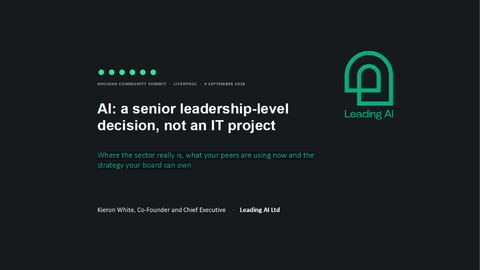
Free webinar – AI in Housing is a senior leadership decision, not an IT project
Events